Pair of Stirrups
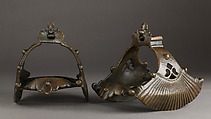
The carved geometric designs refer to Mapuche symbolism and cosmogony. The circle with the cross represents meli witran mapu (literally the land of the four places), the four parts of the world. The circles with a central dot, on the lower rim, may be representations of the sun or stars and the crown-shaped symbols may represent the head of Lukutuwe, or the First Man, as he appears on many Mapuche textiles. Hearts and leaf-shaped motifs are other traditional designs, while the four pointed mounts at each corner of the stirrup represent sacred spaces and communication with deities.
The Mapuches are indigenous inhabitants of present-day south-central Chile and southwestern Argentina. Mapuches were fierce warriors, never defeated by the Incas or Spanish, and the Mapuche lands were conquered only in 1883. They adopted the horse for war very shortly after their first encounter with the Spanish in 1551, and before the end of the century they had several organized squadrons of cavalry. The animal then soon became an important part of traditional Mapuche life.
Artwork Details
- Title: Pair of Stirrups
- Date: 19th century
- Culture: Mapuche
- Medium: Wood, iron
- Dimensions: 42.50.440; H. 10 in. (25.4 cm); W. 9 in. (22.9 cm); D. 4 in. (10.2 cm); Wt. 2 lb. 13.4 oz. (1287.1 g); 42.50.441; H. 10 in. (25.4 cm); W. 9 in. (22.9 cm); D. 4 1/2 in. (11.4 cm); Wt. 2 lb. 13.6 oz. (1292.7 g)
- Classification: Equestrian Equipment-Stirrups
- Credit Line: Gift of Stephen V. Grancsay, 1942
- Object Number: 42.50.440–.441
- Curatorial Department: Arms and Armor
More Artwork
Research Resources
The Met provides unparalleled resources for research and welcomes an international community of students and scholars. The Met's Open Access API is where creators and researchers can connect to the The Met collection. Open Access data and public domain images are available for unrestricted commercial and noncommercial use without permission or fee.
To request images under copyright and other restrictions, please use this Image Request form.
Feedback
We continue to research and examine historical and cultural context for objects in The Met collection. If you have comments or questions about this object record, please contact us using the form below. The Museum looks forward to receiving your comments.
Content Notice
The Metropolitan Museum of Art presents over 5,000 years of art from around the world, and our online collection reflects ongoing work conducted over the course of our more than 150-year history. You may encounter objects or images that may be inappropriate for some viewers or information that may be outdated.