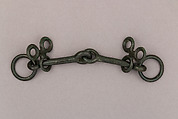
Snaffle Bit
This type of bit was inspired from contemporary Near Eastern examples, found in the Luristan region (Iran), and often featuring animals on their sides.
Horses had a great value among Villanovan and Etruscan societies. They were used for military and leisure purposes, and possessing them was an indicator of high social status. Equestrian objects, like bridles or even chariots, were often deposited in the tombs of the wealthy individuals, the deceased hoping to equip their steeds in the afterlife. Horses are also widely present among the paintings, ceramics and other decorated objects found in the same burials.
Artwork Details
- Title: Snaffle Bit
- Date: 8th–7th century BCE
- Culture: Villanovan
- Medium: Copper alloy (bronze)
- Dimensions: H. 5 3/4 in. (14.6 cm); W. 5 7/8 in. (14.9 cm); Wt. 12.8 oz. (362.9 g)
- Classification: Equestrian Equipment-Bits
- Credit Line: Gift of Stephen V. Grancsay, 1942
- Object Number: 42.50.500
- Curatorial Department: Arms and Armor
More Artwork


Research Resources
The Met provides unparalleled resources for research and welcomes an international community of students and scholars. The Met's Open Access API is where creators and researchers can connect to the The Met collection. Open Access data and public domain images are available for unrestricted commercial and noncommercial use without permission or fee.
To request images under copyright and other restrictions, please use this Image Request form.
Feedback
We continue to research and examine historical and cultural context for objects in The Met collection. If you have comments or questions about this object record, please contact us using the form below. The Museum looks forward to receiving your comments.
Content Notice
The Metropolitan Museum of Art presents over 5,000 years of art from around the world, and our online collection reflects ongoing work conducted over the course of our more than 150-year history. You may encounter objects or images that may be inappropriate for some viewers or information that may be outdated.