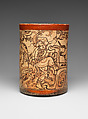
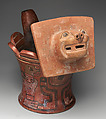
Cylindrical Vessel
‘Codex-style’ pots are so-called for the style of painting which bears a close resemblance to the four extant screen-fold Maya books, known as codices, located in Madrid, Paris, Dresden, and Mexico City. These books date to the Postclassic Period (ca. a.d. 1000–1492). The characteristics of the codex-style are a cream or yellowish slipped background, often framed by red bands above and below, and a black calligraphic line outlining figures and hieroglyphic texts. Sometimes the painters applied a gray wash to shade figures or other features. In contrast to the richly polychromed vases and bowls from the large corpus of Maya vessels, codex-style pots stand apart in their grayscale, which is almost certainly a reflection of their development vis-à-vis calligraphic books.
Artwork Details
- Title: Cylindrical Vessel
- Date: 7th–8th century
- Geography: Guatemala or Mexico, Mesoamerica
- Culture: Maya
- Medium: Ceramic, slip, pigment
- Dimensions: H. 5 1/4 x Diam. 4 1/8 in. (13.3 x 10.5 cm)
- Classification: Stone-Containers
- Credit Line: Gift of Mr. and Mrs. David Heller, 1983
- Object Number: 1983.543.3
- Curatorial Department: The Michael C. Rockefeller Wing
More Artwork
Related Content
 Free to download
Research Resources
The Met provides unparalleled resources for research and welcomes an international community of students and scholars. The Met's Open Access API is where creators and researchers can connect to the The Met collection. Open Access data and public domain images are available for unrestricted commercial and noncommercial use without permission or fee.
To request images under copyright and other restrictions, please use this Image Request form.
Feedback
We continue to research and examine historical and cultural context for objects in The Met collection. If you have comments or questions about this object record, please contact us using the form below. The Museum looks forward to receiving your comments.
Content Notice
The Metropolitan Museum of Art presents over 5,000 years of art from around the world, and our online collection reflects ongoing work conducted over the course of our more than 150-year history. You may encounter objects or images that may be inappropriate for some viewers or information that may be outdated.