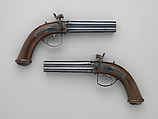
Pair of Over-and-Under Tube-Lock Percussion Pistols with Case and Accessories
As a means of ignition, percussion mechanisms like the tube-lock utilized a highly combustible chemical compound called fulminate, which burns more rapidly than gunpowder when struck with force. The tube-lock operated using pre-fabricated fulminate-filled primer tubes, relieving the user from the step of priming the pan with loose gunpowder, and offering improved water resistance, among other benefits. The mechanism became relatively popular among consumers compared to the many of the other percussion systems that were being developed in London at that time.
Firearms technology advanced at an extraordinary pace in Europe in the early nineteenth century. London’s elite gunmakers, intensely focused on optimizing accuracy, handling, and speed to meet the expectations of England’s sporting gentry were at the forefront of its development. Building on design advancements made in the 1780s and 1790s, particularly the refinement of the flintlock ignition mechanism, they secured in the next three decades dozens of patents for a dizzying variety of new technologies ranging from improved lock mechanisms to novel barrel-making techniques, competing to protect and market their inventions. Handmade with remarkable precision, many London firearms of the period display extraordinary mechanical ingenuity, in addition to being elegantly designed. This creative push in the firearms field may be framed within the broader context of the Industrial Revolution in England—a period marked by the glorification of technological advancements and the celebration of individual inventors and engineers.
Artwork Details
- Title: Pair of Over-and-Under Tube-Lock Percussion Pistols with Case and Accessories
- Gunsmith: Durs Egg (British, born Switzerland, baptized Oberbuchsiten, Switzerland 1748–1831 London)
- Date: ca. 1805–10; converted after 1818
- Geography: London
- Culture: British, London
- Medium: Pistols: steel, wood (walnut, rosewood), gold, platinum, brass, horn; case: wood (mahogany), textile, brass, bone, paper; powder flask: brass, steel, wood, leather; bullet mold: steel; box with patches: textile, paper, tin
- Dimensions: Pistol (a): L. 9 3/4 in. (24.8 cm); L. of barrels 4 3/8 in. (11.1 cm); Cal. of barrels .45 in. (11.4 cm); Wt. 1 lb. 2.2 oz. (516 g); pistol (b): L. 9 5/8 in. (24.4 cm); L. of barrels 4 5/16 in. (11 cm); Cal. of barrels .44 in. (11.2 mm); Wt. 1 lb. 2.6 oz. (527.3 g); powder flask (c): H. 4 3/4 in. (12.1 cm); Wt. 5.1 oz. (144.6 g); bullet mould (d): L. 4 5/8 in. (11.7 cm); Wt. 2.3 oz. (65.2 g); patch box (e): H. 13/16 in. (2.1 cm); Diam. 9/16 in. (1.4 cm); Wt. 1 oz. (28.3 g); case (f): H. 2 3/4 in. (7 cm); W. 14 7/8 in. (37.8 cm); D. 8 in. (20.3 cm); Wt. 4 lb. 5.5 oz. (1970.3 g)
- Classification: Firearms-Pistols
- Credit Line: Gift of Charles M. Schott Jr., 1917
- Object Number: 19.53.106a–f
- Curatorial Department: Arms and Armor
More Artwork



Research Resources
The Met provides unparalleled resources for research and welcomes an international community of students and scholars. The Met's Open Access API is where creators and researchers can connect to the The Met collection. Open Access data and public domain images are available for unrestricted commercial and noncommercial use without permission or fee.
To request images under copyright and other restrictions, please use this Image Request form.
Feedback
We continue to research and examine historical and cultural context for objects in The Met collection. If you have comments or questions about this object record, please contact us using the form below. The Museum looks forward to receiving your comments.
Content Notice
The Metropolitan Museum of Art presents over 5,000 years of art from around the world, and our online collection reflects ongoing work conducted over the course of our more than 150-year history. You may encounter objects or images that may be inappropriate for some viewers or information that may be outdated.