Panel with Hunting Scenes
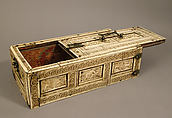
The panel originally formed the back of an exceptionally large casket (now lost). The casket is known from an eighteenth- century engraving that shows the conclusion of the hunt, with the stag's head being presented to courtly figures. As key examples of secular ivory carving in Paris during the time of Charles V (1338-1380), the images are rendered with crisp, graphic carving that creates rich surface and spatial effects commensurate with the finest luxury works of the city.
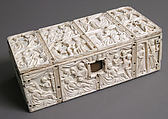
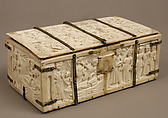
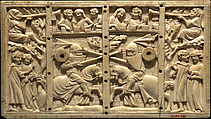
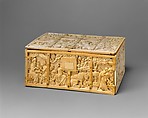
Joining the celebrated secular ivories from the Morgan collection, this panel and three others illustrated here enable the Museum to offer an unparalled glimpse of the secular spirit of the high Middle Ages.
Artwork Details
- Title: Panel with Hunting Scenes
- Date: ca. 1350
- Geography: Made in Paris, France
- Culture: French
- Medium: Ivory
- Dimensions: Overall: 4 5/16 x 12 1/8 x 3/16 in. (11 x 30.8 x 0.5 cm)
W: 29.0-30.8 cm; Depth: .2-.5 cm - Classification: Ivories-Elephant
- Credit Line: The Cloisters Collection, 2003
- Object Number: 2003.131.2
- Curatorial Department: Medieval Art and The Cloisters
More Artwork
Related Content
Research Resources
The Met provides unparalleled resources for research and welcomes an international community of students and scholars. The Met's Open Access API is where creators and researchers can connect to the The Met collection. Open Access data and public domain images are available for unrestricted commercial and noncommercial use without permission or fee.
To request images under copyright and other restrictions, please use this Image Request form.
Feedback
We continue to research and examine historical and cultural context for objects in The Met collection. If you have comments or questions about this object record, please contact us using the form below. The Museum looks forward to receiving your comments.
Content Notice
The Metropolitan Museum of Art presents over 5,000 years of art from around the world, and our online collection reflects ongoing work conducted over the course of our more than 150-year history. You may encounter objects or images that may be inappropriate for some viewers or information that may be outdated.