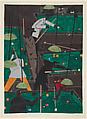
The Shoemaker
The Shoemaker, like the other paintings Lawrence made in this period, likely reflects his observations of workplaces in Harlem—especially those concentrated in and around "306," an art workshop and community gathering place on 141st Street, where Lawrence studied as an "artist-apprentice" in the 1930s, with artists Charles Alston and Augusta Savage. Many artist workshops doubled as repair shops; Lawrence’s attention to practices of repair speaks to his unique vision of American work in this moment—a vision whose focus on small-scale making and mending set it at odds with mainstream accounts of postwar industry and consumerism.
Lawrence is today considered one of the foremost innovators of modernism in the United States, and a consummate storyteller dedicated to animating the lives of Black, poor, and marginalized people. By 1945, he was an established presence in the emerging New York art world. He was known especially for his historical series detailing the lives of heroic individuals (The Life of Toussaint L’Ouverture, 1938, Amistad Research Center, Tulane University, New Orleans; The Life of Frederick Douglass, 1939 and The Life of Harriet Tubman, 1940, both Hampton University Museum, Hampton, Va.; or the struggles of everyday Black people (The Migration Series, 1940–41, Museum of Modern Art, New York and the Phillips Collection, Washington, D.C.). For these multi-panel series, Lawrence developed a unique process: months of painstaking research preceded a concentrated burst of drafting and painting, during which Lawrence applied colors one-by-one to all the panels, ensuring continuity across the series. The 1945–46 paintings of Black workers, however, employed a different process. Rather than a carefully planned and researched series, it represented what Lawrence called a "theme": a group of paintings, completed individually, which explored a related idea or topic without adhering to a specific narrative or predetermined agenda. The looser, more fluid theme format allowed Lawrence to meet the demands of his gallerist, Edith Halpert, founder of the influential Downtown Gallery. Halpert’s efforts to market Lawrence’s work on a national stage met with great success. One of the only Black artists represented by a major New York gallery in the 1940s and 1950s, Lawrence was the subject of significant interest on the part of major museums, private collectors, and critics. The Met acquired The Shoemaker, for example, just months after it was completed. Lawrence’s singular inclusion in the art world came with its own difficulties, however: his work often met reductive, if not outright racist, characterizations in the press, a trend only further exacerbated by Halpert’s emphasis and capitalization on his racial difference. Lawrence turned to Black workers and makers as subjects, therefore, at a moment in which he was working through questions about the nature of his own work, prompted by its complicated enfolding within a professionalizing art world.
Artwork Details
- Title: The Shoemaker
- Artist: Jacob Lawrence (American, Atlantic City, New Jersey 1917–2000 Seattle, Washington)
- Date: 1945
- Medium: Watercolor and gouache over graphite on paper
- Dimensions: 22 3/4 × 31 in. (57.8 × 78.7 cm)
- Classification: Drawings
- Credit Line: George A. Hearn Fund, 1946
- Object Number: 46.73.2
- Rights and Reproduction: © 2022 The Jacob and Gwendolyn Lawrence Foundation, Seattle / Artists Rights Society (ARS), New York
- Curatorial Department: Modern and Contemporary Art
More Artwork
Related Content

 Free to download
Research Resources
The Met provides unparalleled resources for research and welcomes an international community of students and scholars. The Met's Open Access API is where creators and researchers can connect to the The Met collection. Open Access data and public domain images are available for unrestricted commercial and noncommercial use without permission or fee.
To request images under copyright and other restrictions, please use this Image Request form.
Feedback
We continue to research and examine historical and cultural context for objects in The Met collection. If you have comments or questions about this object record, please contact us using the form below. The Museum looks forward to receiving your comments.
Content Notice
The Metropolitan Museum of Art presents over 5,000 years of art from around the world, and our online collection reflects ongoing work conducted over the course of our more than 150-year history. You may encounter objects or images that may be inappropriate for some viewers or information that may be outdated.