Oboe
Techical description:
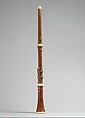
Simple system oboe, stamped on all three sections with "BROD" (front) and "24" (rear side). The oboe is composed of three sections of boxwood and mounted with ivory sleeves. The wood shows weak burls in some areas of the upper joint and foot. The thumb rest consists of a screwed-in pivot of brass. The third and fourth finger holes have double bores. The key mechanism is made of brass and mounted in pillars. The system is comprised of 11 length-keys with B-natural as lowest key. The workshop of the brothers Brod was very innovative and invented numerous gadgets and improvements. In this oboe the following arrangements were not common if at all in use by other makers of the time:
- New inventions: 1) a rocking lever that connects the E-flat and C-touch-piece, allowing a swift transition between E-flat and C; 2) a half-hole plate to produce a clear C-sharp and C; 3) some keys are equipped with guide pins of the same shape as the pivots.
- Keys not universally used at the time: two separate keys for e-flat key for the left and right hand, a double high C key, a half-hole plate, and a speaker key.
Length: 218 mm (upper joint) + 209 mm (middle joint) + 139 mm (foot joint) = 566 mm (whole)
Artwork Details
- Title: Oboe
- Maker: Henri Brod (French, Paris 1799–1839 Paris)
- Date: 1837–38
- Geography: Paris, France
- Culture: French
- Medium: Boxwood, ivory, brass
- Dimensions: 22 3/8 × 2 × 2 in. (56.8 × 5.1 × 5.1 cm)
- Classification: Aerophone-Reed Vibrated-double reed
- Credit Line: Purchase, Robert Alonzo Lehman Bequest, 2008
- Object Number: 2008.455
- Curatorial Department: Musical Instruments
More Artwork
Research Resources
The Met provides unparalleled resources for research and welcomes an international community of students and scholars. The Met's Open Access API is where creators and researchers can connect to the The Met collection. Open Access data and public domain images are available for unrestricted commercial and noncommercial use without permission or fee.
To request images under copyright and other restrictions, please use this Image Request form.
Feedback
We continue to research and examine historical and cultural context for objects in The Met collection. If you have comments or questions about this object record, please contact us using the form below. The Museum looks forward to receiving your comments.
Content Notice
The Metropolitan Museum of Art presents over 5,000 years of art from around the world, and our online collection reflects ongoing work conducted over the course of our more than 150-year history. You may encounter objects or images that may be inappropriate for some viewers or information that may be outdated.