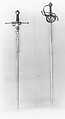
Combination Sword and Wheellock Pistol
The sword-pistol constitutes a major addition to The Met's holdings of combination weapons, notably swords, daggers, and staff weapons of various types that are fitted with wheellock mechanisms and barrels. While combination arms were, in theory, capable of being fired, they seem to have been more important as “the play-things of princes,” mechanical marvels that were intended to delight with their novel design, exquisite workmanship, and ingenious integration of two weapon types into one.
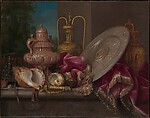
It also complements the holdings of European Paintings, whose collection includes a canvas, Still Life with Silver and Gold Plate, Shells, and a Sword, by Meiffren Conte of Marseilles (ca. 1630–1705), in which this very sword, or an identical one, is represented (acc. no. 2012.542).
Artwork Details
- Title: Combination Sword and Wheellock Pistol
- Date: ca. 1550–55
- Geography: probably Paris
- Culture: French, probably Paris
- Medium: Steel, iron, copper alloy, gold, silver
- Dimensions: L. 35 in. (88.9 cm); blade L. 27 ½ in. (70 cm); W. 8 in. (20.3 cm); D. 2 in. (5.1 cm); Wt. 4 lb. 11 oz. (2132 g)
- Classification: Combination Weapons
- Credit Line: Gift of Irene Roosevelt Aitken, in celebration of the Museum's 150th Anniversary, 2026
- Object Number: 2026.267.1
- Curatorial Department: Arms and Armor
More Artwork
Research Resources
The Met provides unparalleled resources for research and welcomes an international community of students and scholars. The Met's Open Access API is where creators and researchers can connect to the The Met collection. Open Access data and public domain images are available for unrestricted commercial and noncommercial use without permission or fee.
To request images under copyright and other restrictions, please use this Image Request form.
Feedback
We continue to research and examine historical and cultural context for objects in The Met collection. If you have comments or questions about this object record, please contact us using the form below. The Museum looks forward to receiving your comments.
Content Notice
The Metropolitan Museum of Art presents over 5,000 years of art from around the world, and our online collection reflects ongoing work conducted over the course of our more than 150-year history. You may encounter objects or images that may be inappropriate for some viewers or information that may be outdated.