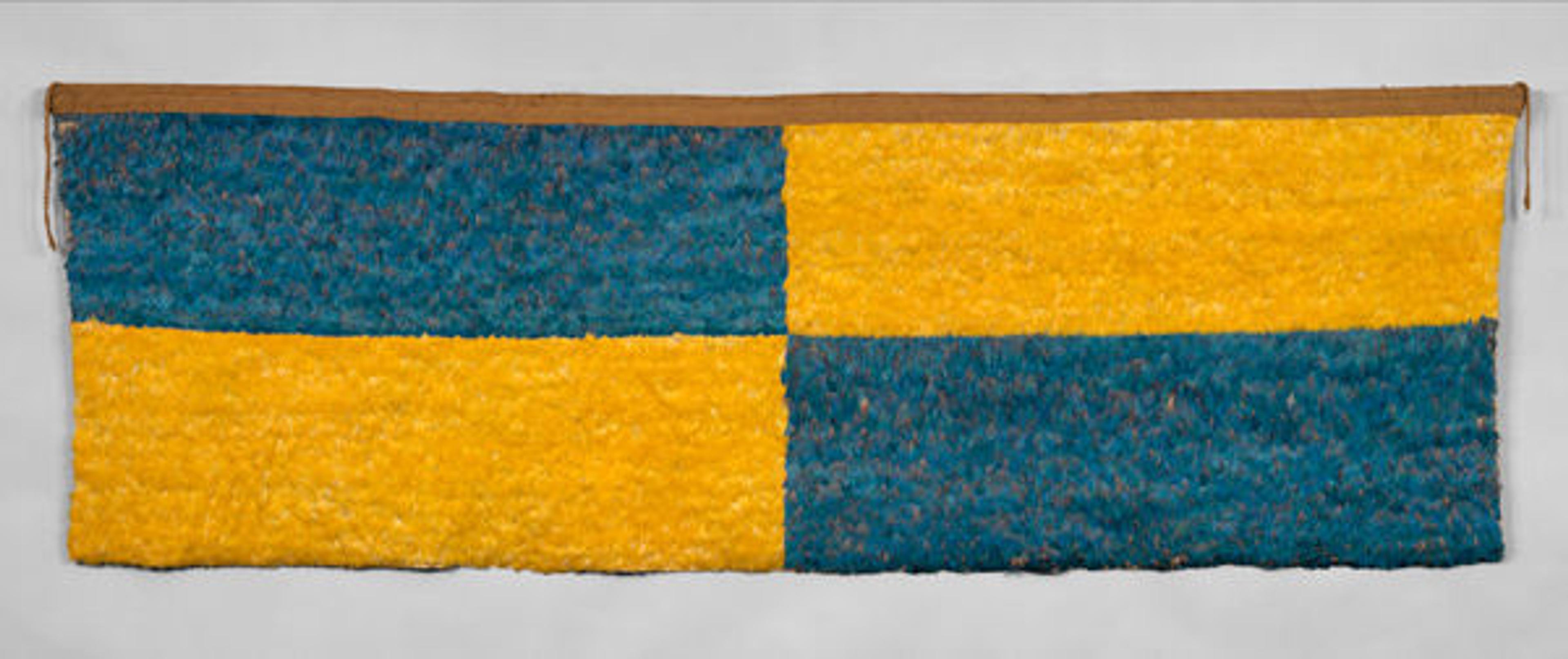
Feathered Hanging, 7th–8th century. Peru. Wari. Feathers on cotton, camelid hair. The Metropolitan Museum of Art, New York, The Michael C. Rockefeller Memorial Collection, Bequest of Nelson A. Rockefeller, 1979 (1979.206.470)
«As a preface, I would just like to ask that you not take my excitement about the work above to be some kind of authoritative perspective on it—in other words, that you'll visit the Museum, see this piece and have a great, transcendent epiphany with the swelling baritone of a hallelujah chorus behind you. Perhaps it's just me being overzealous and getting unnecessarily pumped up about something as usual. But, for a second, let's be indulgent and allow me to express how this piece requires you to reconfigure your mind, and just how weird and interesting it is. Let's break it down for a second, shall we?»
These monstrously exuberant panels of geometrically arranged blue and yellow feathers, crafted by the Wari people of Peru sometime in the seventh or eighth century, are just hanging nonchalantly against a white wall in a museum in New York. When I first saw them, I had a few of those very mild and acceptable but ultimately bland first-art-history-paper-of-your-undergraduate-career type of thoughts, like "It's such a deeply sensory experience," and "Such sophisticated minimalism for such a primitive time period." But then I was like, "Wait, wait, wait, let's actually think about this for a second." Over a thousand years ago, it was probably a mammoth undertaking just to acquire this phenomenally excessive amount of feathers, and then the panels actually had to be constructed, which took countless hours of delicate sewing by people whose everyday lives we probably cannot comprehend. Once the panels were discovered in recent times, they required only minimal restoration before being shipped about, displayed, and now viewed by people like us.
Doesn't it give you pause for a second to consider the fact that these macaws, these little yellow and blue creatures who lived so long ago, are now weirdly immortalized, their actual bodily material still on display after more than a thousand years even though the artists themselves remain anonymous? I mean, I think that's pretty impressive.
Come see the panels for yourself in the exhibition Feathered Walls: Hangings from Ancient Peru, and let us know what you think about them. How do you feel about these bodily materials being used in art—and about the birds' immortality in contrast to the artists' anonymity?