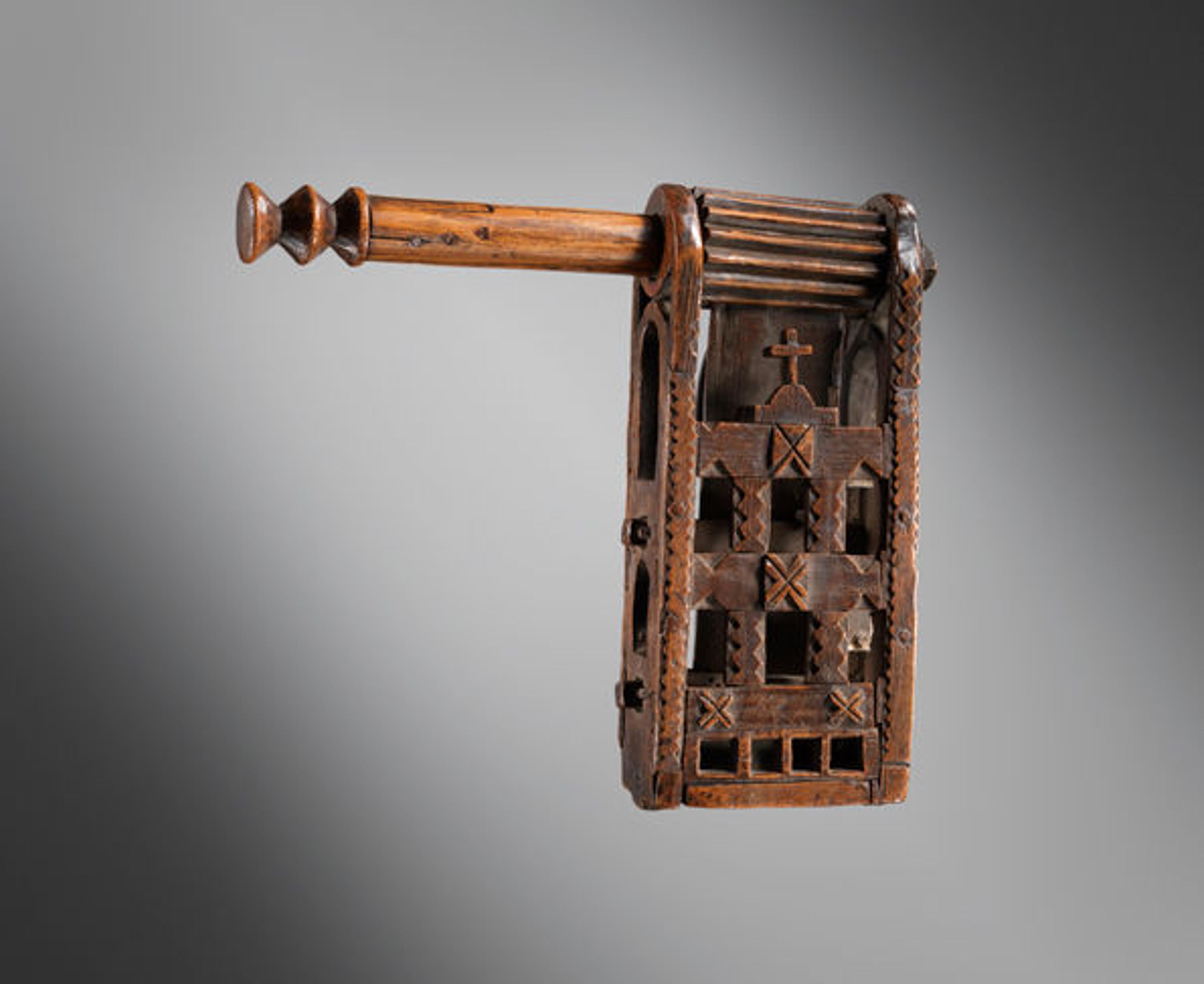
Cog Rattle. France, 15th or 16th century. Wood. The Metropolitan Museum of Art, New York, Gift of Blumka Gallery, 1954 (54.160)
«Bells have been used in the Latin Mass of the Roman Catholic Church since at least the eighth century. A tradition developed of setting aside the bells during Holy Week, the week leading up to Easter Sunday, as their ringing was considered too joyous for such a somber time of the liturgical year and the bells were said to have flown to Rome. When the bells were not in use, they were replaced by a cog rattle—a noisemaker that produces a loud rattling sound when whirled around by its handle. This tradition still continues in certain Latin American countries.»
A cog rattle is a relatively simple musical instrument, comprising an integral handle with a fluted cogwheel, and a box that encloses a wooden tongue. When the rattle is spun, the wooden tongue catches on the sharp edges on the cogwheel and produces the raucous sound. In addition to its service in the Mass, this type of instrument was used historically in processions and on naval vessels, where it was used as an alarm. Today, the instrument, often made of metal or plastic, is most commonly found at parties and carnivals.
The extraordinary example of the cog rattle found in the Museum's collection is a survivor from the Renaissance, and dates from the fifteenth or sixteenth century. The box, or cage, that holds the wooden tongue is decorated with rough carvings, which include a small Roman cross.
Follow Jayson on Twitter: @JayKerrDobney