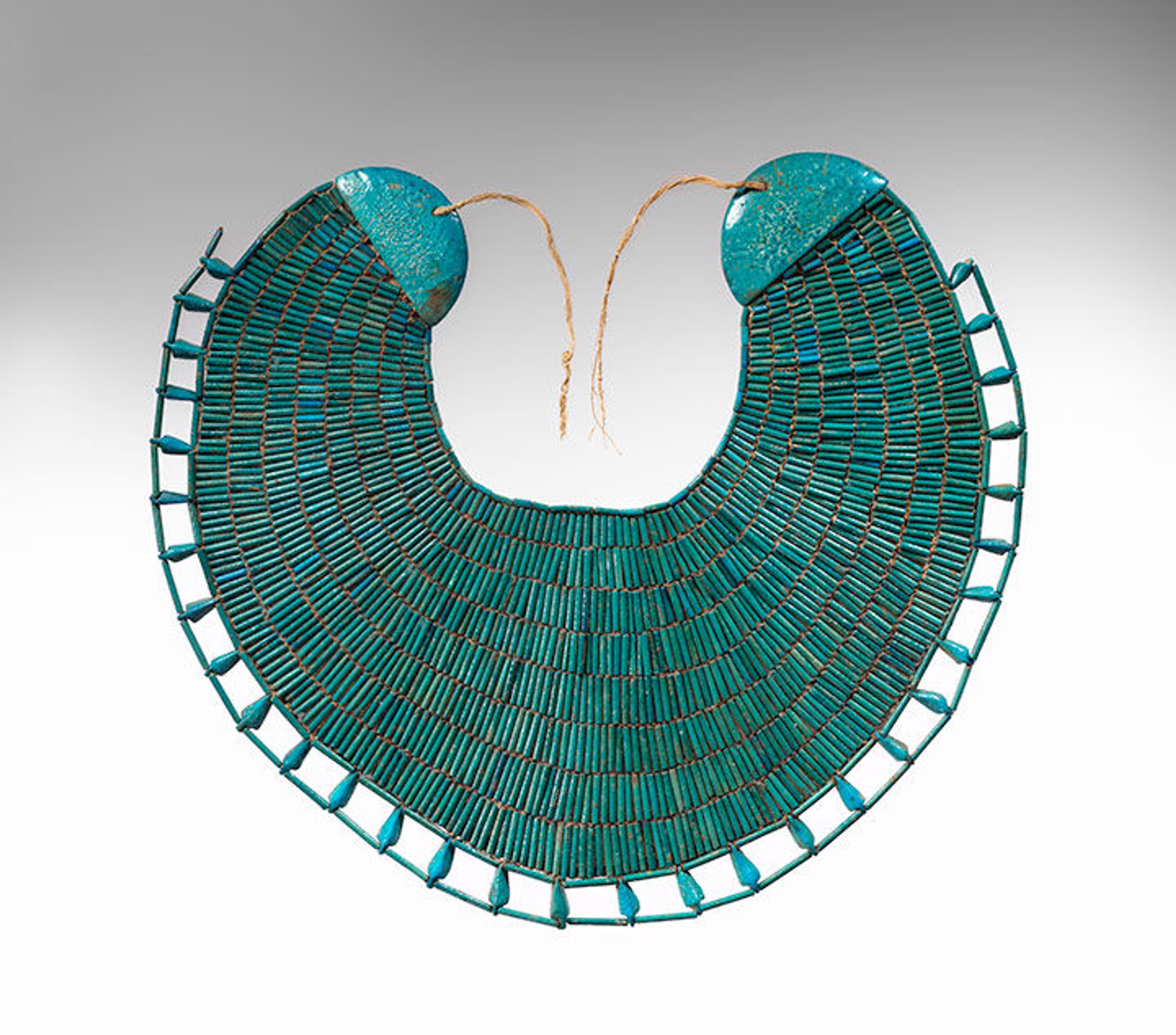
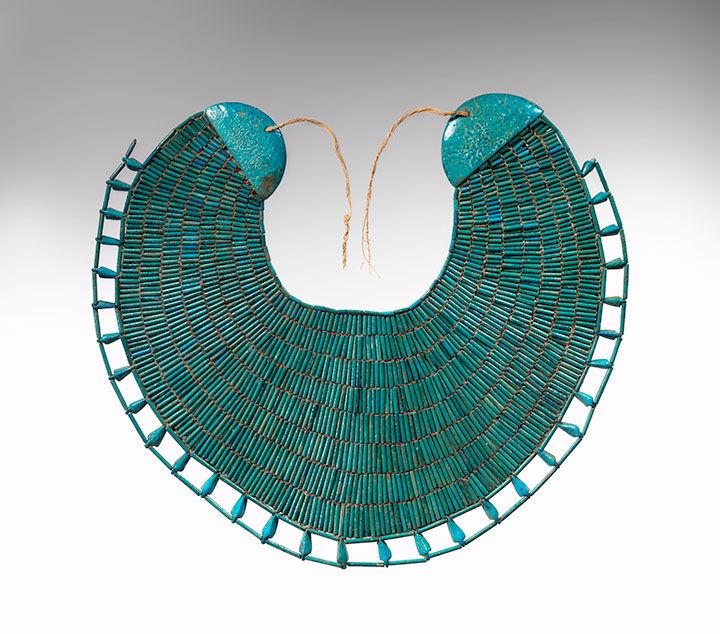
Broad collar of Wah. Middle Kingdom, Dynasty 12, reign of Amenemhat I, early (ca. 1981–1975 B.C.). From Egypt, Upper Egypt, Thebes, Southern Asasif, Tomb of Wah, Mummy, in wrappings on chest, MMA excavations, 1920. Faience, linen thread, H. 34.5 cm (13 9/16 in.), W. 39 cm (15 3/8 in.). The Metropolitan Museum of Art, New York, Rogers Fund and Edward S. Harkness Gift, 1940 (40.3.2)
«The ancient Egyptian faience collar in The Met collection pictured above was part of the Museum's holdings long before anyone knew it. In 1920, workers on an expedition led by the Museum came across a small tomb in Thebes belonging to a man of seemingly humble means. As the director of the expedition, Herbert E. Winlock, later wrote: "The meal of beer and bread and meat beside the coffin was so simple, and so were the few objects in the coffin, that there seemed little likelihood of there being anything of value inside."»
The mummy of the man, who was identified as Wah, was taken to New York and displayed at the Museum for 15 years alongside other findings from Thebes. There was little reason to unwrap it, Winlock wrote, "since this was not the sort of person who might be expected to be buried with jewels, so far as our experience went."
An x-ray of the mummy revealed otherwise. Among the treasures inside were bracelets, anklets, large scarabs made of silver and lapis lazuli, and stringed beads of black and white porphyry, all bundled into 375 square meters of linen—which alone would have been costly. The broad collar of Wah was among the most handsome objects found when the mummy was unwrapped in 1940. (These days, owing to different ethical sensibilities, mummies are not unwrapped, and can be studied efficiently at arms length through scanning technology that was unavailable in Winlock's day.)
This carefully made work of faience jewelry was designed specifically as a funerary ornament. "In ancient Egypt, objects created with faience were considered magical, filled with the undying shimmer of the sun, and imbued with the powers of rebirth," as Carolyn Riccardelli, conservator in the Department of Objects Conservation, writes in a new essay that explores the techniques involved in making objects such as these.
The entirety of Riccardelli's essay, along with more than 1,000 others spanning the full range of the Museum's collection, is available on our Heilbrunn Timeline of Art History.


