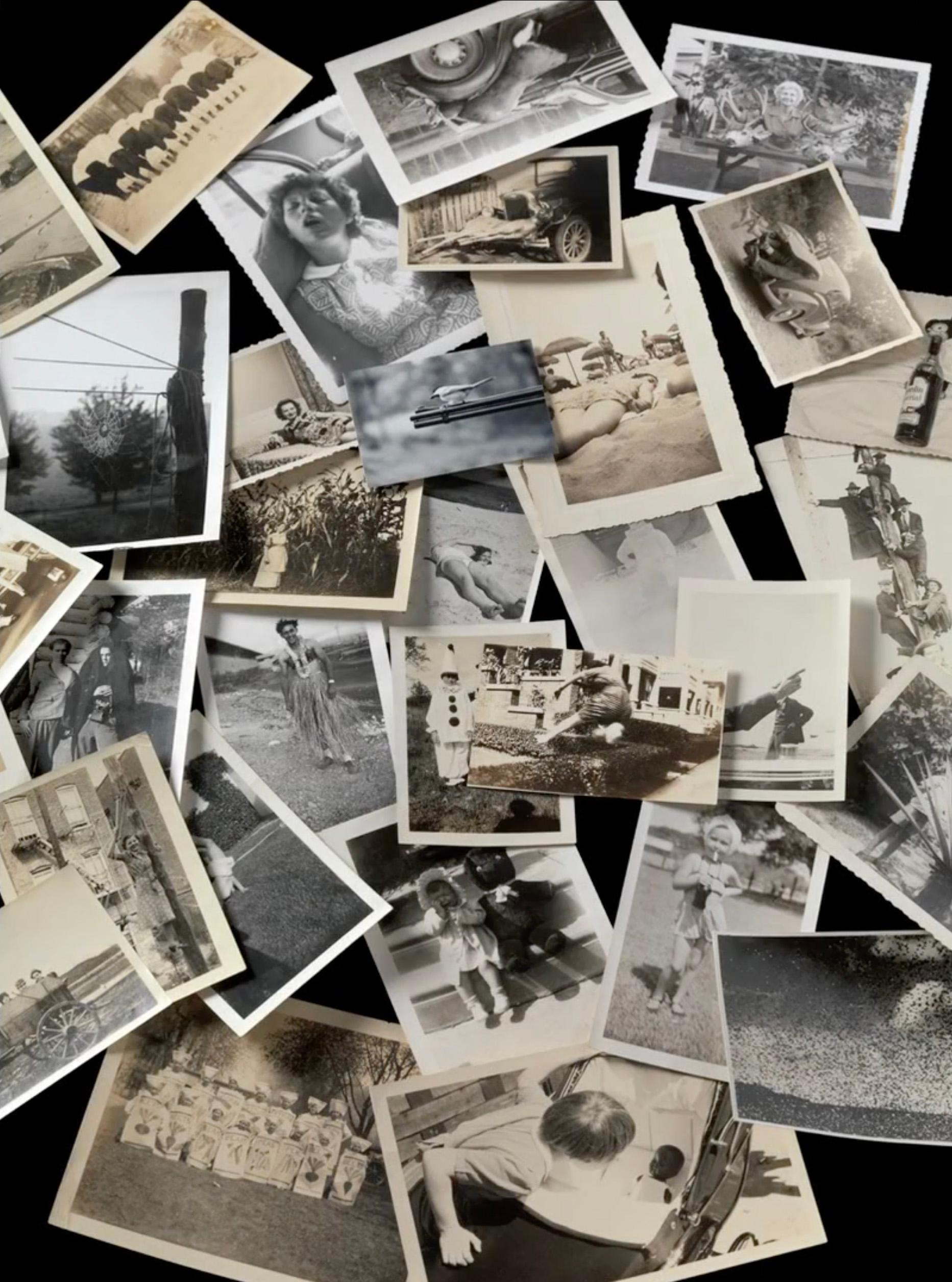
[243 Amateur Snapshots], 1900s–1970s. Gelatin silver prints, Instant diffusion transfer prints, and chromogenic prints, various sizes. The Metropolitan Museum of Art, New York, Gift of Peter J. Cohen, 2012 (2012.556.1.1–.243)
One of the things that people get their cameras out for is something ephemeral: a flight of locusts, a heavy snow. It’s like, “I built this snowman. He’ll never look better than he looks right now, let me get the camera.”
I have this theory that photography is the poor man’s taxidermy. In other words, people take this picture to show you the deer they shot. The photo becomes a kind of trophy.
Or the people are hyper-aware that it’s a record, almost like reality TV. It’s unscripted behavior, but it’s behavior that wouldn’t be happening if a camera weren’t there.
The art of it is somewhat in the eye of the beholder. The people are so unprofessional there’s something kind of moving about it. There are some really wonderful mistakes. And where the accident ends and the self-reflexivity we associate with modern art begins in this genre one never knows.
We all are familiar with this Duchampian idea that you can take something that wasn’t intended to be art, and you, the artist, with your big deal artistic intentions, can recontextualize it and call it art, and we accept that. But what happens if no one calls it art, ever? What if they die and go to their grave, and never said this is art?
For me it’s art-stimulating. I’m mining them for one thing I want. I want this guy’s boots, or I want this head in the sand. So there’s a forensic quality that you can bring to these snapshots. They’re filled with information, with what I call the thinginess of things: curtains, cardboard, cornfields, agave plants. Here’s the man wearing the hula skirt. I know exactly what it feels like to have that skirt on. It’s our skirt. It’s cultural shared information.
People are coming to have greater and greater regard for these snapshots. I think it’s a combination of the ubiquity of amateur photography—everyone’s taking pictures—oddly coupled with the decline of analogue photography and the fact that these are vanishing.
The people who made these photographs aren’t artists, and nobody inside the pictures, the subjects, thought they were part of a work of art, either. We have no reason to think they imagined they would end up at the Metropolitan Museum, but I think you can learn more about photography after you’ve looked at these pictures.