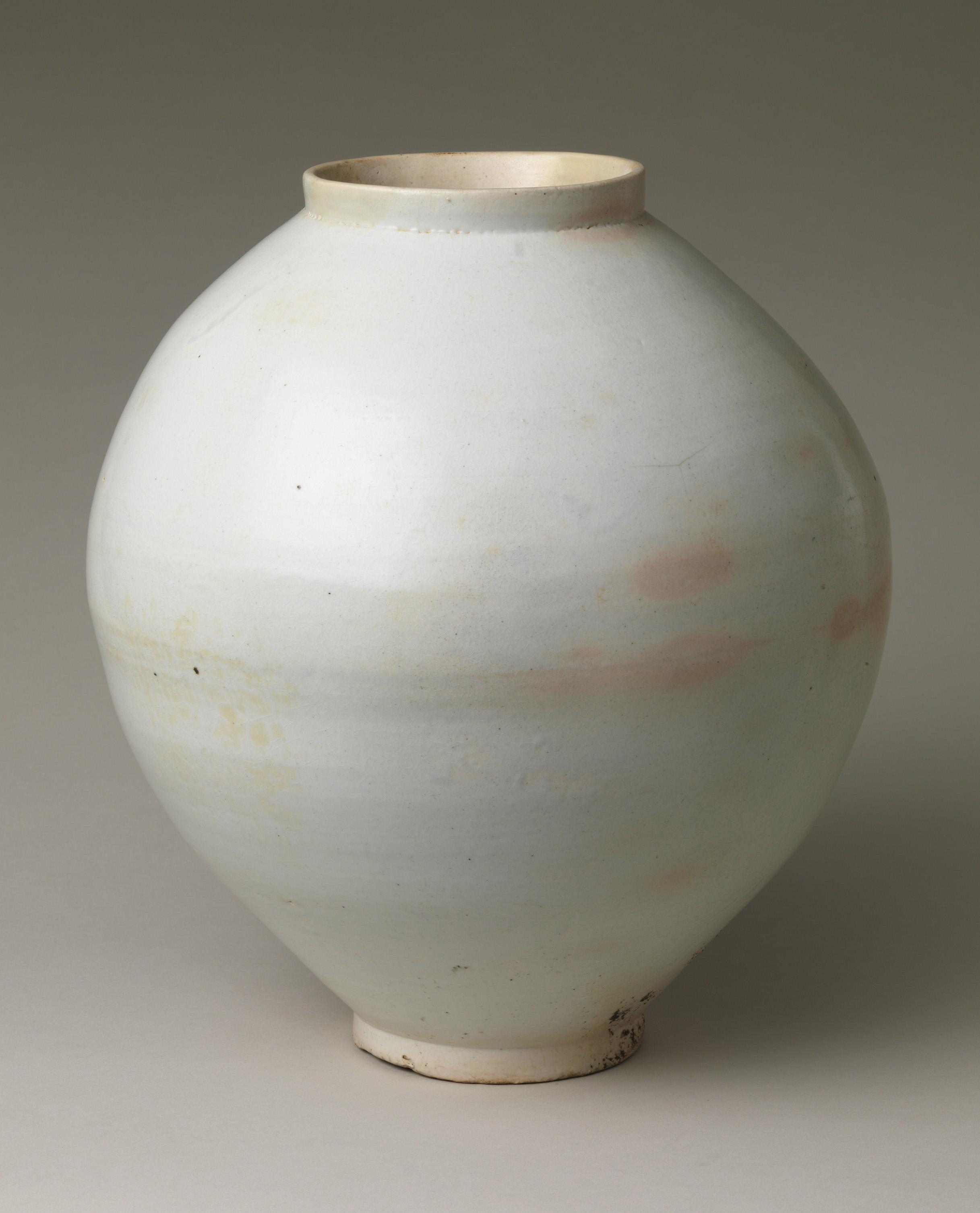
Moon jar, second half 18th century. Korean, Joseon dynasty (1392–1910). Porcelain, H. 15 1/4 in. (38.7 cm); Diam. 13 in. (33 cm); Diam. of rim 5 1/2 in. (14 cm); Diam. of foot 4 7/8 in. (12.4 cm). The Metropolitan Museum of Art, New York, The Harry G. C. Packard Collection of Asian Art, Gift of Harry G. C. Packard, and Purchase, Fletcher, Rogers, Harris Brisbane Dick, and Louis V. Bell Funds, Joseph Pulitzer Bequest, and The Annenberg Fund Inc. Gift, 1975 (1979.413.1)
My name is Lee Ufan. I am a artist who makes both canvas and also sculpture too.
This is a vase that's from eighteenth-century Korea. We don't know much about who created it. We don't have much data on it either. But the reason why I chose it is because it almost has a magical sense to it. The shape is not completely symmetrical: it's not completely round, it's not completely oval. It's a little bit off. Even the color, I think. They do call this white, but it's almost an off-white, and there's also tinges of earth and orange and blue. It's almost indescribable. Did he do it on purpose or did he not do it on purpose? You really don't know. Maybe the heat created that little imperfection there and he was ok with it.
When you look at eighteenth-century Chinese pottery it's almost too perfect. It's almost unreal in it's perfection. Japan tries to get perfection also, but Japan's trying to create a humanness to it. Korea is situated right in between both of them, and I think this vase shows that. It's not trying to achieve perfection. It's actually trying to achieve imperfection. It reflects life in itself. Your life is changeable. Your life is imperfect. That's how the people in the Korean peninsula look at life. It actually allows you to become more open, more free. It allows for the imperfection of yourself.
There's a Japanese word: "reading the air." You have to be able to sense the atmosphere, sense the vibration of everything around you. I think that shows up in the way he was able to present the color, the shape. He was trying to create a vibration through the imperfection. Even in my art, I use simple strokes, but I'm not trying to have that one stroke become the piece. I want the sense of that stroke together with the rest of the canvas, the space within the canvas, and the vibration of the whole piece. I think this artist is trying to do that also.
And this is, to me, very feminine; it almost has an eroticism to it, almost evoking a softness. In European art, you talk about Venus. I think this piece gives off that vibe of the voluptuousness of a woman.
A lot times people kind of look down and, "well, this is not perfect" or "this is a little bit imbalanced." I think the imbalanced imperfection allows you to see things in an unlimited way, a real-life way, and show the unlimited potential that there is in us.