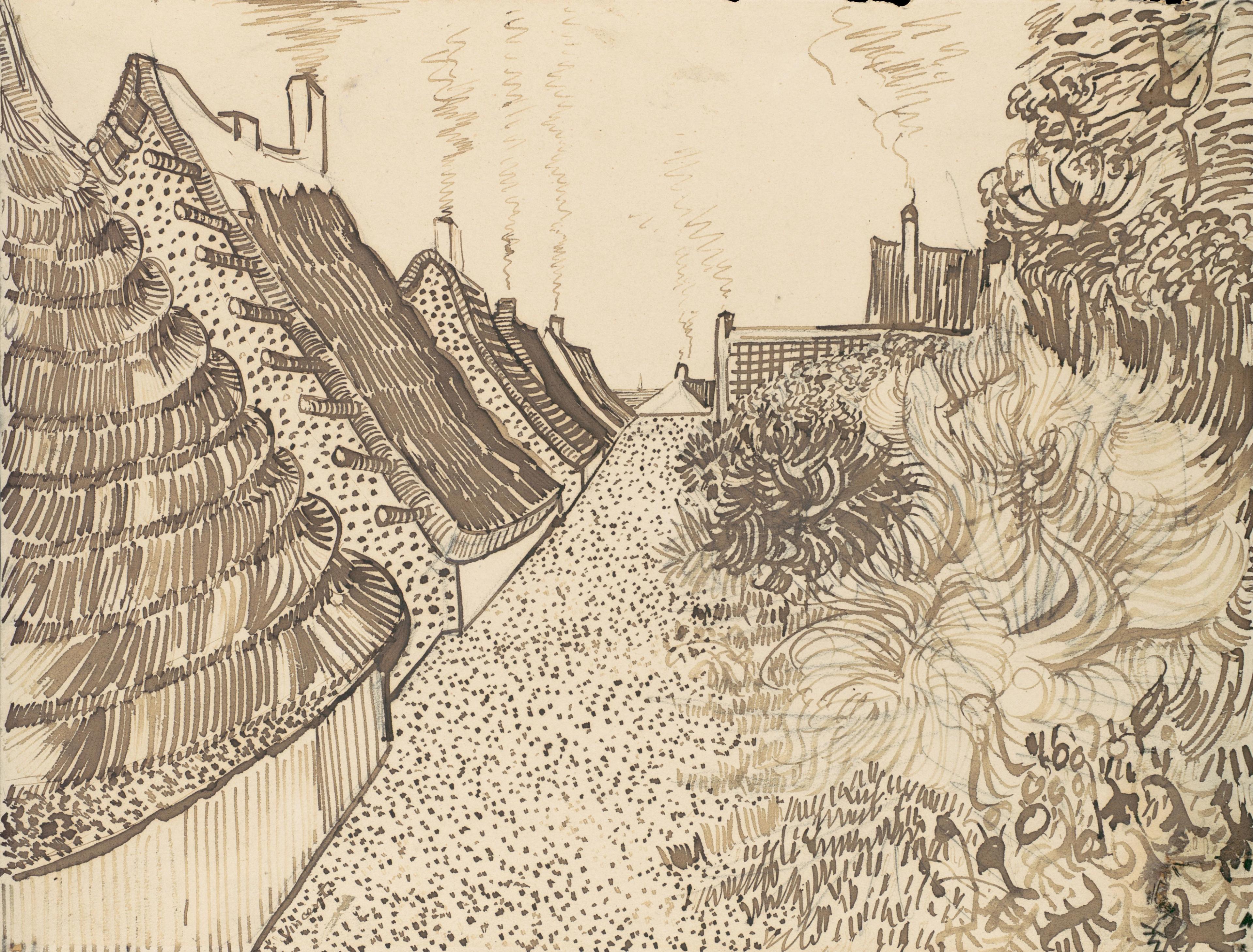
Vincent van Gogh (Dutch, 1853–1890). Street in Saintes-Maries-de-la-Mer, 1888. Reed pen, quill, and ink over chalk on wove paper (backed with wove paper), 9 5/8 x 12 1/2 in. (24.3 x 31.7 cm). The Metropolitan Museum of Art, New York, Bequest of Abby Aldrich Rockefeller, 1948 (48.190.1)
My name is Sopheap Pich. I'm a sculptor.
I didn't come to art until very late. My parents had always said to me: "Don't be an artist. Be a doctor. Be somebody that can do something for the world. Artists don't do anything for the world." But I was not convinced that that was the truth. I thought that the world was rich and full of possibilities.
I always say that Van Gogh was a big influence on me. I didn't know how to intellectualize it when I was younger, but now that I'm making sculpture and I'm dealing with line and I'm dealing with building, I see myself in direct relationship with Van Gogh because he built his paintings or he built his forms. There's a process of building up lines. I think that's what gives it weight and that's what gives it its own substance.
Part of our discipline is drawing. This is the essential aspect of the life of an artist. And we see a sense of gradual change in the earlier drawings he is figuring out how to portray a landscape. How to portray a branch or a stick. In the later drawings you can feel a sense of resolve. There's a sense of surrender which I love. There's a sense that he is in front of something that tells him how to look, what to put down on paper, a kind of directness about how to see nature. The marks are telling you that it's interesting, or else it's really just a simple landscape. Yet the line sings to you so you are consumed by it.
There's timelessness in his work. His drawings are about slowing down. It's about focus, it's about attention, but it's also about being free, it's also about a kind of playfulness. So, it's not so much about admiring this part or that part as an overall being. You can't be in the studio making this kind of work; you have to be in nature to make this kind of work.
When I think about Van Gogh I don't think about the mad Van Gogh. That's not interesting to me. I don't read his biography, trying to dig into his psychology and why and where and he was this and that. I'm interested in what he does. I'm interested in the product that he has produced. I'm interested in the evidence of what he's made. To me, a drawing is an evidence. It's an evidence of what you've done. This is my journey. This is the evidence that I existed.