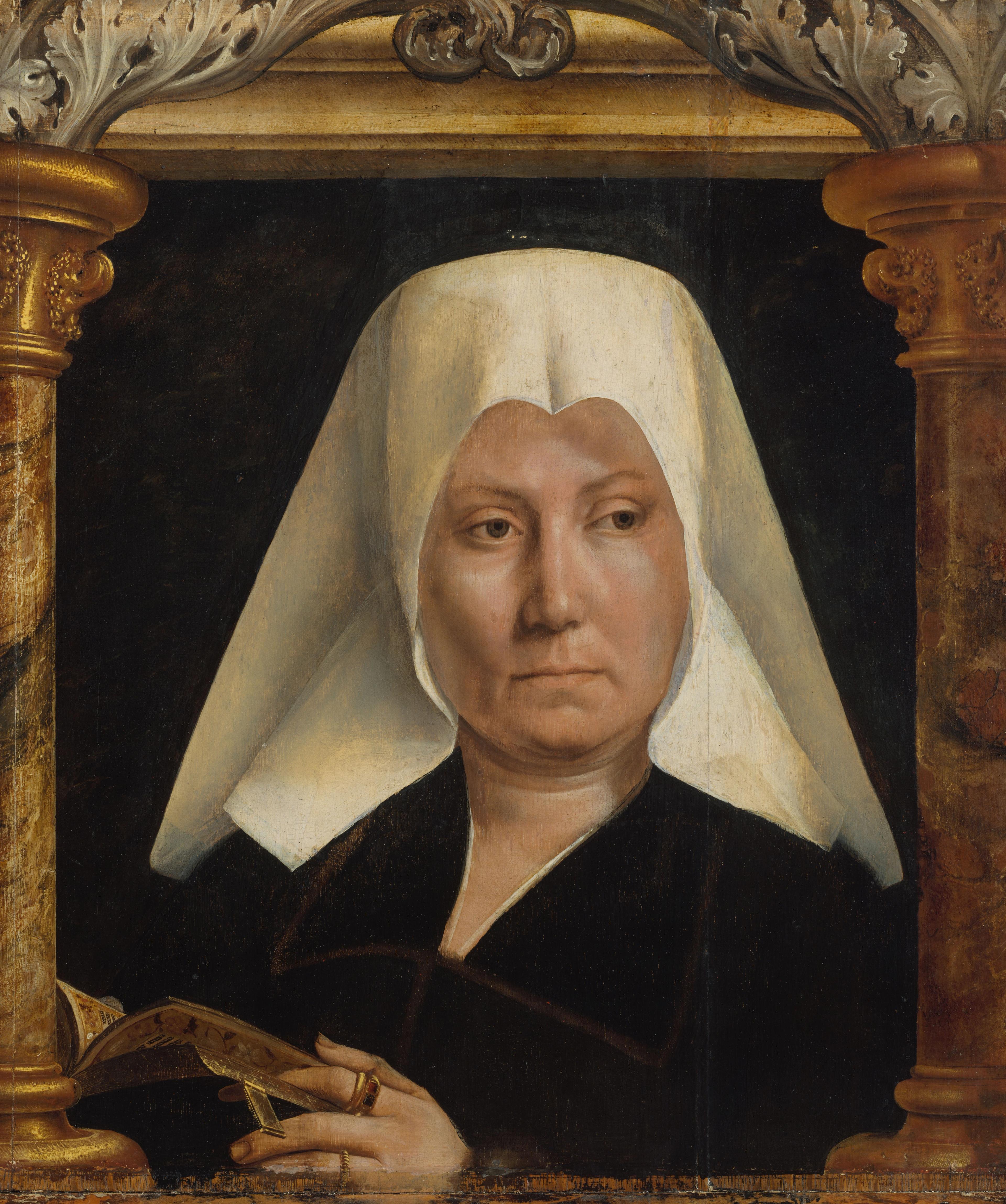
Quinten Massys (Netherlandish, 1466–1530). Portrait of a Woman, ca. 1520. Oil on wood, 19 x 17 in. (48.3 x 43.2 cm). The Metropolitan Museum of Art, New York, The Friedsam Collection, Bequest of Michael Friedsam, 1931 (32.100.47)
My name is Nina Katchadourian.
I'm really a very twenty-first-century kind of artist/maker. I have never in my life made a painting, but whenever I visit The Met I always head for these paintings. They have become like these friends I want to visit.
Like this portrait pair by the painter, Hans Memling: to me she seems to be the one in control of the situation, which is historically probably quite false. I mean he's the husband, he's older—quite a lot older—than her, in fact. He was in his forties, she was fourteen? Hmm, you know, that's interesting already—a little alarming to our contemporary sensibilities. But the arch of her eyebrows, the slight skepticism: she looks like someone who knows what she thinks.
I do imagine their dialogue, what their interaction would be. How happy were they to be together? I'm aware that my readings of these may also be so inflected by my contemporary headspace. I'm really responding in some ways recklessly and irresponsibly, which actually I think is okay.
A lot of my subject matter is based in the mundane, everyday stuff that surrounds us. I really look to sometimes the most unspectacular things as starting points for my work.
I love the austerity of these paintings. It's so high-contrast and bold. There's a lot packed in. But there's a kind of low, humming tension around it. You're sort of watching someone alone with themselves. The body positioning, the facial expressions, the solemnity, the calm. Maybe this does connect to my own set of questions of how little you can harness in order to have the biggest impact.
There is a certain virtuosic showoffy-ness in some of these. I mean, the fellow with the stubble: I know that stubble is there partially to show off how skilled the painter is. The painter is looking so carefully and with such precision of vision, without dolling them up or making them look more or less good-looking. You feel like, my God, that is someone who really existed with all their quirks of face and awkwardness of expression. They feel so specific, like faces that you could see once you walk outside.
This may be a strange way to try to connect my practice to someone like Memling's, but I do try to be an acute observer of the stuff that surrounds me. I kind of see that as the job: pay attention to things in the world, and then try to show people, who might be looking at your work, what you have been paying attention to and what you want to show them.