English
DonateMembershipTickets

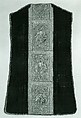
Chasuble

ca. 1720 (figurative woven silk), ca. 1775 (embroidered orphrey), cut patched and reassembled ca. 1775
Not on view
This colorful chasuble– the tabard-like garment worn by a Roman Catholic priest– is composed of an older fabric, carefully cut, seamed, patched, and repurposed here. A figurative satin brocade, it is decorated with a repeat pattern of motifs from classical mythology: naked Hercules fights the Nemean lion, whilst Apollo, in glory, is seated in a grotto on mount Parnassus; around a dolphin-tailed fountain of life cavort unicorns, peacocks, leopards and turkeys, flanked by tulips, palm and cypress trees. Another fragment of textile brocaded with a very similar design is in The Met's collection (52.29.2). The central embroidered orphrey strips on front and reverse seem to have been created expressly for this garment, countering the pagan elements with Christian symbols, which nonetheless sympathetically pick up the brocade's palette and motifs from nature. On the front of the chasuble, the IHS monogram (standing for Jesus Christ) appears above a phoenix rising from ashes (alluding to Christ's resurrection), a red rose (symbol of his mother, the Virgin Mary), a mother pelican feeding her young with blood from her pierced breast (referring to the Christian belief that God sacrificed his son, Jesus, to save humankind), and a pomegranate (whose many seeds represented the souls redeemed by Christ's sacrifice). On the reverse, the crowned MA monogram (for the Virgin Mary) replaces IHS, while at the top of the orphrey is seated the crowned Lamb of God, carrying the banner of the resurrection. The inscription "Qui pascis inter lilia" ([Jesus] "who feeds amongst the lilies") comes from a medieval hymn, Jesu Corona Virginum, based on a fourth-century Latin text.

Artwork Details

Object Information
  • Title: Chasuble
  • Date: ca. 1720 (figurative woven silk), ca. 1775 (embroidered orphrey), cut patched and reassembled ca. 1775
  • Culture: Portuguese
  • Medium: Silk satin, brocaded with chenille and silk; Orphrey: silk satin, embroidered with silk and metal-wrapped thread
  • Dimensions: 48 × 29 in. (121.9 × 73.7 cm)
  • Classifications: Textiles-Woven, Textiles-Ecclesiastical
  • Credit Line: Rogers Fund, 1942
  • Object Number: 42.97
  • Curatorial Department: European Sculpture and Decorative Arts
More Artwork
Piece, Silk and metal thread, Portuguese
Portuguese
early 18th century
Dialogo sobre hua nova obra no Rio Tejo ..., Bento de Moura Portugal  Portuguese
Author Bento de Moura Portugal
1776 (?)
Chasuble, Back, Cut velvet with embroidered and couched orphrey; silk, gilt-metal-strip-wrapped silk, linen., Italian or Spanish
Italian or Spanish
16th century
Curtain, Linen, block-printed
1700–1800
Cope with an Orphrey and a Hood, Cope:  silk warp-float faced 4/1 satin weave with linen plain weave lining.<br/>Orphrey:  linen plain weave with silk and gilt- and silvered- metal strip wrapped silk in satin and split stitches, laid work, couching, and padded couching.  Fringe:  silk, gilt-metal-strip-wrapped silk.  Lining: cotton plain weave.<br/>Hood:  linen plain weave embroidered with silk, gilt- and silvered- metal-strip-wrapped silk, and silvered-metal strips and coils , couching and couching padded with hemp; metal spangles.  Fringe: silk plain weave.  Lining: linen plain weave., Italian, German, Dutch, Spanish
Italian, German, Dutch, Spanish
15th–16th century

Research Resources

The Met provides unparalleled resources for research and welcomes an international community of students and scholars. The Met's Open Access API is where creators and researchers can connect to the The Met collection. Open Access data and public domain images are available for unrestricted commercial and noncommercial use without permission or fee.

To request images under copyright and other restrictions, please use this Image Request form.

Feedback

We continue to research and examine historical and cultural context for objects in The Met collection. If you have comments or questions about this object record, please contact us using the form below. The Museum looks forward to receiving your comments.

Send feedback

Content Notice

The Metropolitan Museum of Art presents over 5,000 years of art from around the world, and our online collection reflects ongoing work conducted over the course of our more than 150-year history. You may encounter objects or images that may be inappropriate for some viewers or information that may be outdated.