Olamina (How do we learn to love each other while we are embattled)
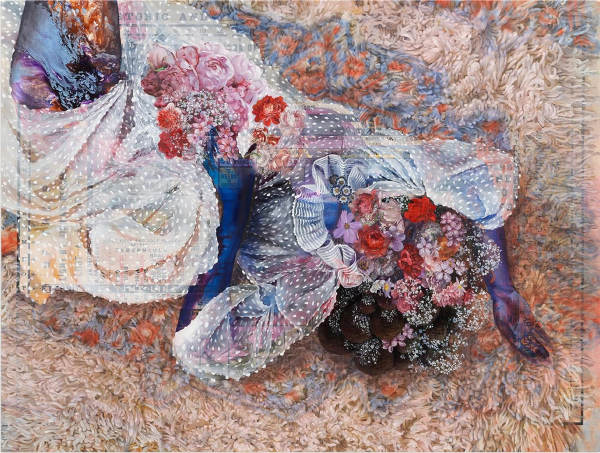
Báez depicts Olamina in a state of repose, borrowed in part from a 1961 photograph of a multigenerational group of female Freedom Riders at rest in a church pew as a white supremacist mob raged outside. For the artist, such moments of calm signal the incredible power, courage, and grace embodied by these women and also signify the importance of self-care in moments of grave danger. Olamina reclines atop a shimmering shag carpet that resembles a bed of anemones; the purplish hue of her skin suggests watery depths, and apart from her striking eyes, her face and torso are masked by a cascade of luscious red, pink, and white flowers. This captivating work centers the strength of feminine resistance in a world structured to diminish that empowerment.
Artwork Details
- Title: Olamina (How do we learn to love each other while we are embattled)
- Artist: Firelei Báez (Dominican, born Santiago De Los Caballeros, 1981)
- Date: 2022
- Medium: Oil and acrylic on inkjet on canvas
- Dimensions: 86 1/2 in. × 9 ft. 6 1/2 in. (219.7 × 290.8 cm)
- Classification: Paintings
- Credit Line: Purchase, Civic Practice Partnership Artist Residency, Anonymous, and Lila Acheson Wallace Gifts, 2023
- Object Number: 2023.355
- Rights and Reproduction: © Firelei Báez
- Curatorial Department: Modern and Contemporary Art
Audio
Firelei Báez’s Olamina | Gallery 915
To this day, artists face challenges in the art world as a consequence of their gender identities. Hear artist Firelei Báez recount obstacles she faced early in her career and how she copes through her artmaking practice.
FIRELEI BÁEZ: I’m Firelei Báez. An artist, painter, sculptor, you name it.
KATY HESSEL: Báez is standing in The Met’s Modern and Contemporary Wing in front of her painting. Its surface is dense with lavish textures and colors, and if you look closely, beneath it all, there lies a woman.
BÁEZ: So this person having a moment of rest on this very soft rug, enveloped by all these fragrant, beautiful flowers.
The title of the piece is Olamina (How do we learn to love each other while we are embattled?)—and that is meant to have many different reads to it. First being that it is an ode to Lauren Olamina, the protagonist of the Earthseed series from Octavia Butler. And in those novels, the world is eerily similar to many of the things we were going through in the world, specifically in the United States—political chaos, environmental distress, policing the body, especially the female body.
HESSEL: The main character of the series, Lauren, is a young Black woman who establishes a new religion and envisions a better future while navigating a present moment teeming with corporate greed and violent politicians.
BÁEZ: And when you’re reading through the story, if you read through it very quickly, you’re like, “Oh my goodness. This is a world in collapse.” And then you read through again and you realize at every point of crisis, she centers a moment of rest.
Before any major battle, she says we cannot address it until we are whole. If we don’t rest at this point, we can win the battle, but we won’t win the war. I kind of get all—sorry—worked up about it, but it’s just incredible that she would have the vision to show both the truth of the crises, and ways out of it.
This idea of having to fix the system—to teach how to change racism, to teach how to end industrialization—the onus of fixing it and teaching is on specific bodies, specific communities.
I wanted to acknowledge that history. And still give a moment of rest, like collectively, we cannot face all that until we are whole. And so that’s why she’s in this moment of repose.
HESSEL: Rest, or rather a lack of rest, is something Báez contends with in her own life and painting practice as well
BÁEZ: Coming into the art world without any financial support meant that I had to, for this thing I love and that makes me feel alive, I had to sacrifice being close to my family. I many times had to have five jobs at once. So creature comforts became secondary, and they shouldn’t have. As a young woman, to then have the space to again rest or bring rest to other people has been almost impossible.
Even when there were extraordinary women painting historically, the fact that their works were either subsumed or had to be extremely exceptional to ever be noted was something I was aware of.
And so, what was I adding to that canon? How was I opening it? How was I making room for others?
Because as much as we think of our ancestors, how do we become better ancestors for other people moving forward?
HESSEL: Listen on to hear more incredible stories about great women artists at The Met.
More Artwork


Related Content
Research Resources
The Met provides unparalleled resources for research and welcomes an international community of students and scholars. The Met's Open Access API is where creators and researchers can connect to the The Met collection. Open Access data and public domain images are available for unrestricted commercial and noncommercial use without permission or fee.
To request images under copyright and other restrictions, please use this Image Request form.
Feedback
We continue to research and examine historical and cultural context for objects in The Met collection. If you have comments or questions about this object record, please contact us using the form below. The Museum looks forward to receiving your comments.
Content Notice
The Metropolitan Museum of Art presents over 5,000 years of art from around the world, and our online collection reflects ongoing work conducted over the course of our more than 150-year history. You may encounter objects or images that may be inappropriate for some viewers or information that may be outdated.