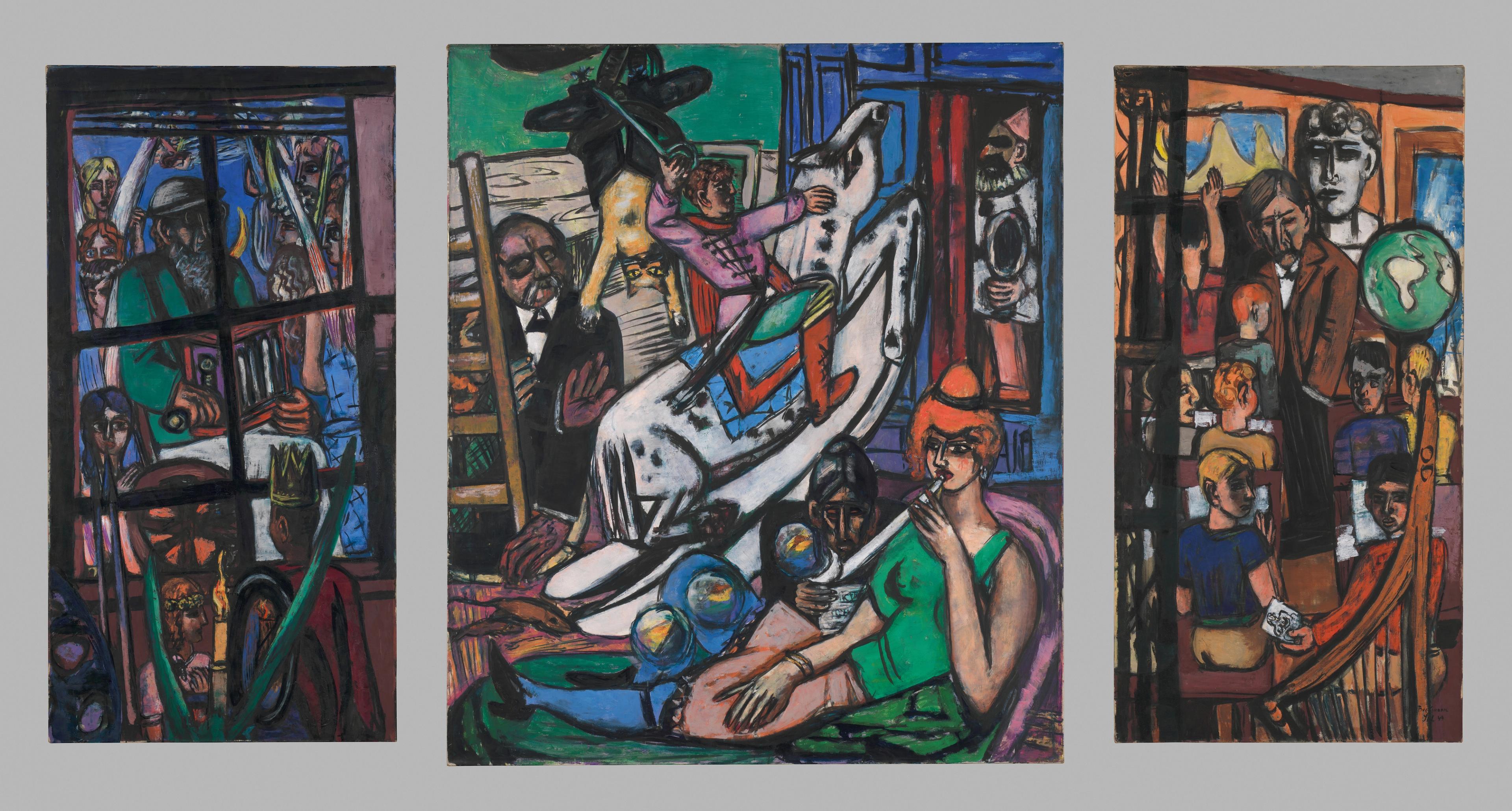
Max Beckmann (German, Leipzig 1884–1950 New York). The Beginning, 1946–49. Oil on canvas, Overall: 69 in. × 125 1/2 in. (175.3 × 318.8 cm); left (a): 65 in. × 33 1/2 in. (165.1 × 85.1 cm); center (b): 69 × 59 in. (175.3 × 149.9 cm); right (c): 65 in. × 33 1/2 in. (165.1 × 85.1 cm). The Metropolitan Museum of Art, New York, Bequest of Miss Adelaide Milton de Groot (1876–1967), 1967 (67.187.53a-c). © 2026 Artists Rights Society (ARS), New York
I'm Eric Fischl. I'm a painter and a sculptor.
People so distrust that they can actually read a painting. It seems like you have to know a lot that's outside the painting in order to understand why I'm even looking at this painting. The great thing about Beckmann is no one reading is actually right. They're narratives that are based on deeply personal associations, coupled with mythologies you don't actually need to know; they just add layers and layers once you do.
I feel very close to the general narrative: a boy coming of age. Beckmann presents in the central panel a boy dressed like a prince on his hobby horse, which is very animated. In the puberty transition, boys destroy their toys. Puss in Boots hanging helplessly there immediately set that in motion for me.
The painting on the right is an elementary school. It's all male. Some of them behaving naughty. Showing you the picture he's passing implicates you both as a disciplinarian or you remember when you did this. There's an old man who seems to be the teacher behind him is a mature male figure but is only a bust, and he's got this globe that also is like a ball and it seems like it's gonna land and pop. He makes it very precarious.
In the panel on the left the boy is looking out at what he is going to enter or possess. He kind of jumps over everything between youth and death. It's almost like a dream-like transformation. Beckmann's sense of hierarchy comes from emotional necessity. You can see him really weighing how to describe something.
Part of rituals in society are that you recognize the momentousness of it and you share it. You go through puberty and it begins to call up the nature of desire, the objectification, you know, the currency of exchange. It makes me feel like I'm not the only one.
There's nobody that can compete with the complexity that he works with. He's as much constructing and watching the thing fall apart simultaneously and yet he stays so closely to the human drama. He's painting about the struggle of being human.