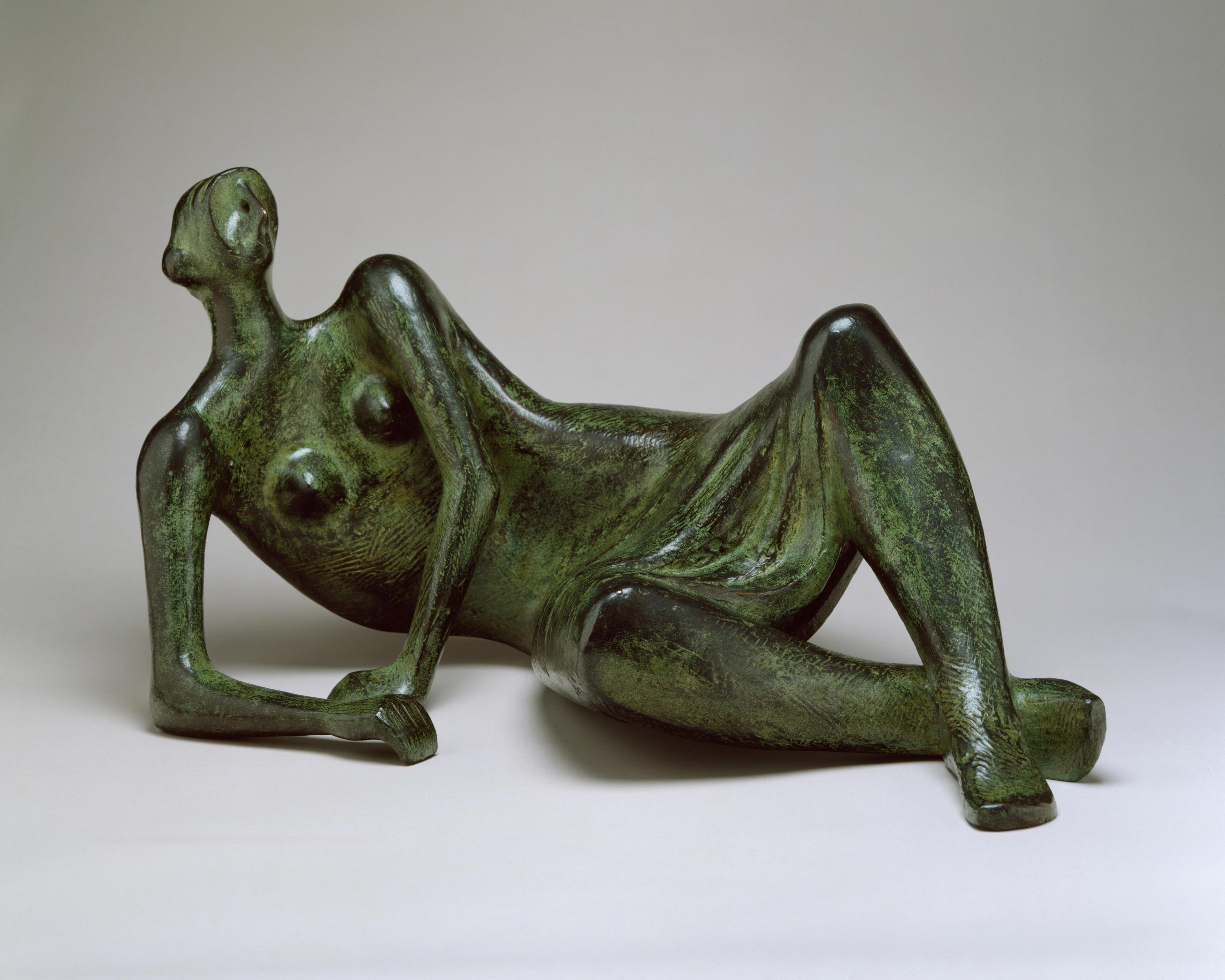
Henry Moore (British, 1898–1986). Reclining Figure, No. 4, 1954–55. Bronze, unnumbered cast from an edition of 7 + 1, 13 1/2 × 23 1/2 × 12 in., 36.9 lb. (34.3 × 59.7 × 30.5 cm, 16.7 kg). The Metropolitan Museum of Art, New York, Gift of Mr. and Mrs. Leonard S. Field, 1995 (1995.600). © 2026 Artists Rights Society (ARS), New York
My name is Krishna Reddy.
All this is like a dream for me. I'm nearing 100 now. I still keep struggling and trying to produce.
I use to live in Paris almost 45–50 years ago. At that time all the great masters were there. There was one little tiny street: all the masters there had studios. All the artists gathered and discussed art. For me, as a young man, I learned a lot from these masters. These are thinkers. They were all oriented to Eastern thinking at that time. It opened up another dimension. I just wanted to know more.
And in London it was Henry Moore. I was in his school. He took me to his studio. I was just taken by these sculptures. They were genuine—totally felt. And I was able to grasp, when he is doing a sculpture, the feeling that flows together and that moment is free. And that feeling in ordinary teaching doesn't exist.
He's still trying to build it from the reality. The figure laying down—simple. It's pure existence, and that's enough for me. It's a question of lived life. From zero, the deeper the artist goes, as if it is from the soul, it flourishes.
In art, all these are excuses for trying to capture that spirit struggling. And that feeling cannot be described. It goes into, I would say, a very spiritual area. Art is a mystery, but it has tremendous meaning. You want to touch that clay, take it out or put it back—you know, it's child's play. If we can express ourselves genuinely, it touches: it is universal.