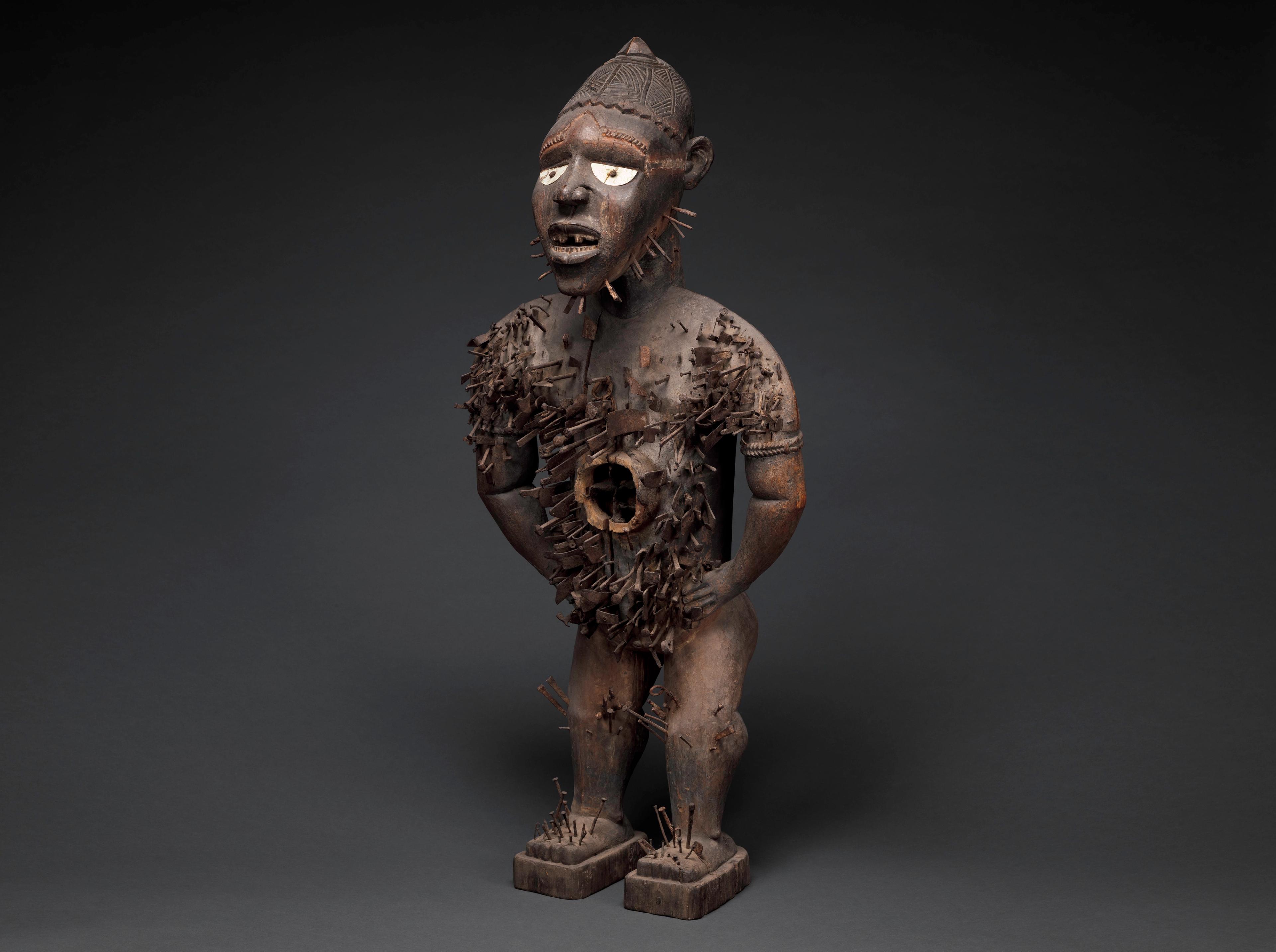
Yombe-Kongo artist and nganga (ritual specialist). Mangaaka Power Figure (Nkisi N’Kondi), ca. 1880–1900, Kongo peoples; Republic of the Congo or Cabinda, Angola, Chiloango River. Wood, iron, resin, ceramic, plant fiber, textile, pigment, 46 7/16 × 19 1/2 × 15 1/2 in., 53 lb. (118 × 49.5 × 39.4 cm, 24 kg). The Metropolitan Museum of Art, New York, Purchase, Lila Acheson Wallace, Drs. Daniel and Marian Malcolm, Laura G. and James J. Ross, Jeffrey B. Soref, The Robert T. Wall Family, Dr. and Mrs. Sidney G. Clyman, and Steven Kossak Gifts, 2008 (2008.30).
My name is Pat Steir and I'm an artist.
There's nothing in the discussion today about soul, about heart, in art. We don't have to talk about that. We're not even permitted to talk about it—you're considered a soggy old sap. I can name the pieces of art that bring tears to my eyes. This sculpture does it.
This power figure is an object that has specific magical powers, made by one person and a spiritual guide that guided him: do exactly that and nothing else. I always visit it when I come to this museum, and I'm not joking when I say the one time I didn't visit him I fell and broke my foot, so… (laughs) it does scare me.
When you walk in, he's the boss. The nails are a sign of power, not a sign of pain. When I first saw it I said, "Oh my God, he's absorbing everybody's pain!" That's not true.
He was made to protect a village. The way he's defensive, he's aggressive. He's, like, screaming, not only at the people who are going to come in and hurt his people, but at the universe. We don't know if the artist made the decisions; it could be that the spiritual advisor said, "He has to stand this way. He has to have his head looking upward."
It's so eloquent in its form, and yet he's sorrowful. He's not out in some little village—the big guy around, beating his chest—but he's doing his best here in the museum, guarding his family in cases: they're all from different times and different places. He's like a retired football player. He's not what he was, and I love him because he's not what he was. That's what's so touching about him.
You see, I love the parts where he's broken as much as the parts where he's complete. He was outside: you can see it from his feet got worm-eaten. And he lost his magic medicine that was embedded in his stomach. He lost the power when he lost that.
He expresses, to me, humanity and human desire and endeavor. And because it's lost so much, he seems human, to me, a friend... me—protecting my family, protecting myself, defending my art.
Even though it's out of its time and its place, it carries itself through time. Any work of art that hits its mark is a useful object because it changes the person who sees it: it adds to you. It doesn't have to be figurative to touch me. He touches me in his figure and his intention, but there's something of the heart of the artist in there more than intellectually.