English
DonateMembershipTickets

Cane

fourth quarter 19th century
Not on view
Apart from their obvious functionality, canes were an elegant accessory in the 19th century, when the afternoon promenade gave members of the fashionable set occasion to display their finery and genteel manners. This gentleman's novelty cane conceals an elaborately engraved and monogrammed sword blade. While technically functional as a sword, the absence of a proper grip and guard make the cane more suited to braggadocio than actual dueling. Another such gadget cane in the Brooklyn collection (2009.300.1125a–e) contains a liquor vial and tiny drinking glass. Equivalent women's sticks sometimes held snuff bottles, powders vials, or other cosmetic materials.

Artwork Details

Object Information
  • Title: Cane
  • Date: fourth quarter 19th century
  • Culture: Spanish
  • Medium: wood, metal
  • Credit Line: Brooklyn Museum Costume Collection at The Metropolitan Museum of Art, Gift of the Brooklyn Museum, 2009; Gift of Arthur Walker, 1961
  • Object Number: 2009.300.1280a, b
  • Curatorial Department: The Costume Institute
More Artwork
Seated Giant, Goya (Francisco de Goya y Lucientes)  Spanish, Burnished aquatint, scaper, roulette, lavis (along the top of the landscape and within the landscape)
Goya (Francisco de Goya y Lucientes)
by 1818 (possibly 1814–18)
Miniature coffeepot, David Clayton  British, Silver, cane, British, London
David Clayton
18th century
Self-Portrait, Goya (Francisco de Goya y Lucientes)  Spanish, Brush and point of brush, carbon black ink
Draftsman Goya (Francisco de Goya y Lucientes)
Sitter Goya (Francisco de Goya y Lucientes)
ca. 1796
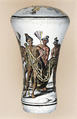
Cane handle, Painted enamel on copper, probably German, Rhenish
probably German, Rhenish
probably second half 18th century
God save us from such a bitter fate; a bandit threatening a woman and a child with a knife, page 41 from the "Black Border Album" (E), Goya (Francisco de Goya y Lucientes)  Spanish, Brush, carbon black gray ink and was, scraper
Goya (Francisco de Goya y Lucientes)
ca. 1816–20

Research Resources

The Met provides unparalleled resources for research and welcomes an international community of students and scholars. The Met's Open Access API is where creators and researchers can connect to the The Met collection. Open Access data and public domain images are available for unrestricted commercial and noncommercial use without permission or fee.

To request images under copyright and other restrictions, please use this Image Request form.

Feedback

We continue to research and examine historical and cultural context for objects in The Met collection. If you have comments or questions about this object record, please contact us using the form below. The Museum looks forward to receiving your comments.

Send feedback

Content Notice

The Metropolitan Museum of Art presents over 5,000 years of art from around the world, and our online collection reflects ongoing work conducted over the course of our more than 150-year history. You may encounter objects or images that may be inappropriate for some viewers or information that may be outdated.