Traveling table (table de voyage or table pliante)
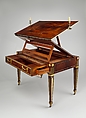
This refined and ingeniously constructed table [2] is a very rare example of a type of multifunctional furniture that was specifically invented for rough and space-limited journeying via coach. Before the advent of the automobile, a traveler could not count on finding the comforts of home at a place where he found himself benighted or stranded by unforeseen events, such as a broken axle-a misfortune that occurred often on unpaved roads.
The fashionable pieds de biche of the Museum's table are hinged to the top and can be folded and locked underneath, making the piece easy to pack away.[3] When standing, it could be used for serving food and beverages, and the raised molding along three sides would prevent valuable and fragile items from sliding off the beautifully grained surface. The fine, flat-carved decoration on the apron conceals a drawer for storing utensils. The tabletop can be extended by unfolding several leaves on either side. These are supported by steel pullout bars. There is a surface covered with leather for writing and another covered with felt for playing cards or dicing. Fully extended, the table could accommodate a company of at least six diners. The legs are decorated with a highly sophisticated design of low-relief carving incorporating floral sprays, small fruits, shell motifs, and interlaced strapwork.
The only known walnut table with similar folding mechanisms is very close to this table in its measurements. It once belonged to the princes de Condé and is now in the Musée des Arts Décoratifs in Paris.[4]
[Wolfram Koeppe 2006]
Footnotes:
1. Wolfram Koeppe. "Möbel und Schaustücke." In Liselotte von der Pfalz: Madame am Hofe des Sonnenkönigs, ed. Sigrun Paas, pp. 179–88. Exh. cat., Heidelberger Schloss. Heidelberg, 1996, pp. 184-85, fig. 5.
2. Katharine Baetjer et al. "The Jack and Belle Linsky Collection in the The Metropolitan Museum of Art: Addenda to the Catalogue." Metropolitan Museum Journal 21 (1986), pp. 165-66, no. A.5 (entry by James Parker)
3. Yet another name for this type of table is table pliante, or folding table; Henry Havard. Dictionnaire de l'ameublement et de la décoration depuis le XVIIIe siècle jusqu'à nos jours. 4 vols. Paris, 1887–90, vol. 4, col. 1208.
4. Yvonne Brunhammer, ed. Cent chefs-d'oeuvre du Musée des Arts Décoratifs. Exh. cat., Pavillon de Marsan, Palais du Louvre. Paris, 1964, p. 64; Pierre Kjellberg. Le mobilier français. Vol. I, Du Moyen Âge à Louis XV. Vol. 2, De la transition Louis XV–XVI à 1925. Paris, 1978–80, vol. 1, fig. 117; and Pierre Verlet. Les meubles français du XVIIIe siècle. 2nd ed. Paris, 1982, p. 132, fig. 29.
Artwork Details
- Title: Traveling table (table de voyage or table pliante)
- Date: ca. 1700–1720
- Culture: French
- Medium: Carved walnut; gilt-bronze mounts; steel hinges; linings of felt and leather
- Dimensions: 28 1/2 x 33 1/4 x 19 3/4 in. (72.4 x 84.5 x 50.2cm); Depth (when fully extended): 58 1/4 in. (148cm)
- Classification: Woodwork-Furniture
- Credit Line: The Jack and Belle Linsky Collection, 1982
- Object Number: 1982.60.83
- Curatorial Department: European Sculpture and Decorative Arts
More Artwork
Related Content
 Free to download
Research Resources
The Met provides unparalleled resources for research and welcomes an international community of students and scholars. The Met's Open Access API is where creators and researchers can connect to the The Met collection. Open Access data and public domain images are available for unrestricted commercial and noncommercial use without permission or fee.
To request images under copyright and other restrictions, please use this Image Request form.
Feedback
We continue to research and examine historical and cultural context for objects in The Met collection. If you have comments or questions about this object record, please contact us using the form below. The Museum looks forward to receiving your comments.
Content Notice
The Metropolitan Museum of Art presents over 5,000 years of art from around the world, and our online collection reflects ongoing work conducted over the course of our more than 150-year history. You may encounter objects or images that may be inappropriate for some viewers or information that may be outdated.