English
DonateMembershipTickets

Clock

Workshop of David Roentgen German
Movement attributed to Elie Prudhomme German, born Switzerland
ca. 1780–90
On view at The Met Fifth Avenue in Gallery 553
Its severe architectural form makes the case of this clock as imposing a classical monument. Typical is the use of finely grained mahogany veneered, applied from a single sheet from the frieze at the top down to the base, combined with brass inlay and gilt-bronze mounts. The base, enamel dial with bold roman numerals, and steel hand that indicates the day of the month make it an ideal timepiece for a desktop. Displayed on the rolltop desk with Chinoiserie, its simplicity looks like an anachronism. It is, however, a perfect match when the rolltop is lifted (see ill.). The movement is attributed to Élie Prudhomme, a Moravian clockmaker in Neuwied. The dial is signed Jean Thomas/Petersbourg. Thomas, a Swiss clock maker who lived in Saint Petersburg in the early nineteenth century, may have repaired the movement.

Artwork Details

Object Information
  • Title: Clock
  • Maker: Workshop of David Roentgen (German, Herrnhaag 1743–1807 Wiesbaden, master 1780)
  • Maker: Movement attributed to Elie Prudhomme (German, born Switzerland, first mentioned 1776)
  • Date: ca. 1780–90
  • Culture: German, Neuwied am Rhein
  • Medium: Oak, pine, and mahogany, veneered with mahogany; brass, gilt bronze and enamel
  • Dimensions: Overall: 18 1/4 × 12 1/2 × 8 1/4 in. (46.4 × 31.8 × 21 cm)
  • Classification: Horology
  • Credit Line: Gift of The Ruth Stanton Family Foundation, in honor of Wolfram Koeppe, 2002
  • Object Number: 2002.237
  • Curatorial Department: European Sculpture and Decorative Arts
More Artwork
Commode à vantaux, David Roentgen  German, Oak, pine, walnut, mahogany, and cherry veneered with hornbeam (partially stained), tulipwood, walnut, holly and maple (both partially stained), boxwood, mahogany, and other woods; red brocatelle marble; gilt bronze; iron, steel, and brass, German, Neuwied am Rhein
Multiple artists/makers
ca. 1775–79 with later alterations
Clarinet in D, Boxwood, brass, German
German
1750–70
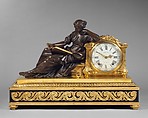
Mantel clock (pendule de cheminée), Julien Le Roy  French, Case: gilded and patinated bronze on a base of oak veneered with ebony with gilded-bronze mounts; Dial: white enamel with black numerals; Movement: brass and steel, French, Paris
Movement by the workshop of Julien Le Roy
Case maker: Joseph Baumhauer
Modeler Bronze figure from a model by Laurent Guiard
ca. 1757–60
Two panels from the 'Verdures du Vatican' series, Jean Démosthène Dugourc  French, Woven silk and metal thread with applied silk and chenille embroidery, French, Lyon
Designer Designed by Jean Démosthène Dugourc
Manufactory Woven by Maison Pernon et Cie.– Camille Pernon (French, 1753 – 1808)
ca. 1799
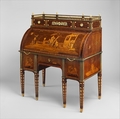
Rolltop desk, David Roentgen  German, Oak, cherry, pine, mahogany, veneered with maple, burl woods, holly, hornbeam (all partially stained), tulipwood, mahogany, and other woods; mother-of-pearl; partially gilded and tooled leather; gilt bronze, iron, steel, brass, partially gold-lacquered brass, German, Neuwied am Rhein
David Roentgen
Designer Drawer pulls after a design by Thomas Chippendale
Designer Marquetry panel after a design by Januarius Zick
ca. 1776–79

Research Resources

The Met provides unparalleled resources for research and welcomes an international community of students and scholars. The Met's Open Access API is where creators and researchers can connect to the The Met collection. Open Access data and public domain images are available for unrestricted commercial and noncommercial use without permission or fee.

To request images under copyright and other restrictions, please use this Image Request form.

Feedback

We continue to research and examine historical and cultural context for objects in The Met collection. If you have comments or questions about this object record, please contact us using the form below. The Museum looks forward to receiving your comments.

Send feedback

Content Notice

The Metropolitan Museum of Art presents over 5,000 years of art from around the world, and our online collection reflects ongoing work conducted over the course of our more than 150-year history. You may encounter objects or images that may be inappropriate for some viewers or information that may be outdated.