America
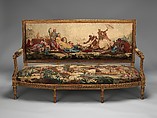
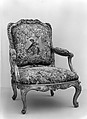
The settee showing America and Europe emphasizes the close relationship between France and the new United States, which France promoted so forcefully in the tapestry depicting America. The figure of France occupies the center of the sofa back, and America is seated off to the left. In this composition, France is ‘introducing the new nation to Europe across Neptune’s domain, the Atlantic; France’s discarded armor lies at her feet, as the war has been won, and Victory crowns her.’³ The armchairs repeat the female personifications of each continent, attended by male figures and some of the fauna typically associated with each. There are three variations on each of the four continents, and, although they are all slightly different, the iconographic program is consistent.
It appears that this upholstery was not affixed to furniture frames until sometime after 1852, decades after its production.⁴ Usually, a client commissioned or purchased high-quality tapestry upholstery before furniture frames were made to accommodate the weavings. This type of upholstery was quite popular in the late eighteenth century, and the Beauvais manufactory made many such sets.⁵ However, the combination of matching wall hangings and seating furniture was more unusual, and clearly more expensive. A suite of furnishings would have been reserved for a formal room, such as a salon or drawing room.
[Melinda Watt, adapted from Interwoven Globe, The Worldwide Textile Trade, 1500-1800/ edited by Amelia Peck; New York: Metropolitan Museum of Art; New Haven: distributed by Yale University Press, 2013]
Footnotes
1. See Standen, European Post-Medieval Tapestries, vol. 2, pp. 572–73.
2. Ibid., p. 573; the Gobelins tapestry upholstery depicted the continents as merchants on the sofa backs. Some of Le Barbier’s designs for the upholstery survive; none of the cartoons for the wall tapestries exist today. See ibid., pp. 572, 588–603, figs. 67–74, all in the Mobilier National, Paris.
3. Ibid., p. 591.
4. Ibid., p. 573, from the sale listing of May 18, 1852, hotel of the duc de Richlieu; no furniture frames were mentioned, nor was the ownership indicated.
5. Kisluk-Grosheide, ‘Peregrinations of a Lit à la Duchesse en Impériale by George Jacob,’ p. 144, and personal communication.
Artwork Details
- Title: America
- Manufactory: Tapestry upholstery by Beauvais
- Maker: Workshop of de Menou (French, active 1780–93)
- Artist: After a composition by Jean Jacques François Le Barbier (French, Rouen 1738–1826 Paris)
- Patron: Commissioned for Louis XVI, King of France (French, Versailles 1754–1793 Paris)
- Date: designed ca. 1786, woven 1790–91; settee frame second half 19th century
- Culture: French, Beauvais
- Medium: Carved and gilded wood; wool, silk
- Dimensions: Overall: 42 1/4 × 75 3/8 × 28 in. (107.3 × 191.5 × 71.1 cm)
- Classifications: Woodwork-Furniture, Textiles-Tapestries
- Credit Line: Purchase, Mr. and Mrs. Claus von Bülow Gift, 1978
- Object Number: 1978.404.5a–c
- Curatorial Department: European Sculpture and Decorative Arts
More Artwork
Related Content
 Free to download
Research Resources
The Met provides unparalleled resources for research and welcomes an international community of students and scholars. The Met's Open Access API is where creators and researchers can connect to the The Met collection. Open Access data and public domain images are available for unrestricted commercial and noncommercial use without permission or fee.
To request images under copyright and other restrictions, please use this Image Request form.
Feedback
We continue to research and examine historical and cultural context for objects in The Met collection. If you have comments or questions about this object record, please contact us using the form below. The Museum looks forward to receiving your comments.
Content Notice
The Metropolitan Museum of Art presents over 5,000 years of art from around the world, and our online collection reflects ongoing work conducted over the course of our more than 150-year history. You may encounter objects or images that may be inappropriate for some viewers or information that may be outdated.