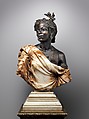
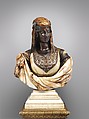
Pedestal [Woman of Algiers]
The busts revel in the period taste for polychromy in sculpture, an international phenomenon sparked by artistic debates about the painting of ancient statuary and inspired by ancient Roman and Renaissance sculpture composed of variously colored marbles. On a trip to Algeria in 1856 Cordier discovered onyx deposits in recently reopened ancient quarries and began to use the stone in busts such as these. He ingeniously fitted enameled bronze heads into the vibrantly patterned stone, creating exciting though costly representations of Africans that appealed to the highest levels of European society.
Artwork Details
- Title: Pedestal [Woman of Algiers]
- Artist: Charles-Henri-Joseph Cordier (French, 1827–1905)
- Maker: Pedestal attributed to designs by Charles-François Rossigneux (French, 1818–afer 1909)
- Date: 1862
- Culture: French, Paris
- Medium: Red and white marble pedestal with gilt-bronze mounts and ornaments
- Dimensions: Pedestal (wt confirmed): 41 3/8 × 18 1/4 × 11 3/4 in., 415 lb. (105.1 × 46.4 × 29.8 cm, 188.2 kg)
- Classification: Sculpture
- Credit Line: European Sculpture and Decorative Arts Fund, 2006
- Object Number: 2006.113d
- Curatorial Department: European Sculpture and Decorative Arts
More Artwork
![Pedestal [for Woman from the French Colonies], Charles-Henri-Joseph Cordier French, Red and white marble pedestal with gilt-bronze mounts and ornaments, French, Paris](https://images.metmuseum.org/CRDImages/es/web-additional/SF2006_112d.jpg)
Research Resources
The Met provides unparalleled resources for research and welcomes an international community of students and scholars. The Met's Open Access API is where creators and researchers can connect to the The Met collection. Open Access data and public domain images are available for unrestricted commercial and noncommercial use without permission or fee.
To request images under copyright and other restrictions, please use this Image Request form.
Feedback
We continue to research and examine historical and cultural context for objects in The Met collection. If you have comments or questions about this object record, please contact us using the form below. The Museum looks forward to receiving your comments.
Content Notice
The Metropolitan Museum of Art presents over 5,000 years of art from around the world, and our online collection reflects ongoing work conducted over the course of our more than 150-year history. You may encounter objects or images that may be inappropriate for some viewers or information that may be outdated.