Зеркало с подставкой в виде женщины в ниспадающих одеждах
Artwork Details
- Название: Зеркало с подставкой в виде женщины в ниспадающих одеждах
- Дата: середина V века до н.э.
- Культура: Греция, аргосская школа
- Материал: Бронза
- Размер: Выс. 40,6 см
- Благодарность: Дарственный фонд Вольтера С. Бэйкера, 1971
- Номер объекта: 1972.118.78
- Curatorial Department: Greek and Roman Art
Audio
1043. Bronze mirror with a support in the form of a draped woman
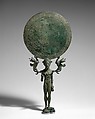
The several parts of this bronze mirror join in a harmonious whole. A female supporting figure, a caryatid, assumes the natural stance classical sculpture portrays so effortlessly. Her left knee comes forward just enough to show that her weight is on her right leg; her simple garment adds stability to the pose.
As a mirror, this object was meant to be admired largely from the front, but the artist who made it included beautiful details in the back as well. Walk around and look at the way the figure holds the bird in her right hand; her thumb curves up from the joint, true to the structure of the human hand and in place to hold the bird securely. You can also pick out every strand of her hair, and if you walk back around to the front, a string of tiny beads on her head.
When the mirror was new, the circle above the caryatid would have reflected your face, tinged with the golden sheen of polished bronze. On the border around the edge, a dog bounds after a hare on either side. At the top, between two rosettes is a siren, a female monster noted for her beautiful voice and irresistible attractiveness. Try to imagine this mirror with a smaller siren, or larger dogs and hares, or without the two rosettes. Every one of these elements affects the whole. You see how gracefully the Greek artist combined them to achieve a balanced composition.
More Artwork
Related Content

Research Resources
The Met provides unparalleled resources for research and welcomes an international community of students and scholars. The Met's Open Access API is where creators and researchers can connect to the The Met collection. Open Access data and public domain images are available for unrestricted commercial and noncommercial use without permission or fee.
To request images under copyright and other restrictions, please use this Image Request form.
Feedback
We continue to research and examine historical and cultural context for objects in The Met collection. If you have comments or questions about this object record, please contact us using the form below. The Museum looks forward to receiving your comments.
Content Notice
The Metropolitan Museum of Art presents over 5,000 years of art from around the world, and our online collection reflects ongoing work conducted over the course of our more than 150-year history. You may encounter objects or images that may be inappropriate for some viewers or information that may be outdated.