Bisj (ancestor pole)
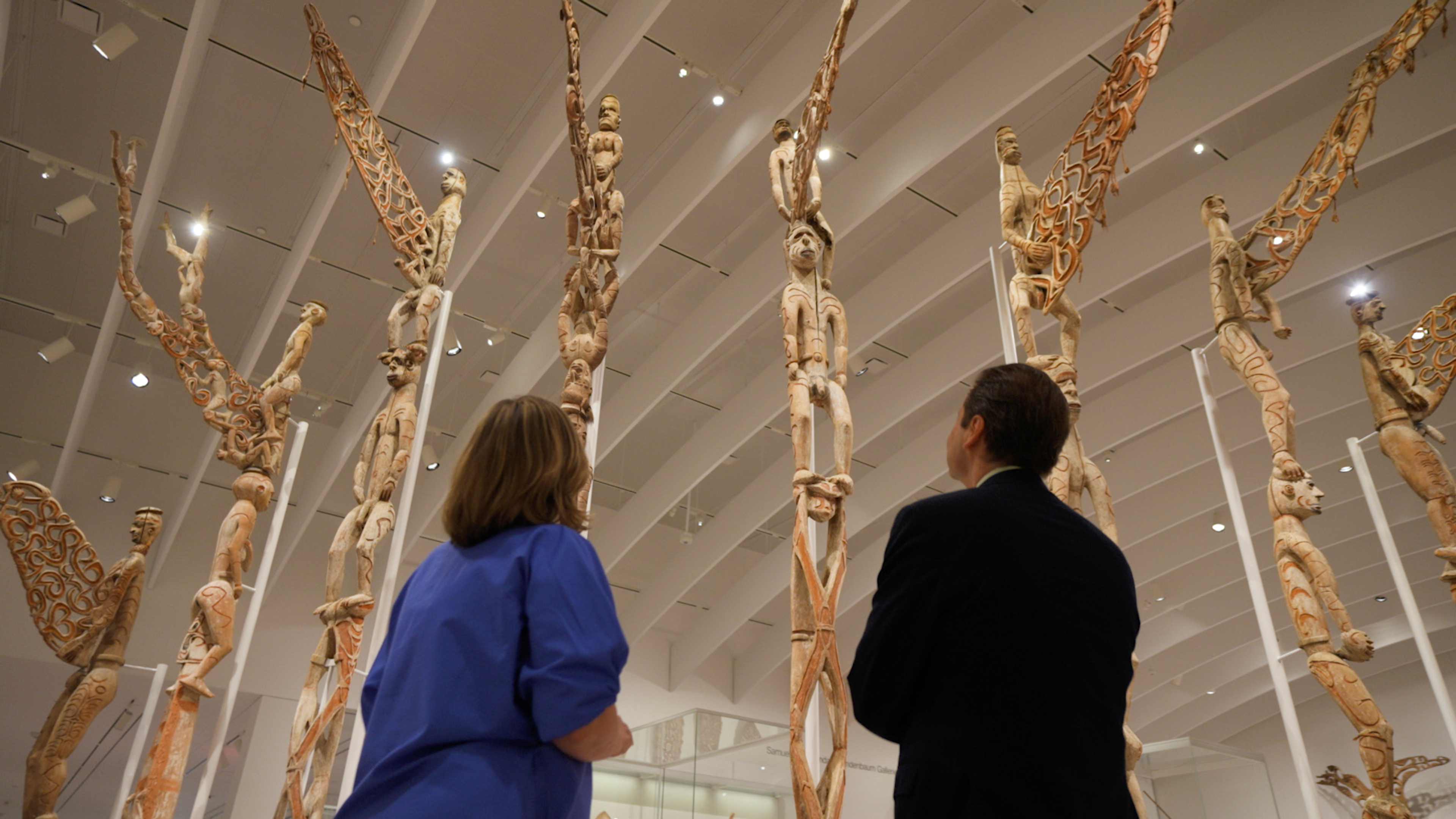
Each bis pole is carved from a single piece of wood. To create the pole’s distinctive form, carvers select trees with plank-like buttress roots. During carving, all but one of the roots are removed, and the tree is inverted, so that the remaining root forms the wing-like projection (cemen) at the top. Bis poles consist of several components. The main section (bis anakat) with the carved figures portrays the deceased individual for whom the pole is named, who is shown at the top, and other recently deceased relatives, who appear below. The cemen represents the pole’s phallus and incorporates motifs symbolic of headhunting, which is also associated with fertility. The lower portion of the pole is called the ci (canoe) and at times depicts the canoe that transported the ancestors to the afterworld (safan). The pointed base (bino) is often inserted into the ground.
Artwork Details
- Title: Bisj (ancestor pole)
- Artist: Jewer
- Date: ca. 1960
- Geography: Indonesia, West Papua, Omadesep village, Faretsj River
- Culture: Asmat people
- Medium: Wood, paint, fiber, sago palm leaves
- Dimensions: H. 17 ft. 4 in. × W. 21 1/2 in. × D. 65 in. (528.3 × 54.6 × 165.1 cm)
- Classification: Wood-Sculpture
- Credit Line: The Michael C. Rockefeller Memorial Collection; Gift of Nelson A. Rockefeller and Mrs. Mary C. Rockefeller, 1965
- Object Number: 1978.412.1248
- Curatorial Department: The Michael C. Rockefeller Wing
Audio
1709. Bisj Poles
More Artwork
Related Content
 Free to download
Research Resources
The Met provides unparalleled resources for research and welcomes an international community of students and scholars. The Met's Open Access API is where creators and researchers can connect to the The Met collection. Open Access data and public domain images are available for unrestricted commercial and noncommercial use without permission or fee.
To request images under copyright and other restrictions, please use this Image Request form.
Feedback
We continue to research and examine historical and cultural context for objects in The Met collection. If you have comments or questions about this object record, please contact us using the form below. The Museum looks forward to receiving your comments.
Content Notice
The Metropolitan Museum of Art presents over 5,000 years of art from around the world, and our online collection reflects ongoing work conducted over the course of our more than 150-year history. You may encounter objects or images that may be inappropriate for some viewers or information that may be outdated.