Headdress
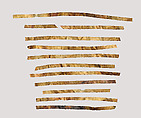
This delicate chaplet of gold leaves separated by lapis lazuli and carnelian beads adorned the forehead of one of the female attendants in the so-called King's Grave. In addition, the entombed attendants wore necklaces of gold and lapis lazuli, gold hair ribbons, and silver hair rings. Since gold, silver, lapis, and carnelian are not found in Mesopotamia, the presence of these rich adornments in the royal tomb attests to the wealth of the Early Dynastic kings as well as to the existence of a complex system of trade that extended far beyond the Mesopotamian River valley.
Artwork Details
- Title: Headdress
- Period: Early Dynastic IIIa
- Date: ca. 2600–2500 BCE
- Geography: Mesopotamia, Ur (modern Tell al-Muqayyar)
- Culture: Sumerian
- Medium: Gold, lapis lazuli, carnelian
- Dimensions: L. 15 1/8 in. (38.5 cm)
- Credit Line: Dodge Fund, 1933
- Object Number: 33.35.3
- Curatorial Department: Ancient West Asian Art
Audio
7015. Headdress
More Artwork
Related Content
Timeline of Art History
Entries and chronologies from The Met's art encyclopedia.

Publications
Books, guides, and catalogues published by The Met.
- Free to download
- Free to download
Research Resources
The Met provides unparalleled resources for research and welcomes an international community of students and scholars. The Met's Open Access API is where creators and researchers can connect to the The Met collection. Open Access data and public domain images are available for unrestricted commercial and noncommercial use without permission or fee.
To request images under copyright and other restrictions, please use this Image Request form.
Feedback
We continue to research and examine historical and cultural context for objects in The Met collection. If you have comments or questions about this object record, please contact us using the form below. The Museum looks forward to receiving your comments.
Content Notice
The Metropolitan Museum of Art presents over 5,000 years of art from around the world, and our online collection reflects ongoing work conducted over the course of our more than 150-year history. You may encounter objects or images that may be inappropriate for some viewers or information that may be outdated.