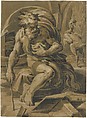
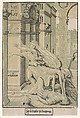
Hercules chasing Avarice from the Temple of the Muses
The drawings of Peruzzi were often engraved by the Master of the Die. In this case, he collaborated with Ugo da Carpi. Ugo da Carpi was an important early practitioner of the multiblock colored woodcut, a technique known as chiaroscuro (literally, 'light-dark'), which he falsely claimed to have invented. This method of printmaking requires the successive printing of two or more blocks. In this case, the line block (a block of wood from which everything has been cut away except the outline) prints the lines and areas of darkest shadow, and a second block prints the areas of mid-tone. The unprinted areas, where the white of the paper is visible, read as highlights in an image that resembles a wash drawing.
Artwork Details
- Title: Hercules chasing Avarice from the Temple of the Muses
- Artist: Ugo da Carpi (Italian, Carpi ca. 1480–1532 Bologna)
- Artist: After Baldassarre Tommaso Peruzzi (Italian, Ancaiano 1481–1536 Rome)
- Date: ca. 1520–27
- Medium: Chiaroscuro woodcut from two blocks in green
- Dimensions: 11 15/16 × 9 1/4 in. (30.3 × 23.5 cm)
- Classification: Prints
- Credit Line: Rogers Fund, 1920
- Object Number: 20.24.76
- Curatorial Department: Drawings and Prints
More Artwork
Research Resources
The Met provides unparalleled resources for research and welcomes an international community of students and scholars. The Met's Open Access API is where creators and researchers can connect to the The Met collection. Open Access data and public domain images are available for unrestricted commercial and noncommercial use without permission or fee.
To request images under copyright and other restrictions, please use this Image Request form.
Feedback
We continue to research and examine historical and cultural context for objects in The Met collection. If you have comments or questions about this object record, please contact us using the form below. The Museum looks forward to receiving your comments.
Content Notice
The Metropolitan Museum of Art presents over 5,000 years of art from around the world, and our online collection reflects ongoing work conducted over the course of our more than 150-year history. You may encounter objects or images that may be inappropriate for some viewers or information that may be outdated.