English
DonateMembershipTickets

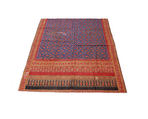
Sash

ca. 1628–58
Not on view
Men’s sashes, called patkas, were wrapped two or three times around the wearer’s waist and tied with their ends hanging down in the front. Worn over jamas, the long robes typical of Mughal India, they allowed men to display their wealth by tucking daggers, pen cases, and other precious objects into the fabric. After being exported to Europe in the colonial period, a modified version of the patka became part of tuxedo sets, taking its name from the Hindustani and Persian term kamarband, which means ‘waist bound up’. Individual stitches running the length of this patka create pleating in the fabric, indicating that it was worn folded over with the ends splayed out.

Artwork Details

Object Information
  • Title: Sash
  • Date: ca. 1628–58
  • Geography: Attributed to India
  • Medium: Cotton; resist and mordant dyed, and painted
  • Dimensions: L. 113 in. (287 cm)
    W. 12 1/2 in. (59. 7 cm)
  • Classification: Textiles-Costumes
  • Credit Line: Rogers Fund, 1928
  • Object Number: 28.159.4
  • Curatorial Department: Islamic Art
More Artwork
Dagger (Katar) with Sheath, Steel, silk, Indian
Indian
18th–19th century
Skirt Cloth (Pha Nung), partial, Resist- and mordant-dyed plain-weave cotton, India (for Thai market)
India (for Thai market)
18th–early 19th century
Crutch Dagger (Zafar Takieh, "Cushion of Victory"), Ivory, steel, Hilt, South Indian; blade, European
Hilt, South Indian; blade, European
17th–18th century
Chasuble, Cotton, drawn and painted resist and mordant, dyed, silk trim, Indian, Coromandel Coast and Central European, for European market
Indian, Coromandel Coast and Central European, for European market
ca. 1725, patched and reassembled in current form ca. 1775
Dagger (Katar), Steel, Indian
Indian
18th century

Research Resources

The Met provides unparalleled resources for research and welcomes an international community of students and scholars. The Met's Open Access API is where creators and researchers can connect to the The Met collection. Open Access data and public domain images are available for unrestricted commercial and noncommercial use without permission or fee.

To request images under copyright and other restrictions, please use this Image Request form.

Feedback

We continue to research and examine historical and cultural context for objects in The Met collection. If you have comments or questions about this object record, please contact us using the form below. The Museum looks forward to receiving your comments.

Send feedback

Content Notice

The Metropolitan Museum of Art presents over 5,000 years of art from around the world, and our online collection reflects ongoing work conducted over the course of our more than 150-year history. You may encounter objects or images that may be inappropriate for some viewers or information that may be outdated.