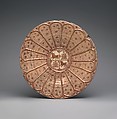
Dish
Knowledge of the technique for creating lusterware made its way to the Iberian Peninsula by the twelfth century, when most of the region was still under Islamic rule. By the 1400s, the Iberian center of lusterware production was in Manises, near the city of Valencia. Previously a Muslim taifa, or principality, the Kingdom of Valencia was conquered in the thirteenth century by James I for the Crown of Aragon, and it was here that Christians and Muslim potters worked, sometimes together, for a diverse clientele with a voracious appetite for high quality lustered wares.
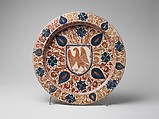
Beginning in the late fifteenth and early sixteenth centuries, the famed lusterware potters of Manises, near Valencia, experimented with new compositions and designs that included incised reliefs of large animals and fantastic creatures spanning the surface of entire dishes such as this one. The artist would use either a stencil or draw freehand and fill in the space around the figure with smaller decorative elements. Here, the artist experimented with wheel-like shapes and four-petaled flowers on the wings, a network of interlinked circles on the body, and swirling plants in the background. Many of the plates that follow this general design are completed in a coppery finish which is created by an absence of silver in the pigment. On the reverse, large fern fronds dominate the surface.
Artwork Details
- Title: Dish
- Date: late 15th–early 16th century
- Geography: Made in probably Manises, Valencia, Spain
- Culture: Spanish
- Medium: Tin-glazed earthenware
- Dimensions: Overall: 18 1/8 in. (46 cm)
- Classification: Ceramics
- Credit Line: The Cloisters Collection, 1956
- Object Number: 56.171.99
- Curatorial Department: Medieval Art and The Cloisters
More Artwork
Research Resources
The Met provides unparalleled resources for research and welcomes an international community of students and scholars. The Met's Open Access API is where creators and researchers can connect to the The Met collection. Open Access data and public domain images are available for unrestricted commercial and noncommercial use without permission or fee.
To request images under copyright and other restrictions, please use this Image Request form.
Feedback
We continue to research and examine historical and cultural context for objects in The Met collection. If you have comments or questions about this object record, please contact us using the form below. The Museum looks forward to receiving your comments.
Content Notice
The Metropolitan Museum of Art presents over 5,000 years of art from around the world, and our online collection reflects ongoing work conducted over the course of our more than 150-year history. You may encounter objects or images that may be inappropriate for some viewers or information that may be outdated.