Tsambouna
The tsambouna is traditionally played across the Greek islands, including the Dodecanese Islands, Islands from the Aegean Sea and Crete (See #89.4.855). It is either accompanied by the drum or the lyra, and is used for celebrations such as weddings, village festivities, and general entertainment. Repertoire includes dance music and songs.
While the overall organology of the tsambouna is shared across the Greek islands, instruments from different islands present differences, in particular regarding the number of fingerholes on the parallel melodic pipe. The island of Karpathos, for example, features a tsambouna with two parallel pipes: one with five finger holes, the other with only one fingerhole. As such the second pipe acts as a two-pitch drone that is used rhythmically and accompanies the main melody. These differences led islands to develop different repertoire, which in turn feed into the uniqueness of each island’s sonic identity. Other differences pertain to the material of the horn: while Naxos favors an animal horn at the end of the melodic pipes, bagpipes from other islands present a monoxyle sleeve ending in a horn, either curved (such as in Karpathos) or straight (Crete).
(Cassandre Balosso-Bardin, 2023)
Technical description
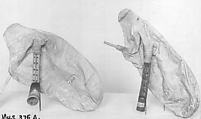
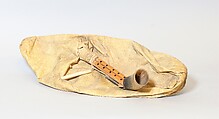
2 cane chanters, 135 mm, with cylindrical bores waxed into wooden yoke, with single horn bell (225 mm including bell);
Fingerholes R 5/0, L 5/0;
Reeds inaccessible (typically, single upcut cane reeds);
Turned insufflation nipple protruding 45 mm outside bag, no evidence of valve, blowpipe tied directly in bag;
Goatskin bag, neck and end tied off inside, pipes in forelegs.
Artwork Details
- Title: Tsambouna
- Period: 19th century
- Date: late 19th century
- Geography: Greece
- Culture: Greek
- Medium: cane, wood, horn, goatskin
- Classification: Aerophone-Reed Vibrated-bagpipe
- Credit Line: The Crosby Brown Collection of Musical Instruments, 1889
- Object Number: 89.4.1357
- Curatorial Department: Musical Instruments
More Artwork

Research Resources
The Met provides unparalleled resources for research and welcomes an international community of students and scholars. The Met's Open Access API is where creators and researchers can connect to the The Met collection. Open Access data and public domain images are available for unrestricted commercial and noncommercial use without permission or fee.
To request images under copyright and other restrictions, please use this Image Request form.
Feedback
We continue to research and examine historical and cultural context for objects in The Met collection. If you have comments or questions about this object record, please contact us using the form below. The Museum looks forward to receiving your comments.
Content Notice
The Metropolitan Museum of Art presents over 5,000 years of art from around the world, and our online collection reflects ongoing work conducted over the course of our more than 150-year history. You may encounter objects or images that may be inappropriate for some viewers or information that may be outdated.