Tutu
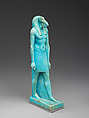
Tutu had many aspects (a powerful and victorious god, a divine king, master of demons), but most essentially he was understood as an accessible god to whom people could turn for help in their everyday existence. Very often he was represented on stelae where he was shown in side view but with his head turned to be viewed frontally, emphasizing this approachability.
This beautiful statue is thought to date relatively early in the god's history because of its restrained iconography. Since the facial fleshiness and features relate to images from the earlier part of the Ptolemaic Period, 300-150 B.C. is a viable range. The statue is likely to have been a temple donation at one of the temples, including that of Neit at Sais, where his cult would have been observed..
Artwork Details
- Title: Tutu
- Period: Ptolemaic Period
- Date: 300–150 BCE
- Geography: From Egypt
- Medium: limestone, pigment inlay; missing inlay
- Dimensions: L 35.6 cm; W 12.1 cm; H 21.1 cm (14 in x 4 3/4 in x 8 5/16 in)
- Credit Line: Theodore M. Davis Collection, Bequest of Theodore M. Davis, 1915
- Object Number: 30.8.71
- Curatorial Department: Egyptian Art
More Artwork

Research Resources
The Met provides unparalleled resources for research and welcomes an international community of students and scholars. The Met's Open Access API is where creators and researchers can connect to the The Met collection. Open Access data and public domain images are available for unrestricted commercial and noncommercial use without permission or fee.
To request images under copyright and other restrictions, please use this Image Request form.
Feedback
We continue to research and examine historical and cultural context for objects in The Met collection. If you have comments or questions about this object record, please contact us using the form below. The Museum looks forward to receiving your comments.
Content Notice
The Metropolitan Museum of Art presents over 5,000 years of art from around the world, and our online collection reflects ongoing work conducted over the course of our more than 150-year history. You may encounter objects or images that may be inappropriate for some viewers or information that may be outdated.