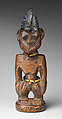
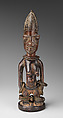
Ẹlẹ́ṣin (equestrian) figure for an Erinlẹ̀ shrine
The makers of this impressive shrine figure, Maku and his son Toibo (Toyinbo), were accomplished woodcarvers, celebrated in their home village of Erin and the region at large. Working both collaboratively and as individuals, they produced a corpus of characteristically sleek, elongated shrine figures and àgéré Ifá (divination vessels) for local patrons. First documented in situ during the 1950s by the German scholar Ulli Beier, their work subsequently entered the collections of several Western museums, including the Yale University Art Gallery and the Brooklyn Museum.
Artwork Details
- Title: Ẹlẹ́ṣin (equestrian) figure for an Erinlẹ̀ shrine
- Artist: Maku of Erin (d. 1915, Erin, Osun State, Nigeria)
- Artist: Toibo (Toyinbo) of Erin (d. 1937, Erin, Osun State, Nigeria)
- Date: 1900–1937
- Geography: Nigeria, Erin
- Culture: Yoruba peoples
- Medium: Wood, paint
- Dimensions: H. 34 1/4 in. x W. 10 3/4 in. x D. 12 3/4 in.
- Classification: Wood-Sculpture
- Credit Line: Gift of Carol B. Kenney, in memory of Jerome P. Kenney, 2025
- Object Number: 2025.97.6
- Curatorial Department: The Michael C. Rockefeller Wing
More Artwork


Research Resources
The Met provides unparalleled resources for research and welcomes an international community of students and scholars. The Met's Open Access API is where creators and researchers can connect to the The Met collection. Open Access data and public domain images are available for unrestricted commercial and noncommercial use without permission or fee.
To request images under copyright and other restrictions, please use this Image Request form.
Feedback
We continue to research and examine historical and cultural context for objects in The Met collection. If you have comments or questions about this object record, please contact us using the form below. The Museum looks forward to receiving your comments.
Content Notice
The Metropolitan Museum of Art presents over 5,000 years of art from around the world, and our online collection reflects ongoing work conducted over the course of our more than 150-year history. You may encounter objects or images that may be inappropriate for some viewers or information that may be outdated.