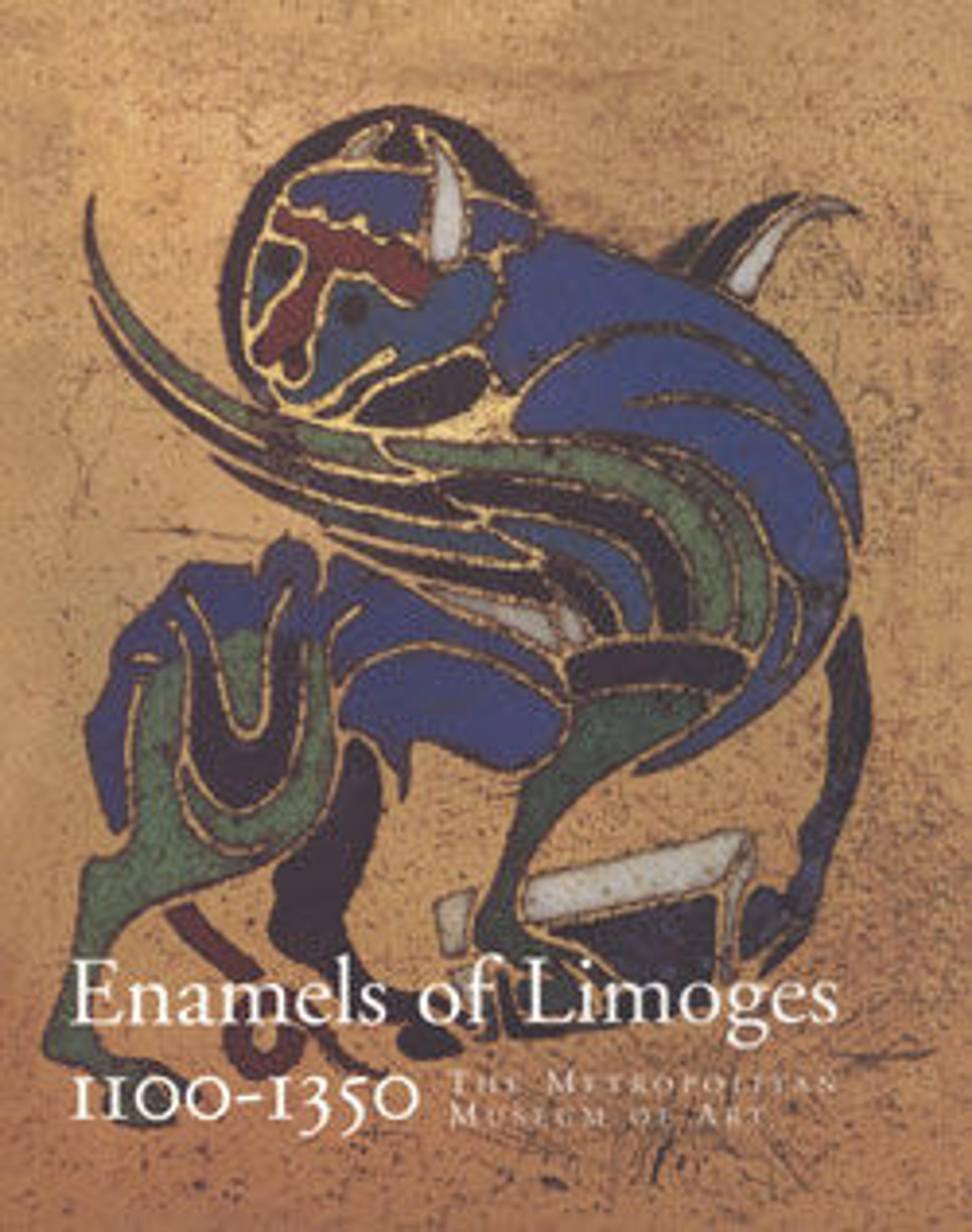
Enamels of Limoges, 1100–1350
Limoges enamels, the richest surviving corpus of medieval metalwork, were renowned throughout Europe in the Middle Ages. Yet today they are little known outside academic circles. The present volume, published in conjunction with the exhibition Enamels of Limoges, 1100–1350, brings to deserved public attention nearly two hundred of the most important and representative examples from the collections of The Metropolitan Museum of Art, the Musée du Louvre, the great church treasuries of France, and other sources. Early in the twelfth century, goldsmiths at the Benedictine Abbey of Conques in the hills of the ancient province of Rouergue began to create enamels whose jewel-like colors and rich, golden surfaces belied their fabrication from base copper. Within a generation, this technique was established in the area of the Limousin itself. By the 1160s the enamels created at Limoges, known as opus lemovicense, were a hallmark of the region. They were to be found not only in the Limousin and the neighboring region of the Auvergne but also in Paris, in monasteries along the pilgrims' road to Santiago de Compostela, at the Vatican, and in the cathedrals of Scandinavia.
The works of Limoges were created for important ecclesiastical and royal patrons. The wealth of enameling preserved from the Treasury of the abbey of Grandmont, just outside Limoges, is due chiefly to the Plantagenet patronage of Henry II and his queen, Eleanor of Aquitaine. Enamels created during their reign resonate with the elegant style of the court, and the dramatic history of Henry's monarchy is evoked by such works as the reliquary of Saint Thomas Becket. Ecclesiastical patrons such as Archbishop Absalon of Lund, Cardinal Guala Bicchieri, and, above all, Pope Innocent III were key to the dissemination of Limoges work throughout the churches of Europe.
While few of the artists who created the enamels that have come down to us are known by name, the works of several—Master Alpais, Garnerius, and Aymeric Chretien—are here juxtaposed with related pieces, some of them demonstrably from the same atelier. Clearly, the ability of the goldsmiths of Limoges to adapt their work to meet the demands of a varied clientele was an essential element in their success. Victorines and Franciscans joined Benedictines among the patrons of Limoges. Before the middle of the thirteenth century, the goldsmiths of Limoges began to create tomb sculptures of gilt copper with enameled surrounds, the most famous being the paired images of John and Blanche of France, children of Saint Louis. Objects decorated with enameled coats of arms came into prominence at about the same time.
Met Art in Publication
You May Also Like

Citation
O’Neill, John Philip, Musée du Louvre, and Metropolitan Museum of Art (New York, N.Y.), eds. 1996. Enamels of Limoges: 1100-1350. New York: Metropolitan Museum of Art : Distributed by H. Abrams.