Homer’s epic poem The Odyssey is one of the best-known tales in history. Composed around the eighth century BCE in Greece, its timeless themes of bravery, loyalty, perseverance, and cunning make it a beloved and enduring source of inspiration. From vase painters in ancient Greece and Rome to contemporary filmmakers like Christopher Nolan, artists have continually retold The Odyssey across mediums.
Countless paintings, ceramics, and statues relate to Odysseus’s ten-year journey home to Ithaka, where he ruled as king alongside his wife, Penelope. Below are seven objects from The Met collection that bring this famous Greek story to life in dynamic and surprising ways.
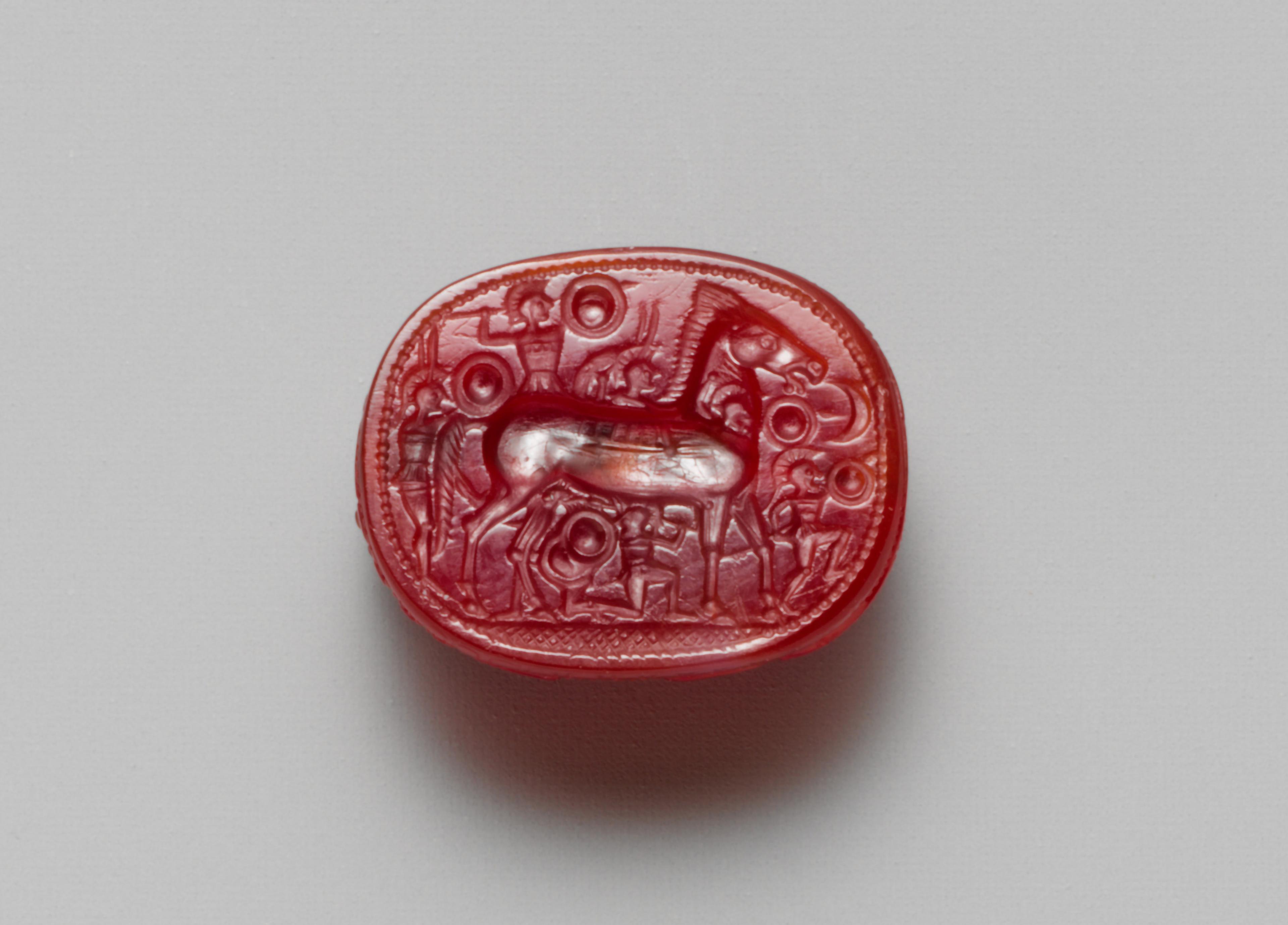
Carnelian scarab, 500–475 BCE. Etruscan, Populonia. Carnelian, 5/8 in. (1.5 cm). The Metropolitan Museum of Art, New York, NY, Fletcher Fund, 1932 (32.11.7). On view in Gallery 170
Before Odysseus set out on his trip home, he had endured the Trojan War, a ten-year mythological conflict between Greek forces and the city of Troy whose final moments comprise Homer’s equally renowned The Iliad. In this conflict, heroes such as Achilles, Diomedes, and Ajax fought alongside Odysseus against the Trojans. Dating from around 500 BCE, an exquisite scarab made of carnelian (a reddish-orange semiprecious stone) is carved with the iconic scene of the Trojan Horse. Odysseus came up with the strategy of “gifting” the Trojans a large wooden horse with soldiers concealed inside, allowing them to sneak into Troy and win the war through a surprise attack. This tiny gem, measuring under an inch, compresses a key episode from the Trojan War onto a remarkably small surface with an array of intricate details.
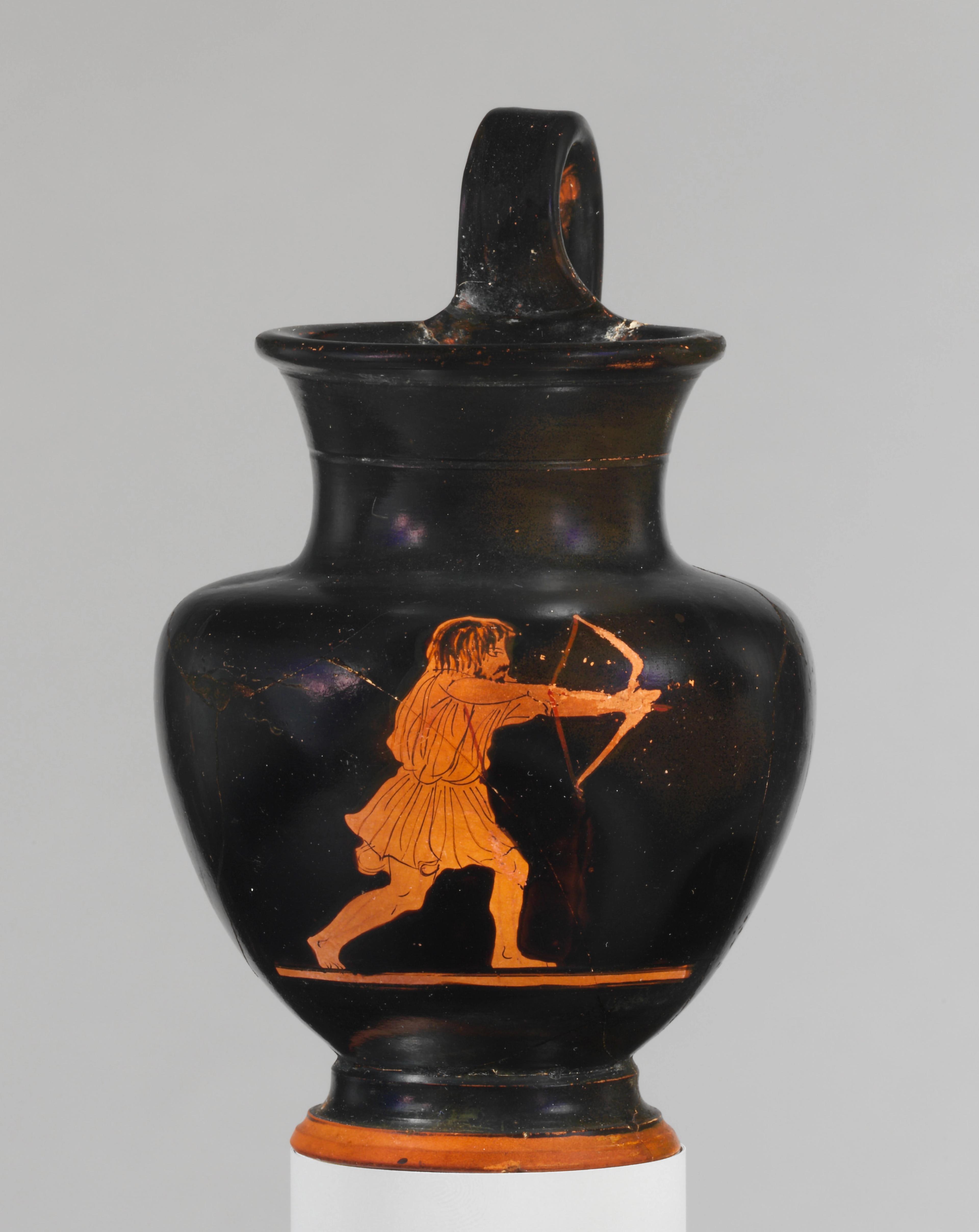
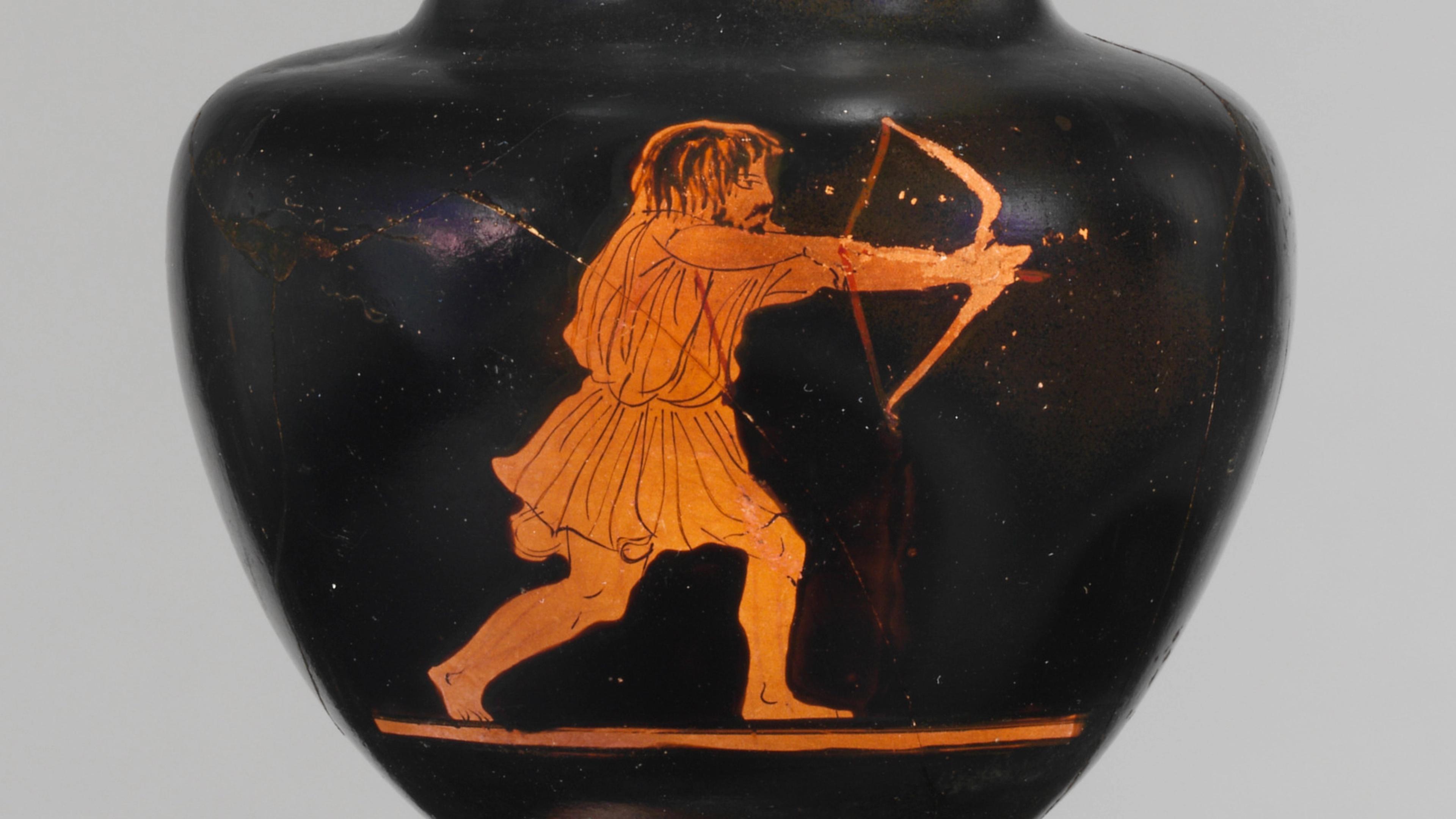
Attributed to the Disney Painter. Terracotta oinochoe (jug), ca. 430–420 BCE. Greek, Attic. Terracotta; red-figure, 5 3/8 in. (13.6 cm). The Metropolitan Museum of Art, New York, NY, Fletcher Fund, 1924 (24.97.24). On view in Gallery 171, Case 30
Odysseus’s defining characteristic is his intelligence—the capacity to overcome any challenge through strategy. A terracotta oinochoe (jug) from around 430–420 BCE depicts the hero, finely rendered in red-figure, pulling back his bow to strike his enemies, exemplifying the cunning and patience necessary to execute a carefully planned attack. Ancient Greek ceramics featured scenes from myth and daily life, which were painstakingly applied after a vessel was shaped. Here, Odysseus wears a look of fierce determination, sporting long, unkempt hair that reflects the hardships of his long journey.
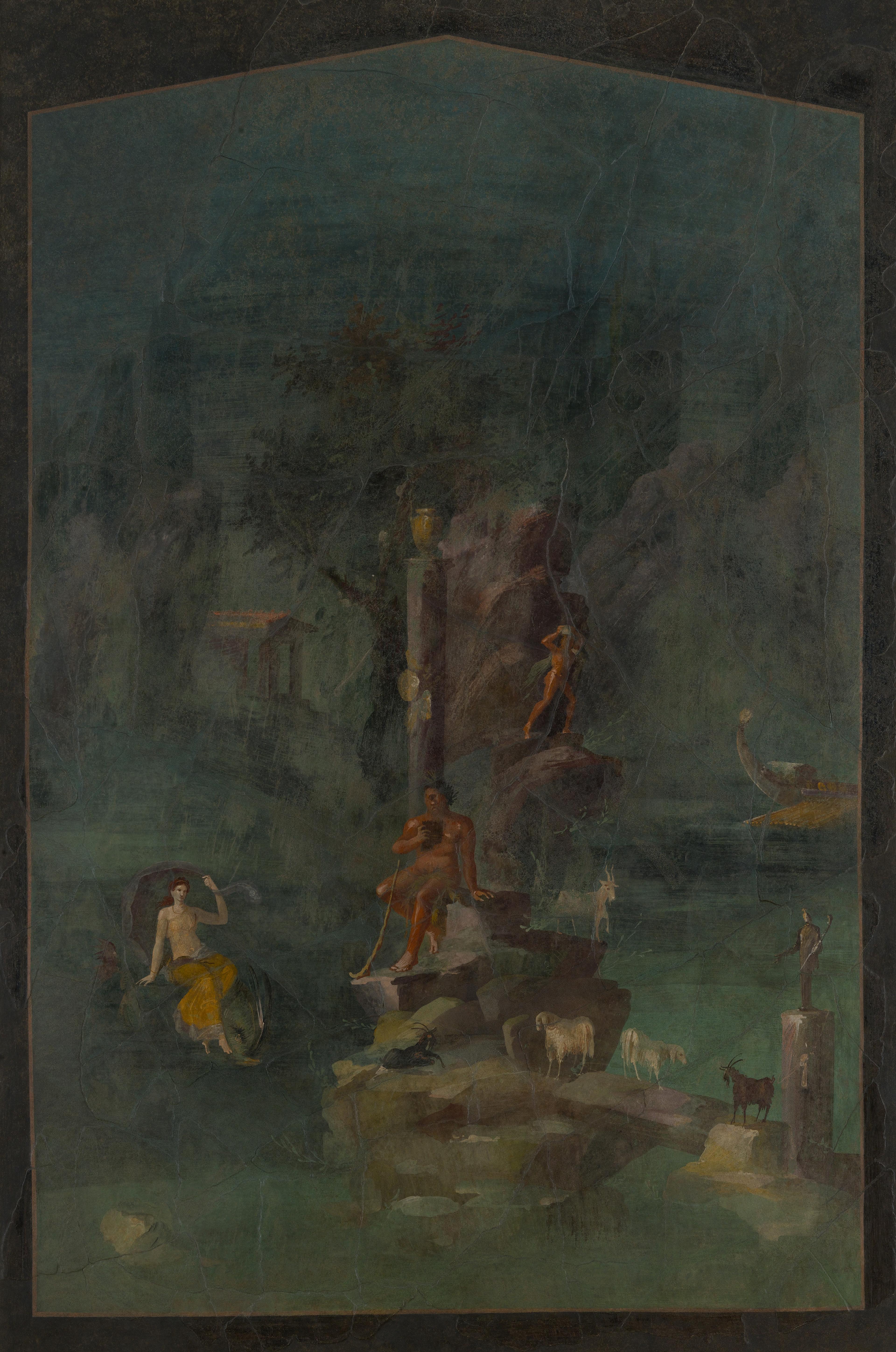
Polyphemus and Galatea in a landscape, from the imperial villa at Boscotrecase, last decade of the 1st century BCE. Early Imperial, Augustan. Roman. Fresco, 73 3/4 x 47 in. (187.33 x 119.38cm.). The Metropolitan Museum of Art, New York, NY, Rogers Fund, 1920 (20.192.17). On view in Gallery 166
On his decade-long voyage home, Odysseus faced many obstacles, one of the most famous being his encounter with the cyclops Polyphemus. While The Odyssey focuses on the conflict between our hero and the one-eyed giant—who traps Odysseus and his men in a cave, consuming several of them—a large first-century BCE fresco depicts Polyphemus in a more compassionate light. Here the cyclops sits as a gentle shepherd in a placid, blue-green landscape speckled with sheep, looking with his single eye toward the sea nymph Galatea, who spurned Polyphemus’s love. The Roman wall painting is a reminder that artists have spent millennia reimagining these characters and their contexts, creating highly original interpretations that play with narrative perspective. In one version of a story, someone might appear as the antagonist; in another, as a tragic or even sympathetic figure.
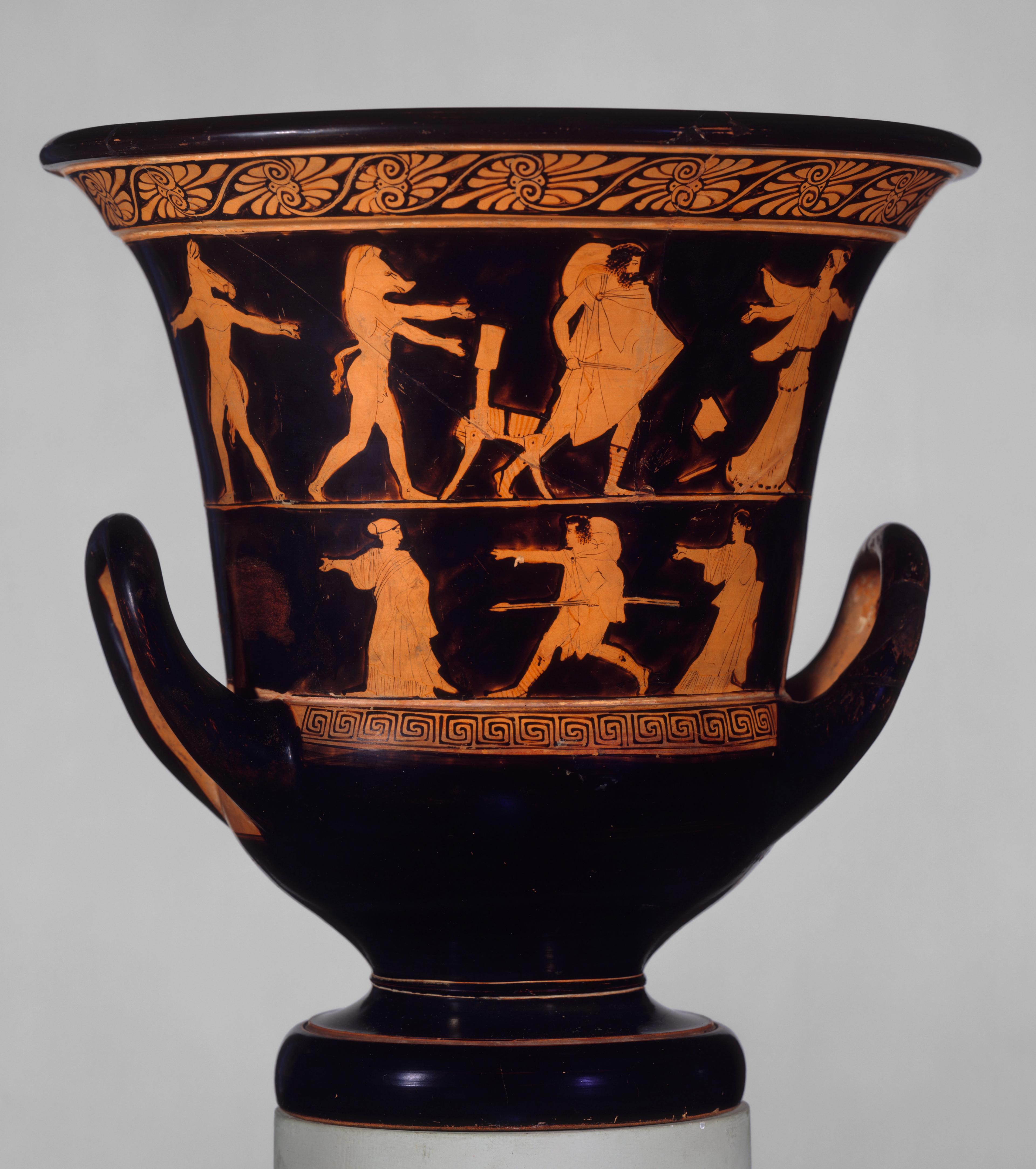
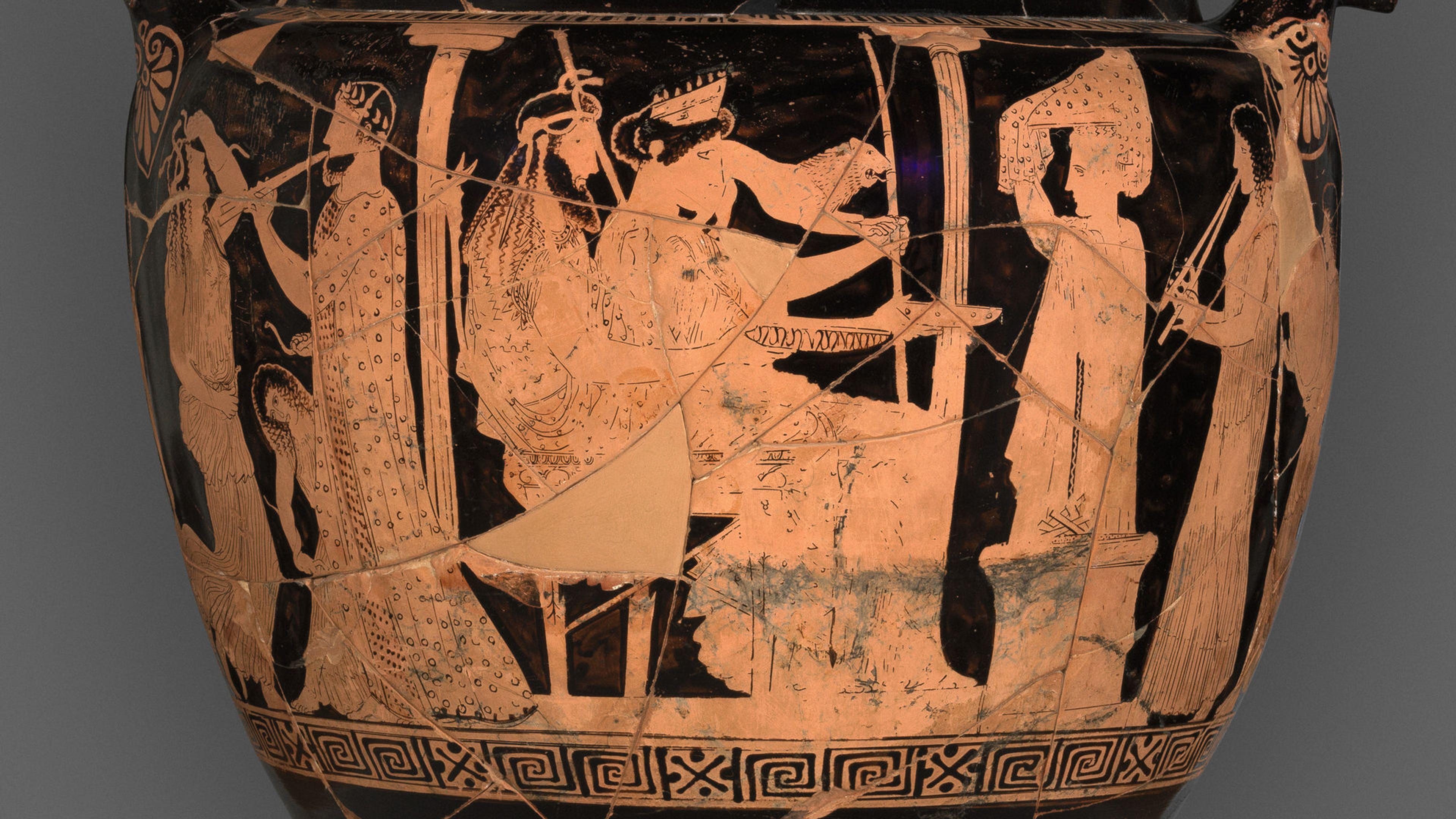
Attributed to the Persephone Painter. Terracotta calyx-krater (bowl for mixing wine and water), ca. 440 BCE. Greek, Attic. Terracotta, red-figure, 14 1/4 x 14 in. (36.2 x 35.5 cm). The Metropolitan Museum of Art, New York, NY, Gift of Amelia E. White, 1941 (41.83)
Another famous trial of Odysseus is found on a terracotta calyx-krater (bowl for mixing wine and water) (ca. 440 BCE), which shows him in pursuit of the enchantress Circe. In the story, Odysseus and his men wind up on Circe’s island, where she turns all but him into swine—a fate Odysseus avoids thanks to the aid of the trickster god Hermes. This terracotta bowl displays Odysseus chasing the enchantress as his men, shown mid-transformation into animals, stand behind him. Circe's magic wand and the skyphos (deep drinking cup) for her potions are beside her, at the right of the composition. Odysseus ultimately frees his men, and they stay on Circe's island for a year while she advises them on the journey forward.
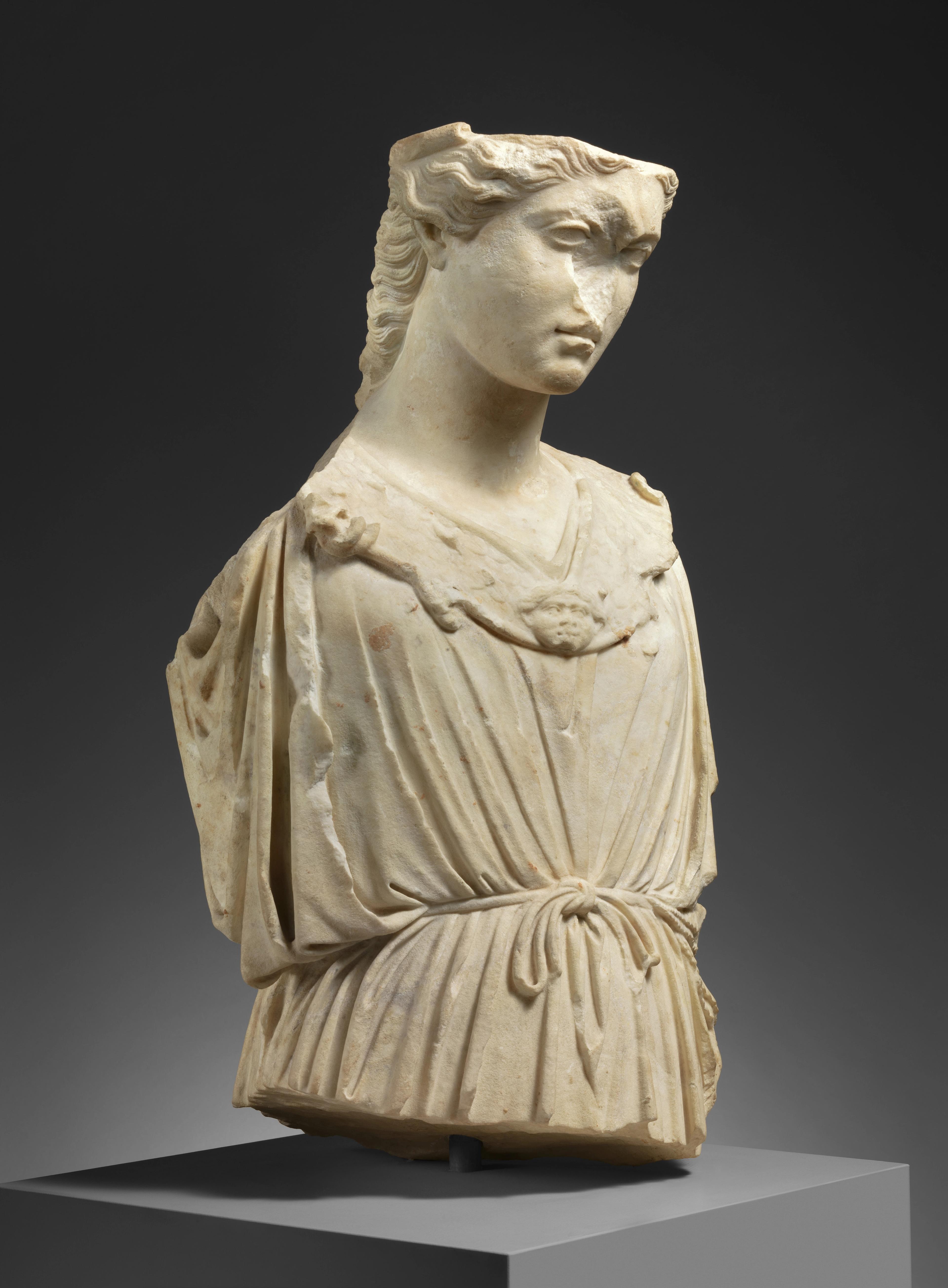
Marble head and torso of Athena, 1st–2nd century CE. Imperial. Roman. Marble, Pentelic, 26 1/2 x 12 3/4 x 11 5/8 in. (67.3 x 32.4 x 29.5 cm). The Metropolitan Museum of Art, New York, NY, Fletcher Fund, 1924 (24.97.15). On view in Gallery 159
The Roman marble head and torso of Athena from the first or second century CE portrays the goddess who was Odysseus’s primary divine guide. The sculpture shows Athena as a beautiful young woman wearing her protective aegis, a goatskin marked with the Gorgon's head at center. This figure represents Athena as the goddess of wisdom and strategy; she favored Odysseus for his intelligence and so guided him throughout the journey, helping him to navigate many perilous episodes that he otherwise would not have survived.
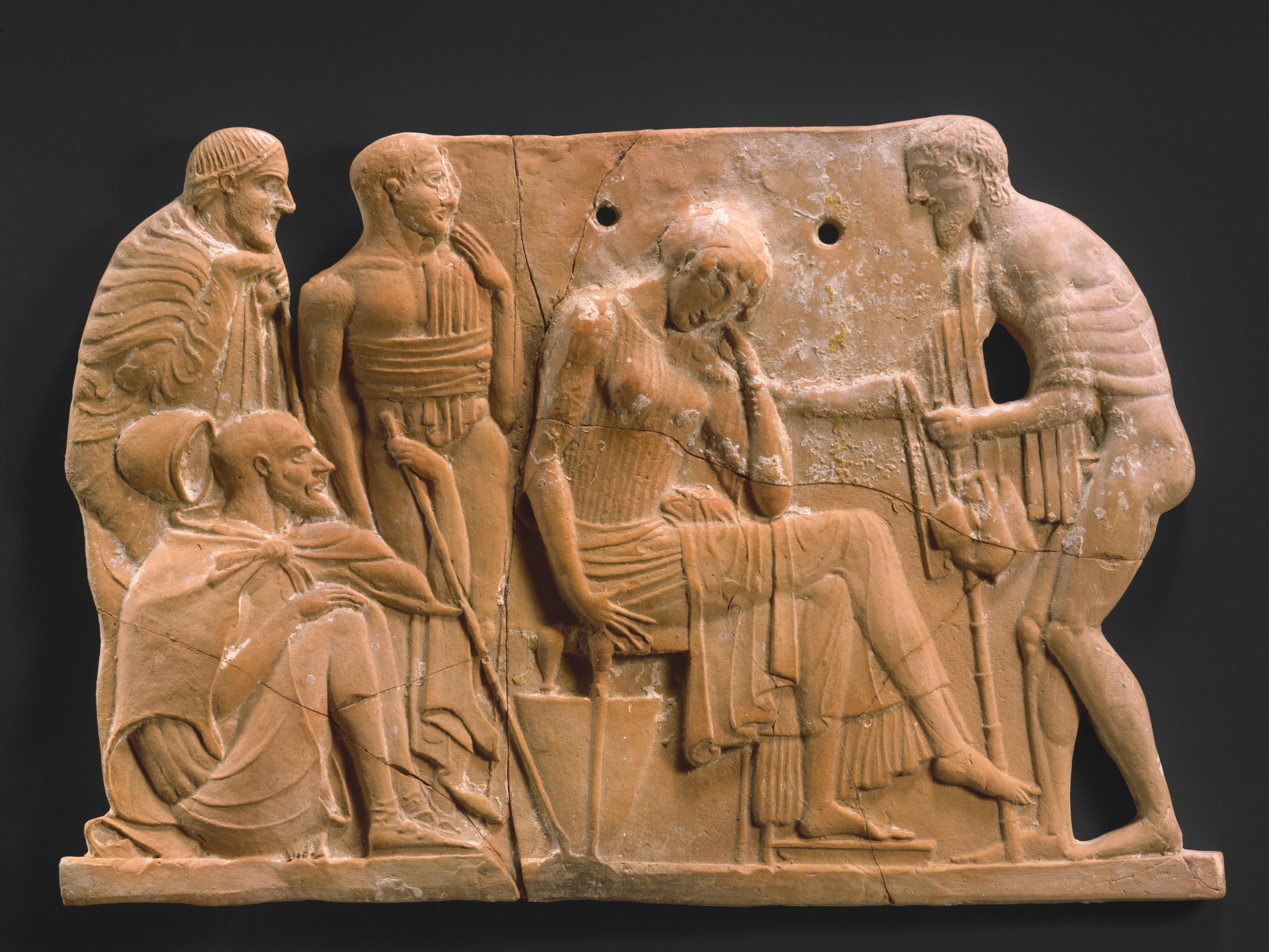
Terracotta plaque, ca. 460–450 BCE. Greek, Melian. Terracotta, 7 3/8 x 11 in. (18.7 x 27.8cm). The Metropolitan Museum of Art, New York, NY, Fletcher Fund, 1930 (30.11.9). On view in Gallery 157
A terracotta plaque (ca. 460–450 BCE) shows one of Athena’s final interventions on behalf of Odysseus. The goddess has disguised our hero as a beggar so he can sneak back into his palace, which is now overrun with suitors who flagrantly deplete his wealth and attempt to woo Penelope, his faithful wife. Here the queen expresses her grief and longing for her husband while members of Odysseus’s household—his father, Laertes; his son, Telemachos; and the swineherd Eumaios—sit behind her. The composition encapsulates the final trial of Odysseus and the members of his family who continued to await the king of Ithaka’s spectacular (and violent) return.
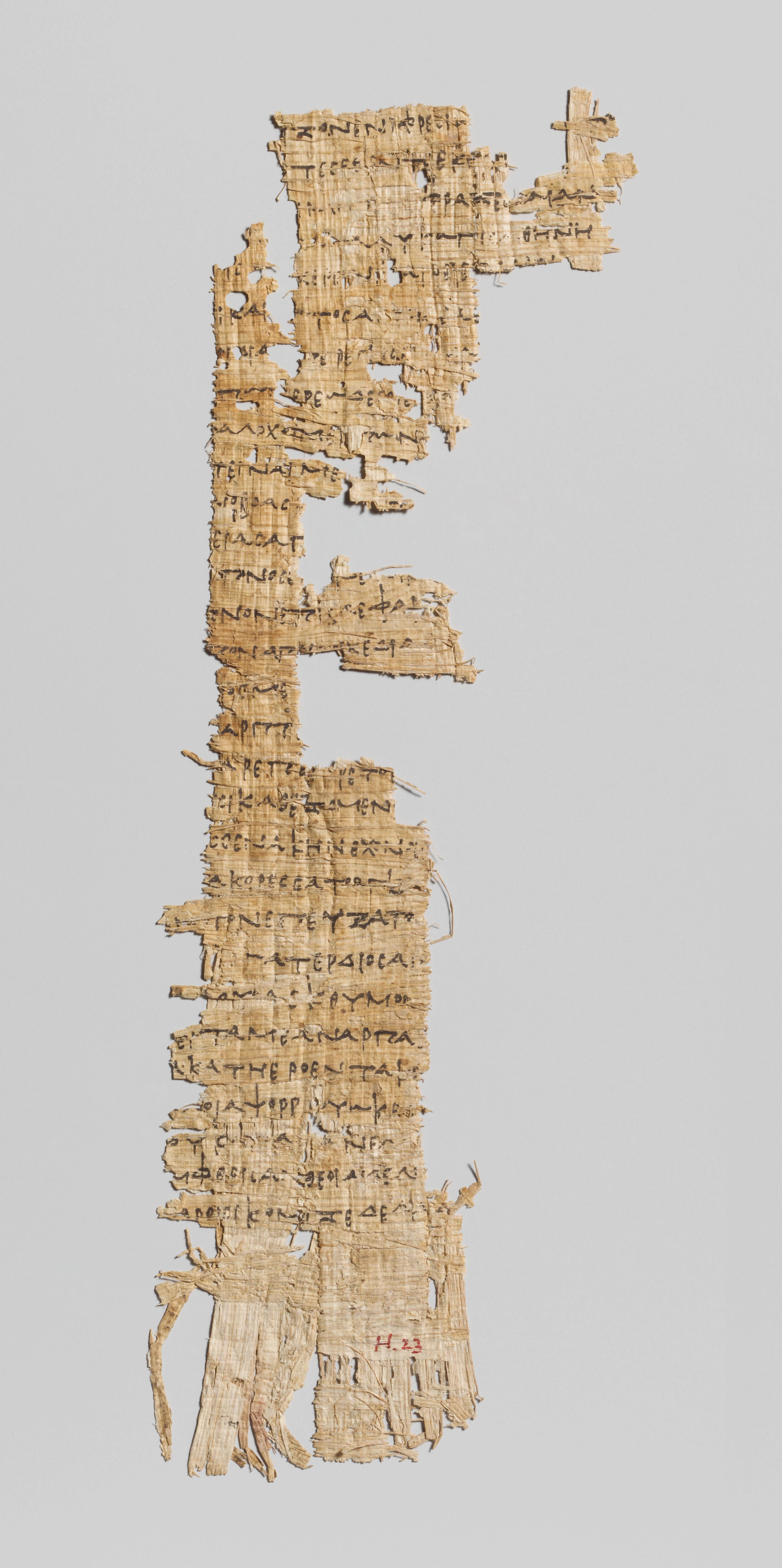
Papyrus fragment with lines from Homer’s Odyssey, ca. 285–250 BCE. Greek, Ptolemaic. Papyrus, 7 1/2 in. (19.1 cm). The Metropolitan Museum of Art, New York, Gift of Egypt Exploration Fund, 1909 (09.182.50). On view in Gallery 162
While the story of The Odyssey has been presented in many ways over centuries, one crucial yet often-overlooked aspect is that it was originally recited by bards in oral performances. As such, there were many different versions of the epic poem, including what’s documented on this papyrus fragment from Book 20, which is the first early Ptolemaic fragment of the text ever discovered. Dating from around 285–250 BCE and made in Egypt, this fragment is beautifully inscribed using a combination of charcoal and water via a stylus on papyrus—one of the most popular materials for writing in antiquity—and contains three lines that do not exist in today’s standard text. Like the Greek warrior, this object reminds us that the telling of The Odyssey itself has taken its own distinct journey through history.
Want to continue exploring the world of Homer’s Odyssey? There are many other related works at The Met across the collection, from helmets used in combat to Dora Wheeler’s “needlewoven tapestry” of Penelope.