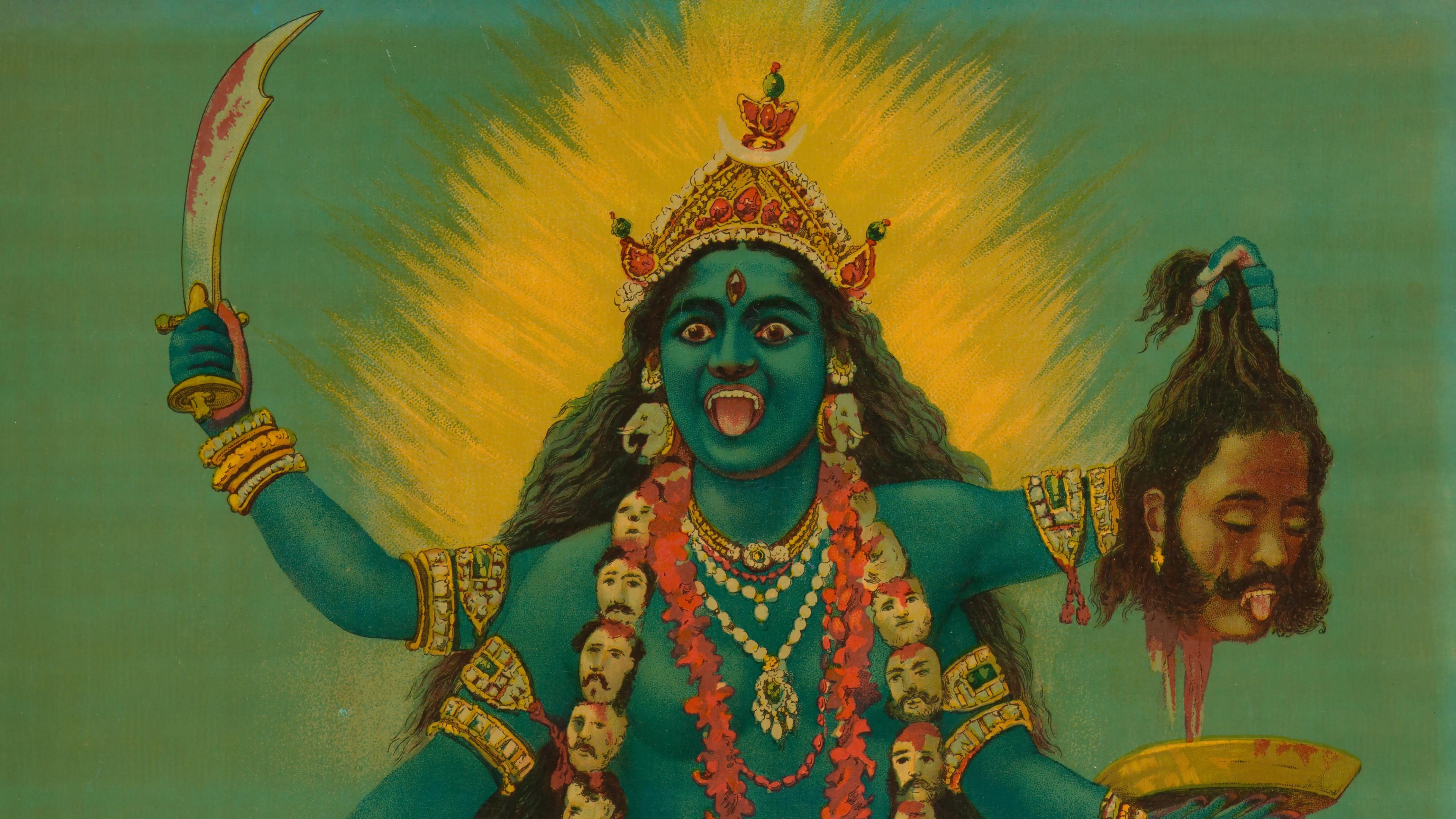
I first noticed her gaze before anything else. In a chromolithograph of the goddess Kali on view in the exhibition Household Gods: Hindu Devotional Prints, 1860–1930, her eyes meet the viewer unflinching, unwavering, and impossibly steady. Around her, the signs of violence are visible; yet it is the gaze that holds, confronting the viewer and leaving little room for retreat. It does not threaten so much as insist on being seen.
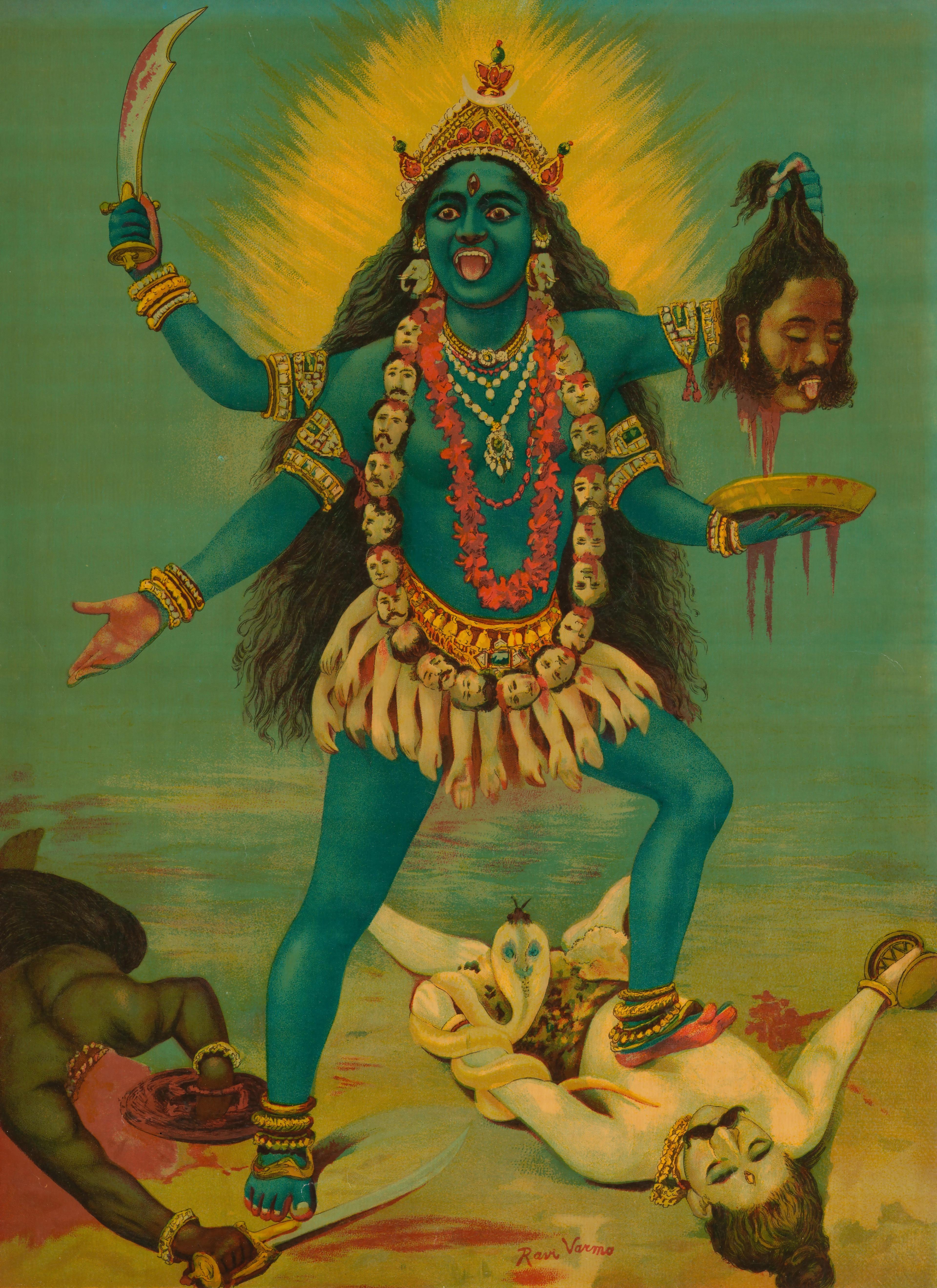
Ravi Varma Press. Kali, the wrathful protector, ca. 1910–20. Chromolithograph with varnish on paper, 20 × 14 1/4 in. (50.8 × 36.2 cm). The Metropolitan Museum of Art, New York, Purchase, Gift of Mrs. William J. Calhoun, by exchange, 2013 (2013.17)
This chromolithograph, Kali, the Wrathful Protector (ca. 1910–20), was produced by the Ravi Varma Press near Mumbai (Bombay), Maharashtra. The blue-skinned Kali stands upon Shiva’s prone body, wearing a skirt of severed arms and adorned with garlands of human heads and hibiscus. In one hand she holds a cleaver and in another the severed head of a demon, whose body lies motionless at her feet. She collects his blood in a bowl for drinking. The colors are intense—deep blues, saturated reds, bright yellows, stark blacks—organized into bold fields that heighten her ferociousness.
Rendered in vivid color through lithographic reproduction, this image of Kali amplifies everything that unsettles a modern viewer: blood, violence, transgression. On seeing the print in the early twentieth century, members of the Bible Churchmen’s Missionary Society in India are recorded to have exclaimed, “What an awful picture!” Such reactions were not merely aesthetic judgements, but a reflection of colonial discourse that cast Hindu idol worship as “degenerate” or “primitive.” Kali’s lolling tongue and her garland of severed heads were read as evidence of barbarism, rather than as religious symbolism. These responses persisted well into popular culture, exemplified by Kali’s portrayal in the 1984 film Indiana Jones and the Temple of Doom as a macabre demoness presiding over human sacrifice. These reactions, however, reveal a historically specific colonial apprehension, not a universal horror. For devotees accustomed to Kali’s visual and mythological grammar, her ferocity did not signal excess; it signaled protection—the assurance that destructive force would be turned outward, against threats both cosmic and everyday.
The goddess Kali has a long, complex, multilayered history. She is most commonly understood as the most wrathful emanation of the Great Goddess (Devī). As an embodiment of the cosmic energy of the universe (śakti), and as a goddess associated with time (kāla) and transformation, Kali simultaneously represents destruction and renewal. Her terrifying appearance does not contradict her nurturing role; rather, it enables it. While she is worshipped across South Asia, Kali has historically received devotion in the subcontinent’s peripheral regions. Although her myths, rituals, and iconography vary widely, she is commonly perceived as a deity who encompasses and transcends life’s opposites. She is at once a bloodthirsty slayer of demons, both the cause and cure of disease, a deity associated with ritual possession, and an all-loving, compassionate mother. Despite, or perhaps because of, these contradictions, devotees continue to address her affectionately as “Ma,” or “Mother.”
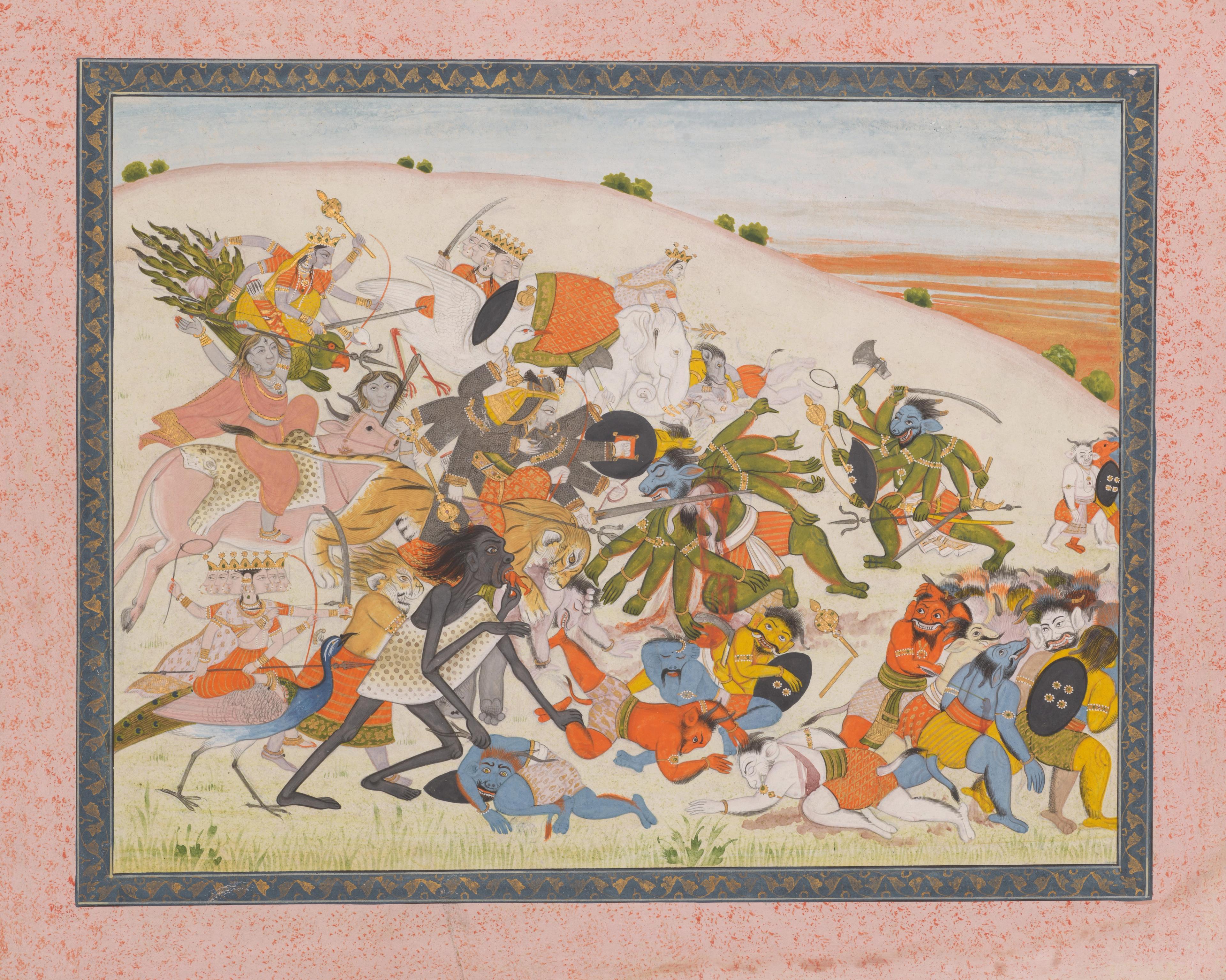
Devi vanquishes the demon Nisumbha and his armies; folio from a Devi Mahatmya series, 18th century. India, Guler, Himachal Pradesh. Opaque pigments with gold on paper, with gilt-decorated blue margin and pink speckled border, 9 7/8 × 12 in. (25 × 30.5 cm). The Metropolitan Museum of Art, New York, Purchase, Bequest of Mary Stillman Harkness, by Exchange and The Vincent Astor Foundation Gift, 2024 (2024.331)
Among the earliest textual references to Kali is the sixth-century devotional text Devi Mahatmya (“Glory of the Goddess”), where she emerges as the personified wrath or the embodied fury of the goddess Durga. Here, she is depicted with black skin, wears a garland of human heads and tiger skin, and wields a skull-topped staff. She is skeletal, with sunken eyes, gaping mouth, and lolling tongue. Roaring loudly and leaping into battle, she tears demons apart with her bare hands, crushing them in her jaws. In this text, Kali joins the goddess Durga and the Seven Mothers (mātṛkā) on the battlefield to annihilate demons, earning the epithet of Chamunda. Between the eighth and sixteenth centuries, as Tantric ritual and philosophy developed across South Asia, Kali was elevated to the status of an ontological absolute and identified with the dynamic ground of the universe itself. From the seventeenth century onward—especially in Bengal, as part of a Tantric revival—she was reimagined as a beautiful yet terrifying female, standing on a supine Shiva, and the loving Mother of all beings.
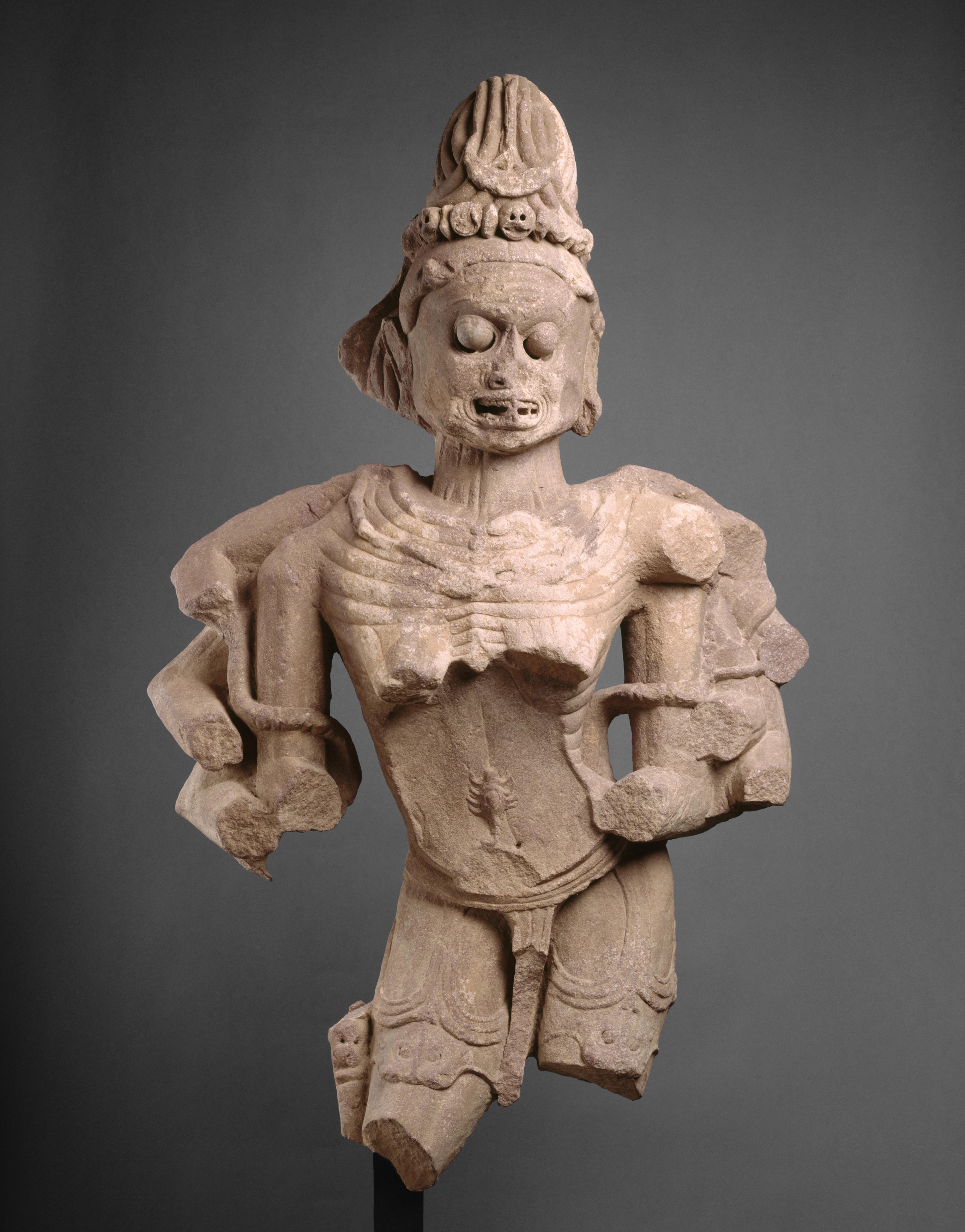
Chamunda, the Horrific Destroyer of Evil, 10th–11th century. India. Sandstone, 44 1/2 in. (113 cm). The Metropolitan Museum of Art, New York, Purchase, Anonymous Gift and Rogers Fund, 1989 (1989.121)
In the early twentieth century, Kali became a symbol of the nationalist movement for India’s independence from British rule, and in the mid-to-late twentieth century, both Indian and Western feminist writers appropriated her as a powerful symbol of female energy and resistance to patriarchal oppression and restrictive social norms. For the twenty-first-century reader, the name Kali may ring a bell from the Netflix hit series Stranger Things, where it is adopted by a character to embody her fierce and unbound nature. These diverse interpretations are unified by a common thread: through her very multivalence, Kali embodies transformative power (śakti).
While Kali was encountered as stone sculpture in temples and as illustration in manuscripts, the introduction of lithography in the nineteenth century for images of gods and goddesses brought about a visual revolution in South Asia. The medium itself plays a quiet but decisive role in shaping this encounter. Lithography allowed artists to draw directly onto stone, preserving the immediacy of the hand while enabling thousands of impressions to be pulled from a single image. Through chromolithography, successive layers of color produced the saturated surfaces that give these prints their intensity. Inexpensive, portable, and easily replaced, lithographs carried divine images far beyond workshops or temples. These prints were meant for individuals and their homes, widely available at picture depots and markets; installed in domestic shrines; and even encountered in the form of advertisements, postcards, and magazines. Kali’s form, once encountered primarily in monumental sculpture or ritual space, now entered the homes of the masses.
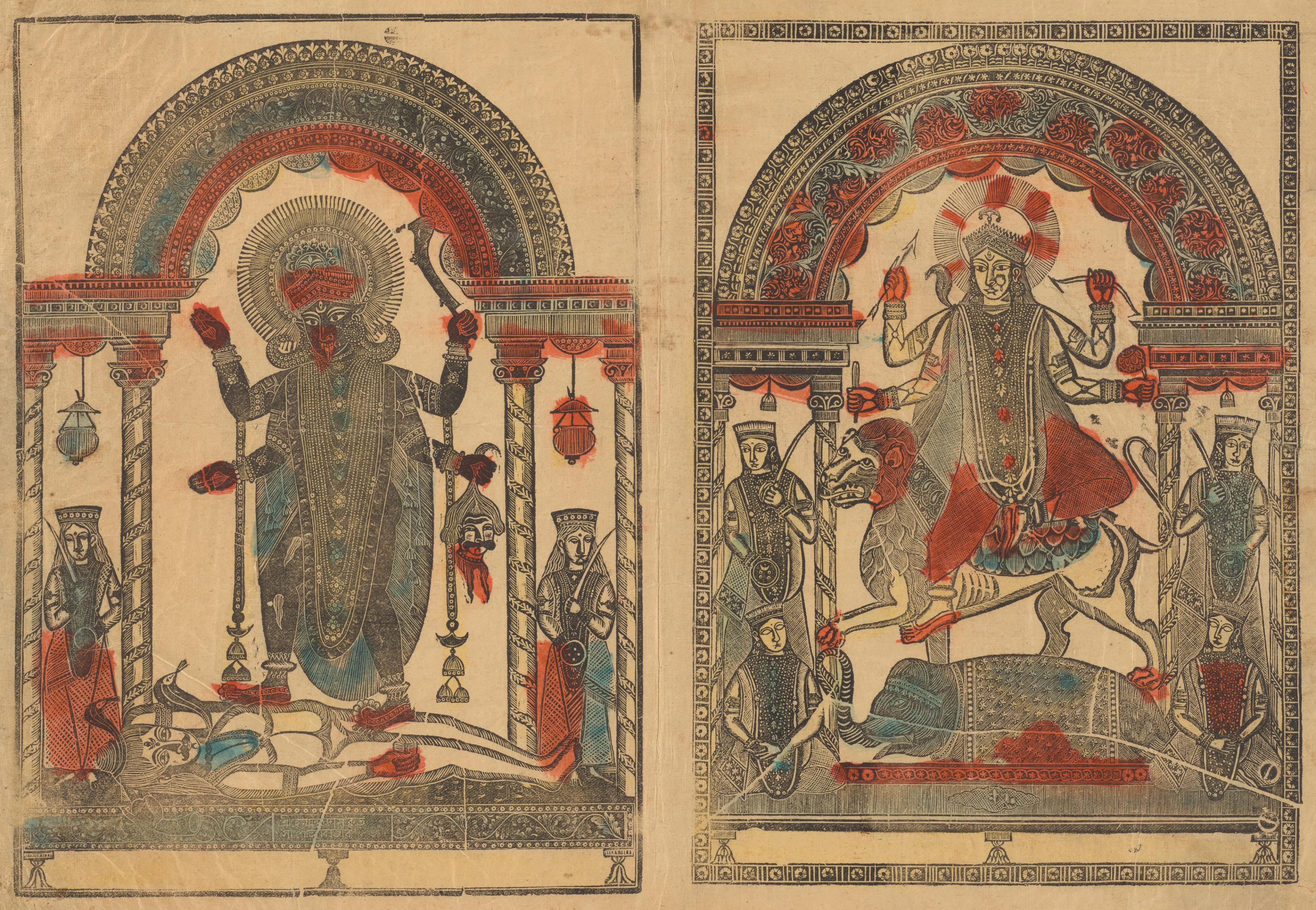
Sri Hemchandra Das (Indian). The goddesses Kali and Jagaddhatri, ca. 1850–70. Relief prints from metal plates, printed in black and hand-colored with red and turquoise watercolor, 17 3/4 × 22 in. (45.1 × 55.9 cm). The Metropolitan Museum of Art, New York, Gift of Mark Baron and Elise Boisanté, 2021 (2021.325.1)
Such images of Kali were particularly popular in West Bengal, where she has long been worshipped as a central deity. One early relief print, known as a Battala print, depicts Kali framed in a cusped arch, an example of a pavilion (pandal) constructed as part of community celebrations for the festival Kali Puja. Since the seventeenth century, Kali Puja (or Shyama Puja), has been a major Hindu festival dedicated to the goddess, celebrated on the new moon night (Amavasya) of the month of Kartik, often coinciding with Diwali. Primarily observed in West Bengal, Odisha, Assam, and Bangladesh, the festival symbolizes the destruction of evil and ego to foster inner strength and spiritual liberation. Even today, Bengalis across the world celebrate the festival with much joy.
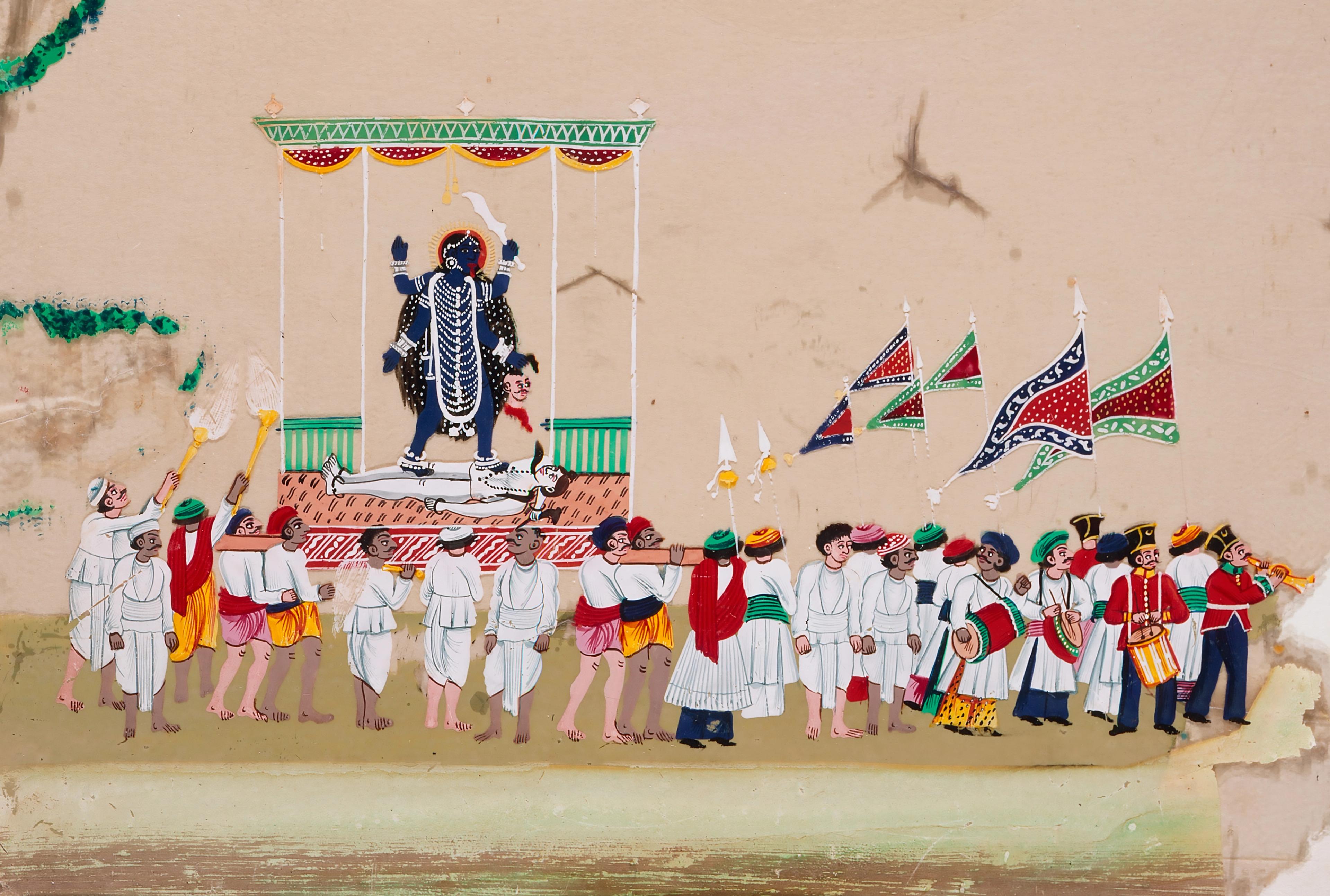
Hindu Religious Procession with Kali, ca. 1800–25. India, West Bengal, Murshidabad. Opaque watercolor on mica, 6 x 7 3/4 in. (15.24 x 19.69 cm). Los Angeles County Museum of Art, Gift of Miss Gertrude McCheyne (37.28.17). Courtesy of LACMA www.lacma.org
With the arrival of chromolithography in the 1860s, printing workshops in Calcutta (now Kolkata), West Bengal, were quick to produce images of Kali. Kali worship is prominent in Kolkata, as it is home to the Kalighat Temple, dedicated to Kali, who is also considered an emanation of Sati, the wife of Shiva and one of the Great Goddess (Devī)’s incarnations. In Hindu mythology, to stop Shiva from wandering the cosmos carrying Sati’s corpse and performing his destructive cosmic dance, Vishnu cut pieces of her body, which scattered across fifty-one sites in South Asia, creating potent sites for the worship of the Goddess in her myriad forms. The Kalighat Temple is believed to mark the spot where her right toes fell to earth, and is one of the fifty-one holiest sites in the Śākta tradition (śakti pīṭhas). On display in Household Gods is an image of Kali made by G. C. Dass in the early 1880s, whose form closely mirrors the iconic representation worshipped at the Kalighat Temple. Kali appears almost doll-like, with an enlarged head, wide-set eyes, and a protruding tongue. She brandishes a sacrificial weapon marked with an all-seeing eye and holds a severed male head. A print like this allowed a devout Kali worshipper to bring an image of the sacred idol of the Kalighat Temple into their homes.
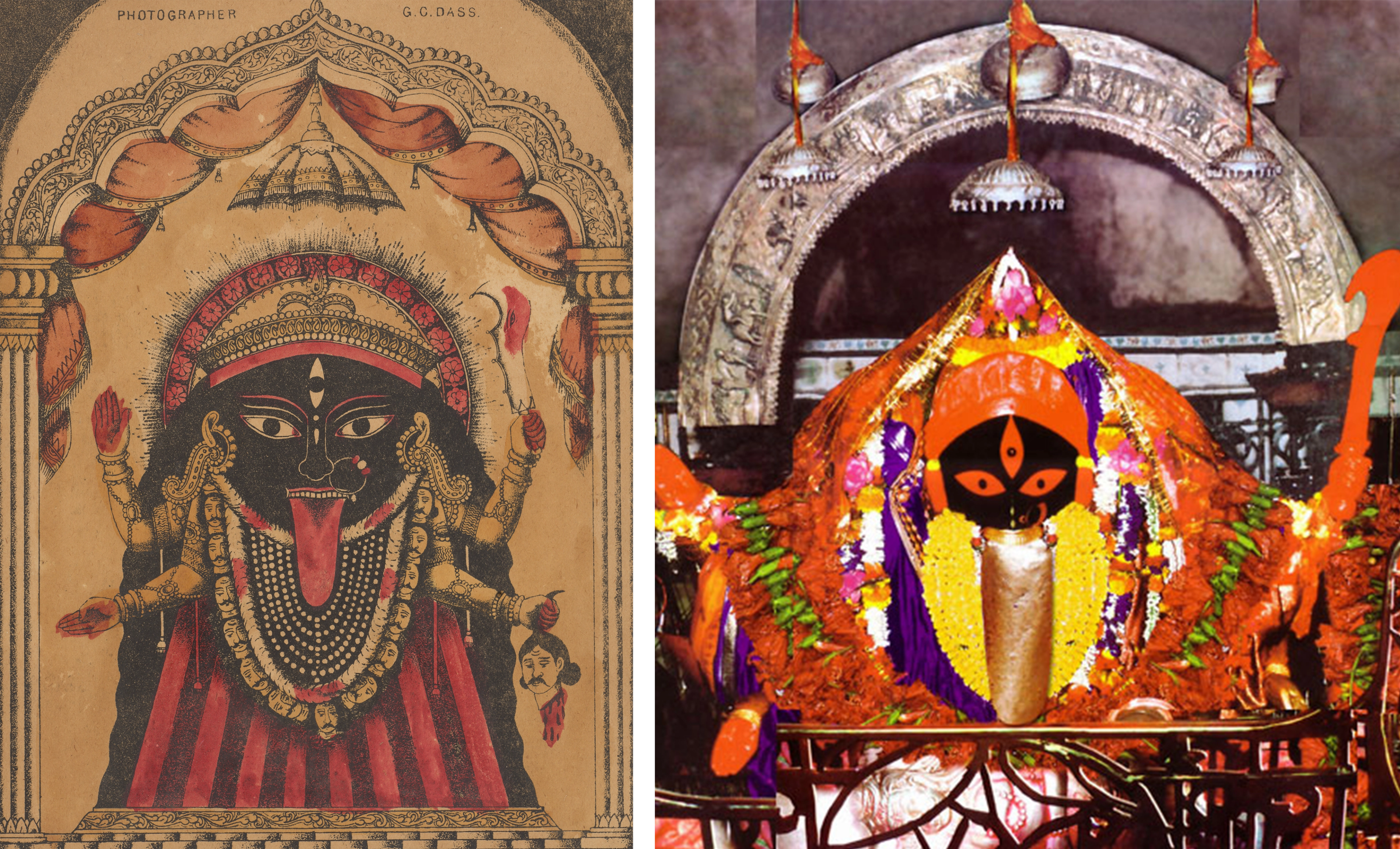
Left: G. C. Dass. Kali, the wrathful protector (Shri Shri Kali) (recto), ca. 1880–85. Lithograph with watercolor on paper, 8 3/4 × 6 5/8 in. (22.2 × 16.8 cm). The Metropolitan Museum of Art, New York, Gift of Mark Baron and Elise Boisanté, 2021 (2021.325.6a). Right: Representation of Kali at Kolkata’s Kalighat Temple. Courtesy of William Clark via Kali Bhakti
Interestingly, on the verso of the same print is another image of Kali (circa 1875–85), which indicates that the lithograph was printed on a previously used sheet. While only the upper half of this second image survives, it likely resembled the print of Kali designed and published by the Calcutta Art Studio in 1879.
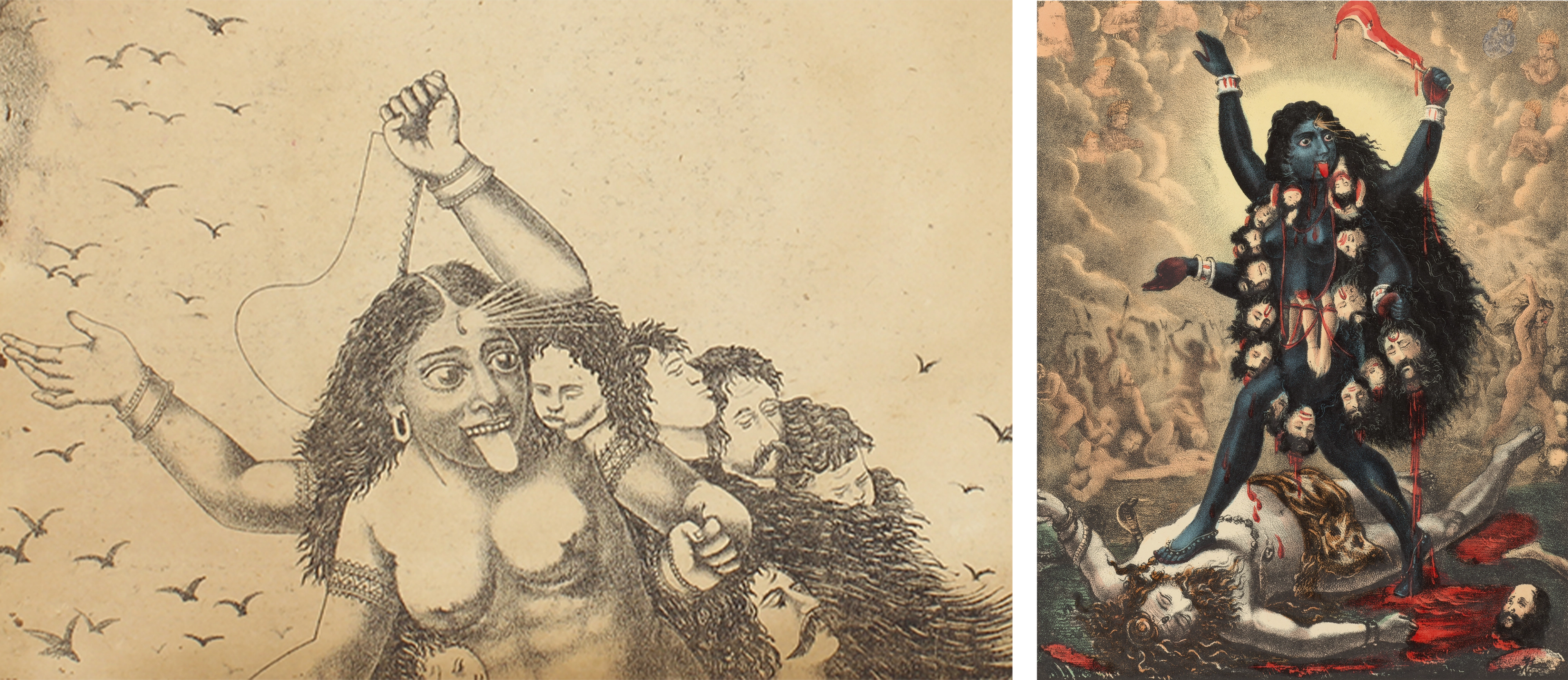
Left: Kali (verso), ca. 1875–85. Lithograph, printed in black, 8 3/4 × 6 5/8 in. (22.2 × 16.8 cm). The Metropolitan Museum of Art, New York, Gift of Mark Baron and Elise Boisanté, 2021 (2021.325.6b). Right: Calcutta Art Studio (India, Kolkata, West Bengal). Kali, the wrathful protector, 1879. Chromolithograph with watercolor on paper, 15 3/4 × 12 1/2 in. (40 × 31.8 cm). The Metropolitan Museum of Art, New York, Purchase, Robert and Bobbie Falk Philanthropic Fund Gift, 2021 (2021.200)
The iconography represented in these prints drew upon the various myths associated with her. The characteristic features that became associated with the image of Kali in lithographs are her dark blue or black complexion, a garland of severed heads and a belt of detached arms, wild unbound hair, and an extended red tongue. In one of her four hands, she holds a bloody cleaver, and in another she holds a severed head by its hair while blood drips from its neck. She stands atop a prostrate Shiva, in a battlefield setting. The myth behind these popular images recounts that Kali, intoxicated by the blood of those she had slain, began an uncontrollable dance across the battlefield. To end her destructive frenzy, Shiva lay motionless among the dead. When Kali stepped upon his body, she recognized him as her husband and halted her dance. Thus, it is in the form of a corpse that Shiva pacifies Kali and draws forth her grace. Kali’s violence is not a deviation; it is a promise that danger, when encountered, will be met with force equal to its threat. This form of Kali also appears alongside other gods and goddesses, including in representations of the ten Hindu Tantric goddesses (Mahāvidyās) and as part of composite sets of divine imagery.
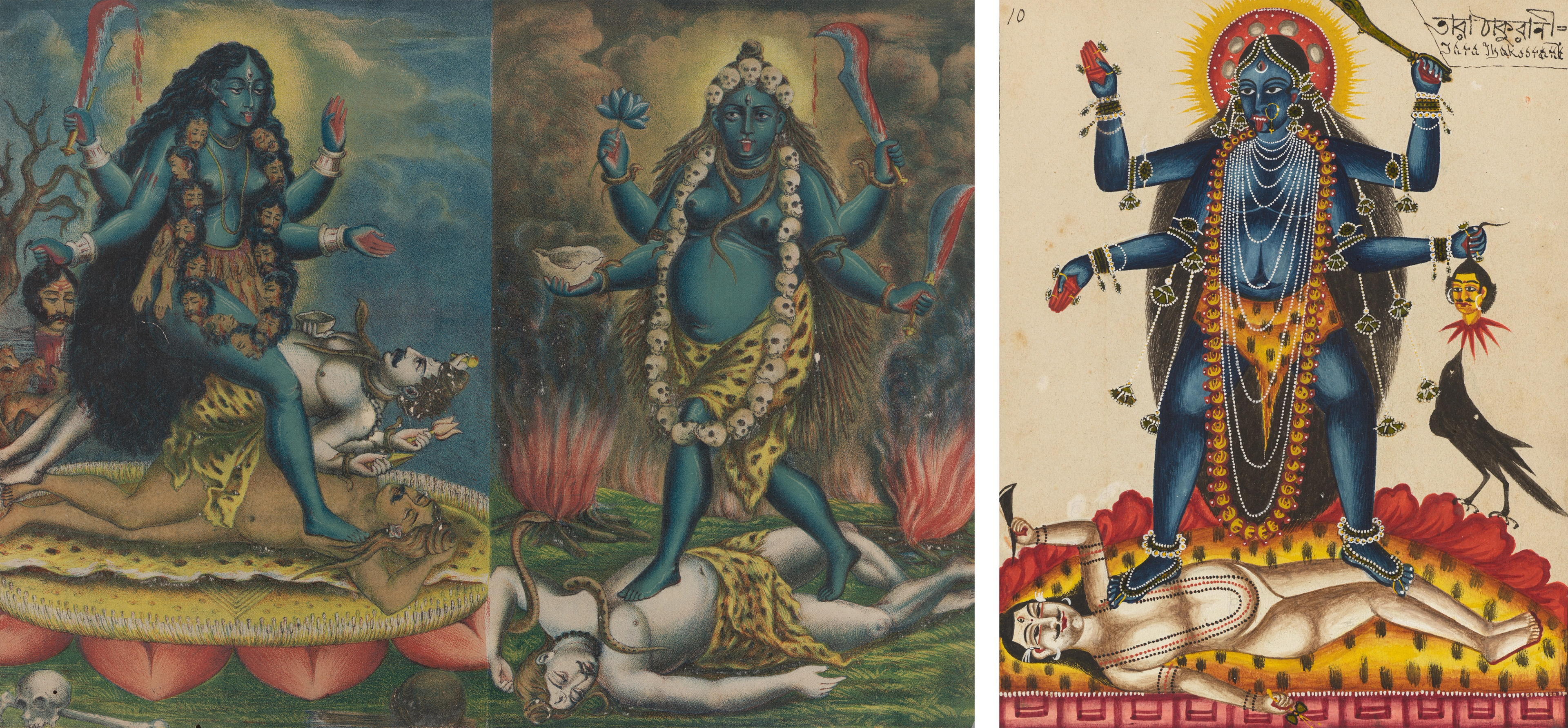
Left: Calcutta Art Studio (India, Kolkata, West Bengal). Diptych of Kali / Tara, wrathful protectors, 1885–90. Chromolithographic on paper, 12 × 16 in. (30.5 × 40.6 cm). The Metropolitan Museum of Art, New York, Gift of Mark Baron and Elise Boisanté, 2018 (2018.292). Right: Tara, a form of Kali (Tara Thakoorani), early 20th century. India, Kolkata, West Bengal. Gouache and ink on paper, 8 1/2 × 7 1/8 in. (21.5 × 18 cm). The Metropolitan Museum of Art, New York, Purchase, Bequest of Mary Stillman Harkness, by Exchange, 2024 (2024.470)
The mass production of these images meant that they found their way into the smallest of household shrines. In domestic contexts, such images framed Kali not only as a destroyer of demons but as a fierce guardian of the household. Reproduced through lithography, her image could be touched, addressed, adorned, and replaced—its power reinforced through use rather than rarity.
The Ravi Varma Press print represents a culmination of this visual tradition. Though produced across the country from Calcutta, its drama is heightened through color in ways that echo earlier Bengali lithographs. This image does not seek to shock; it rewards recognition. Its subject assumes a viewer fluent in myth, ritual, and visual code—an audience for whom Kali’s dual nature as destroyer and protector was already understood. Her violence is measured, purposeful, and assured. Here, wrath is neither suppressed nor sensationalized. It is meaningful. The image endures in homes even today, be it in household shrines as icons of worship or on bookshelves as striking cover art.
This essay is published in conjunction with the exhibition Household Gods: Hindu Devotional Prints, 1860–1930, on view through June 27, 2027.