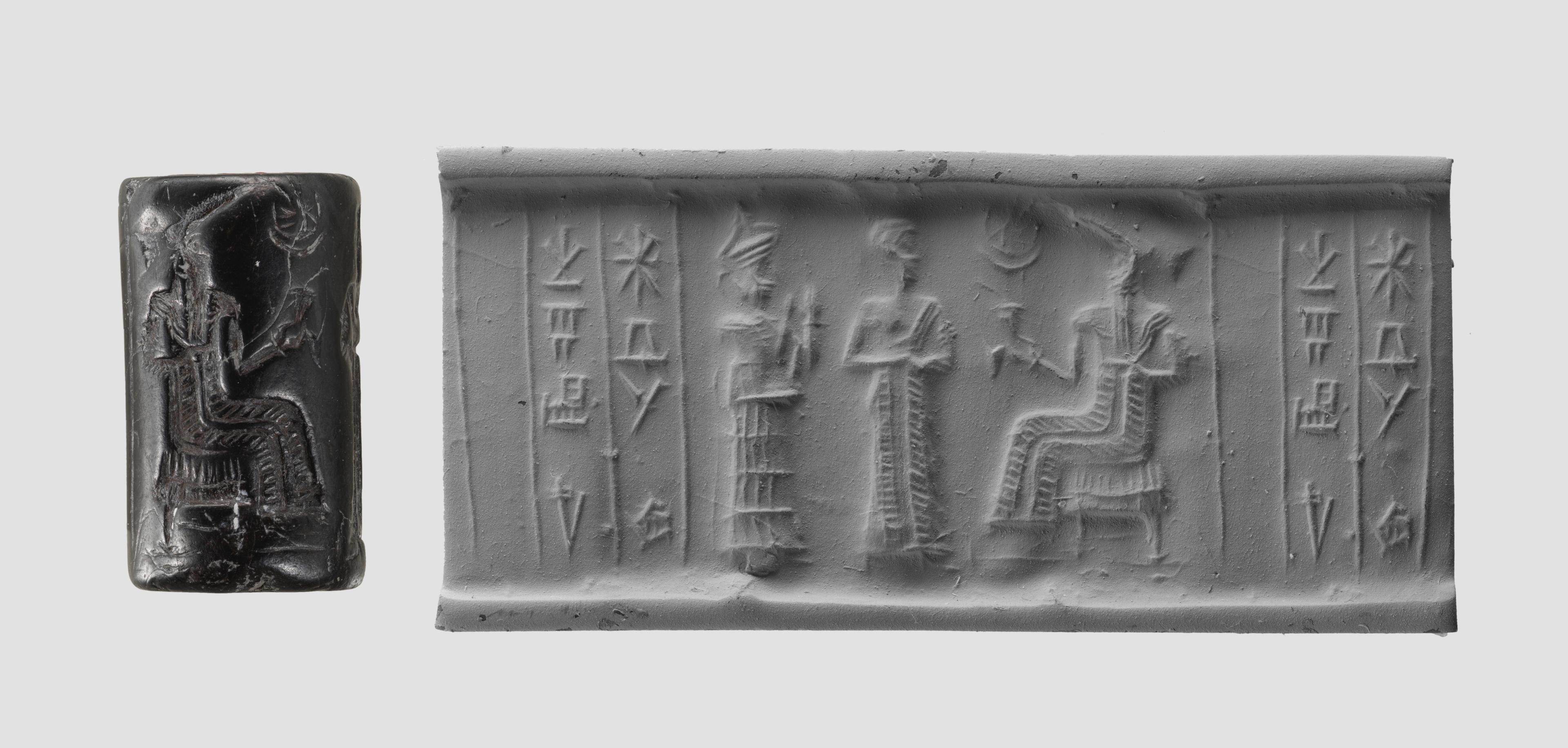
Cylinder seal and modern impression: presentation scene, ca. 2000–1750 BCE. Iran, Luristan, Surkh Dum, Isin-Larsa period. Hematite, 1 × 1/2 × 1/2 in. (2.3 × 1.3 × 1.3 cm). The Metropolitan Museum of Art, New York, Rogers Fund, 1943 (43.102.35)
My name is Dustin Yellin. I make sculptures.
I used to work in a rock shop and I still go hunting for rocks. I go onto the beach and I start touching the rocks for hours. And the people that I’m with are always like, “What’s wrong with you?” But rocks are the most beautiful artifacts to me in the world, and they haven’t even been touched. So I came to cylinder seals because they’re taking something so raw and carving a miniature picture into the rock.
Some are hematite and some are quartz, and the rocks are probably millions of years old and then the carving is probably 3000-years-old. I like this idea that you don’t look at a picture, but you read a picture. Until you actually got out a piece of clay and rolled them out, you couldn’t really see what you were looking at. And that moment, it’s mind-blowing. It’s almost like these messages have been hidden for thousands of years. Some of them are really straightforward. This is a hunting scene. This is a prayer scene. This is conflict. You see battles of the gods.
I don’t think time exists in a line. I think you have access to the past and the future and the present simultaneously. I don’t think of the fact that we roll one out now. It was the picture they were looking at thousands of years ago. Think of the state of their consciousness: they were trying to understand their relationship to the cosmos and their place in nature.
When I make work, I think of everything as an artifact. I think of humans being gone. When I see these cylinder seals, I almost think about the future. If I could live for 3000 years, that’s like my dream. You think about how things have changed in the last hundred years and how they’re going to change in the next hundred years. It’s bananas.
These cylinder seals are sort of the bridges. We look at the past because it’s the future. One of the centers of the history of civilization was born where these cylinder seals are from. The invention of the wheel, the invention of agriculture, the invention of writing were rising to the surface during this period. Cuneiform is a huge evolutionary change in our species. We were getting inner thought patterns out, literally into patterns. Cylinder seals are still sophisticated when you compare them to technology and art from the last hundred years. What was being channeled through these?
The fact that you could have a hidden message in code in a rock, to me, is so innovative. These are almost early computers. This is like the first analog-digital moment. But this cylinder seal is more technologically fluid to last, to pass on its message, it’s story, through history.