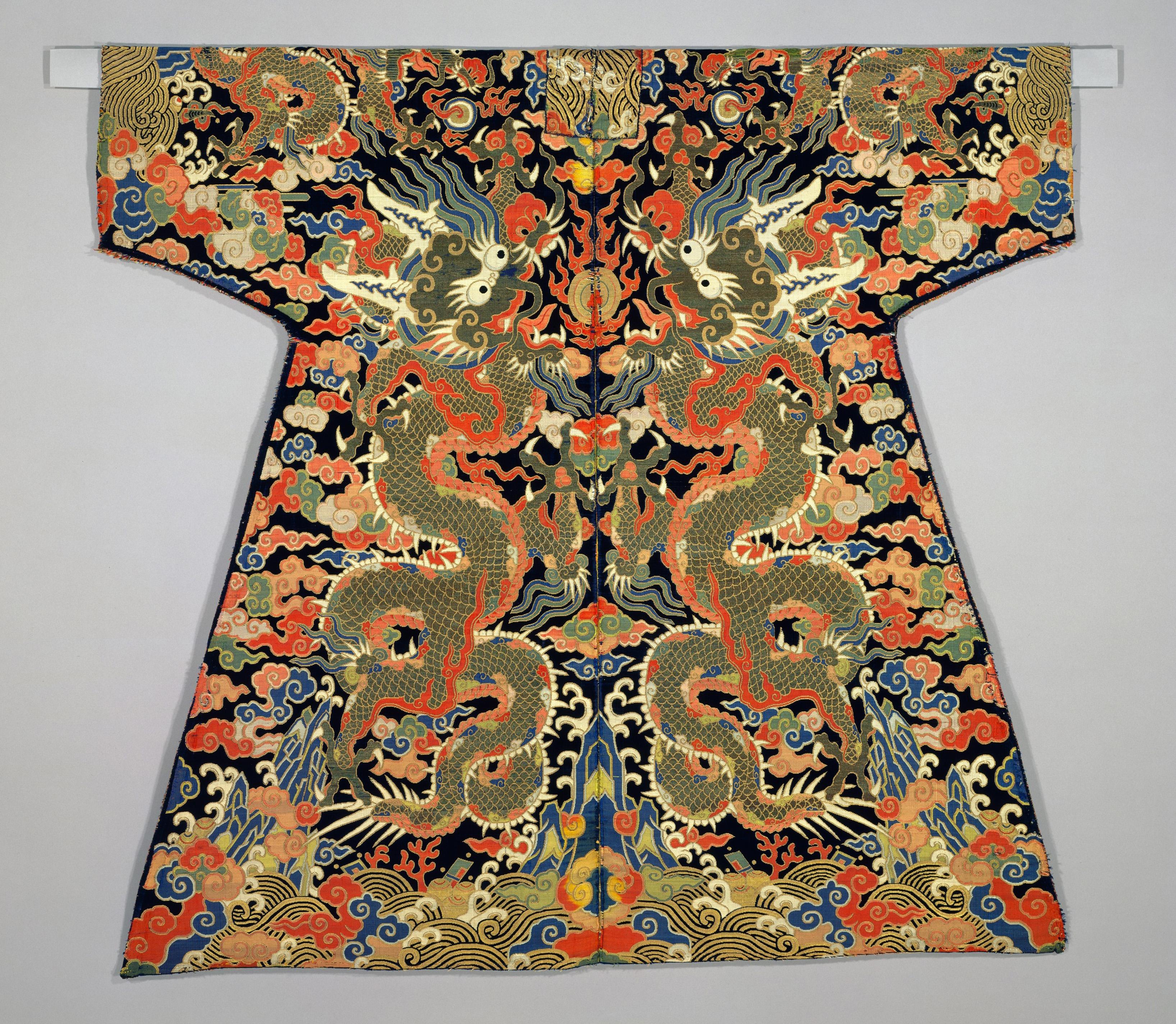
Velvet Textile for a Dragon Robe, 17th century. China, Qing dynasty (1644–1911). Silk velvet with weft patterning in silk, metallic thread, and feather thread, 55 in. × 8 ft. 6 in. (139.7 × 259.1 cm). The Metropolitan Museum of Art, New York, Purchase, Friends of Asian Art Gifts, 1987 (1987.147)
My name is Lee Mingwei. I am a conceptual artist who does interactive work.
I was a weaver for many years before becoming a conceptual artist. Clothing—especially these magnificent ones—are a signifier, almost like a second skin. It's almost like a chameleon. You can change your skin and put on a different robe and you're a different person.
Two out of these three robes are for imperial purpose. The middle one here is for a performance purpose. The symbolisms are very strict: you can not wear anything that is above or even below your rank. The bluish, yellow-golden one has a lot of bats flying around and for Westerners you think, "why bats?" It's a linguistic reason. "Bats" in Mandarin has exactly the same pronunciation as the "fortune" / "good fortune" so that's why they use bats. And they are circling around this character "shòu" which means "longevity"—suggestion of you're going to live forever. This other one is for the emperor, the Son of Heaven, so you have the dragon which is even higher. It's for the emperor's use only. And you have these highly stylized waves and clouds and the fire. So all these are natural elements that have mystical element to it, just like the person wearing it.
I know that there were court weavers; the ones that were creating work for the empress probably do not do things for the lesser concubines. There is a hierarchy. I was looking at these and thinking what I'm wearing right now is really the direct descendant of these. It's quite impressive that throughout 300–400 years nothing really changed that much. They are designed in such a way that they make you look bigger and most of the people at that time were quite small, and you start thinking these are designed not to show your body as to hide your body and to make you look magnificent when you walk into the hall.
Not many people wear this anymore, however when I'm in the West this is what I wear because a different part of me comes out. And I like that my body moves in a very different way because the fabric catches the air. Therefore, I have to walk in a kind of stately way. And I like that glance of admiration from someone from a different culture looking at my own heritage. It's creating a character for the audience. Your message is very powerful: "You're my subject."