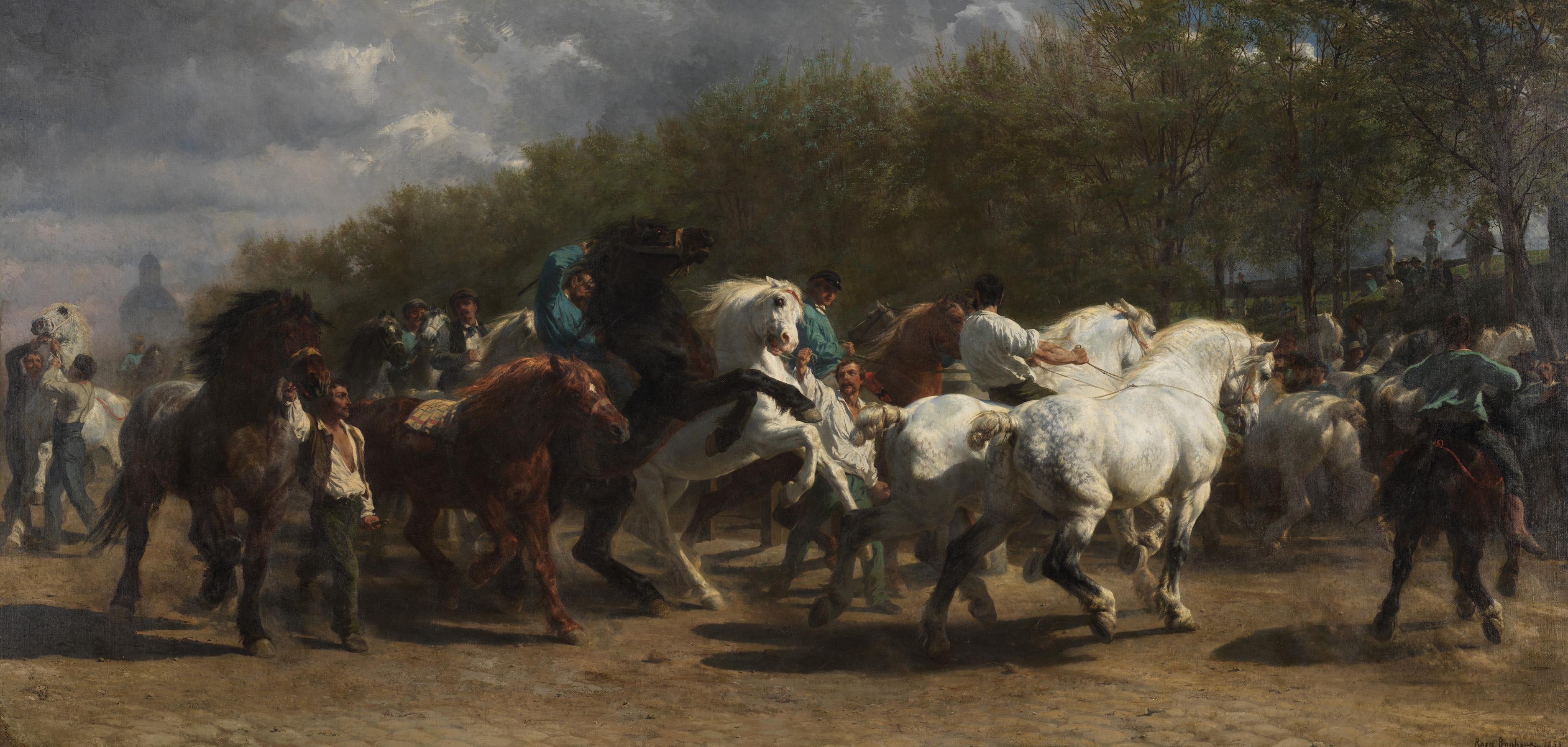
Rosa Bonheur (French, 1822–1899). The Horse Fair, 1852–55. Oil on canvas, 96 1/4 x 199 1/2 in. (244.5 x 506.7 cm). The Metropolitan Museum of Art, New York, Gift of Cornelius Vanderbilt, 1887 (87.25)
My name is Wayne Thiebaud. I am a painter and teacher.
This is a marvelous horse show and you might compare it today to going to a car show, where you go to find the latest model. I saw this painting when I was about seven years old in a photographic reproduction in black-and-white over my grandfather's desk. And I said, "I love that photograph," and he said, "Wayne, that's not a photograph. It's a painting, much bigger than this: 8 feet by 16 feet long."
It's absolutely astounding what she's done. And it's particularly interesting to me as a teacher because she's used almost every painting convention. There's classic, realism, romanticism, beautiful kinds of impressionism. This marvelous circular motion... Way up in the upper right hand corner there's a whole group of about ten or fifteen people looking at this thing going by. You could almost put some poles on that damn thing and have a merry-go-round.
Every kind of horse: blacks and whites, grays, spotted, even a little sorrel horse—the only one that doesn't seem to have an attendant. It's like he's broken loose. Maybe it's Rosa Bonheur, who was a kind of renegade herself and wants to ensure that there's always an out.
All those legs—both the legs of the human beings and the horses—and to see what an amazing kind of choreograph it is, and how much you'd have to know if you're going to paint all of those forms.
She's used every kind of light—glowing, glinting, all the way to no light. She's expressing about three or four miles of space. This is not easy to do. You notice that you're challenged to find lines. The lines are all inferred here. Line is an abstraction so she's avoided that, but built into the painting all of the things she needs for that marvelous kind of three-dimensional, illusionistic space.
People like Cézanne, whose nuanced little strokes are taking you on a space ride—the same with her. Look at that manure dust, the way she's kicked that up. The empathy factor is also what's very crucial here. You really can identify and walk up to those horses because the space is so valid.
I mean, they're all cheap tricks, in a way, made into a masterpiece. This is what you're going to have to do if you want to be a painter, to be able to employ all that heritage we have as painters. It's a wonderful challenge, and we're damn lucky to be in that business.