Figure pendant
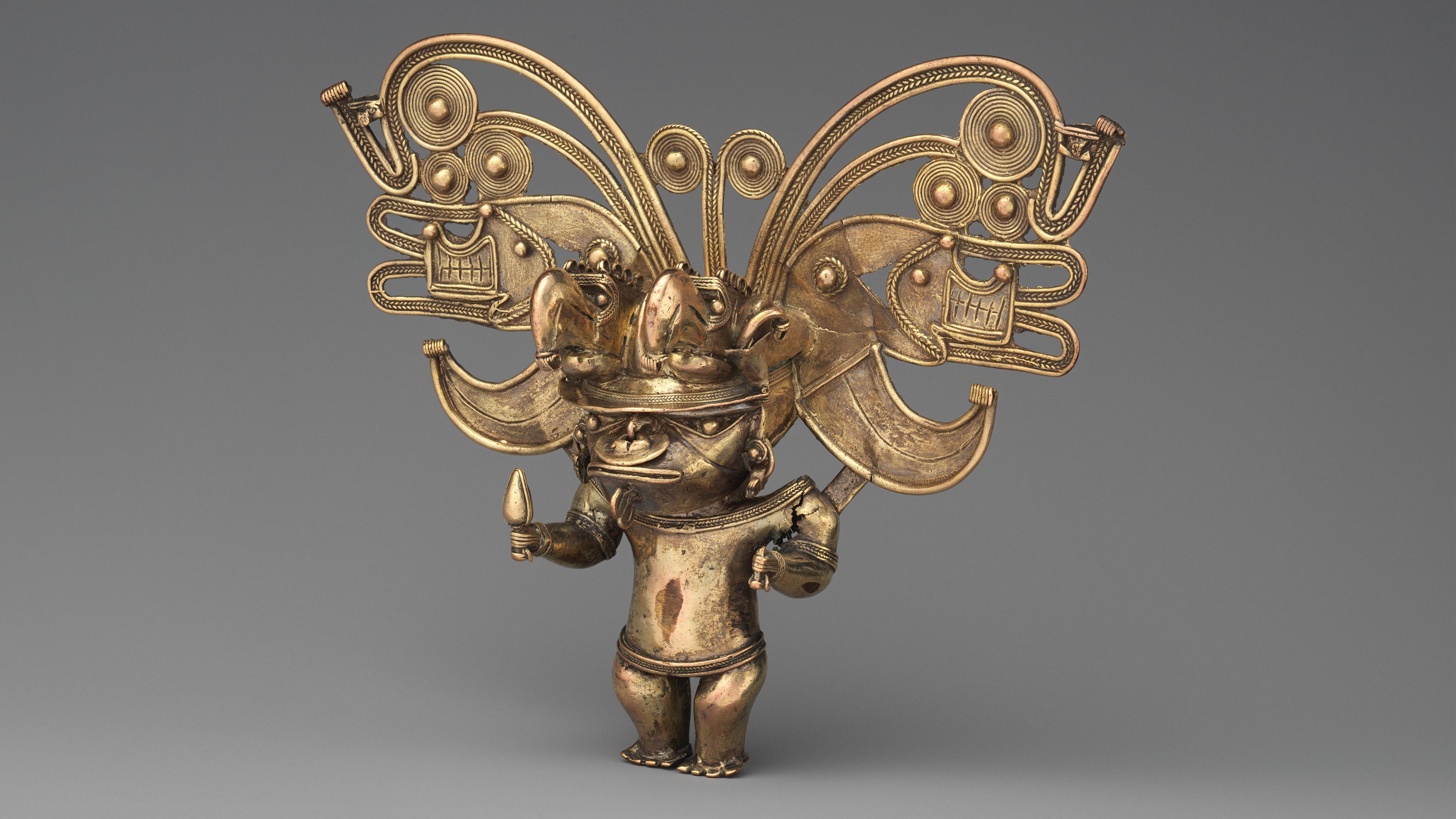
Tairona artists of the Sierra Nevada de Santa Marta in northern Colombia produced some of the grandest and most complex gold objects ever made in the Americas. This pendant is an excellent example of the skill and virtuosity possessed by Tairona goldworkers. Of considerable volume, it depicts a broad-shouldered male figure standing in a confrontational hands-on-hips stance. His head features a toothy snout of a crocodile, but a diamond-shaped nose leaf characteristic of bats. He wears an enormous headdress that is as tall as the figure itself. It has two big-beaked birds on the front of its cap and elaborate sidepieces with detailed spiral and braided elements. The figure may portray a supernatural being, or a ruler or ritual specialist in a state of symbolic and spiritual transformation.
The pendant was cast of tumbaga (a gold-copper alloy) by the lost-wax process. Its surface was subsequently enriched by the depletion method, also known as mise-en-couleur.
The pendant was cast of tumbaga (a gold-copper alloy) by the lost-wax process. Its surface was subsequently enriched by the depletion method, also known as mise-en-couleur.
Artwork Details
- Title: Figure pendant
- Artist: Tairona artist(s)
- Date: 900–1600 CE
- Geography: Colombia, Sierra Nevada/Caribbean region
- Culture: Tairona
- Medium: Gold
- Dimensions: H. 5 1/4 × W. 5 3/4 × D. 2 in. (13.3 × 14.6 × 5.1 cm)
- Classification: Metal-Ornaments
- Credit Line: Jan Mitchell and Sons Collection, Gift of Jan Mitchell, 1991
- Object Number: 1991.419.31
- Curatorial Department: The Michael C. Rockefeller Wing
More Artwork
A slider containing 5 items.
Press the down key to skip to the last item.
Press the down key to skip to the last item.
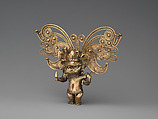
Tairona artist(s)
900–1600 CE
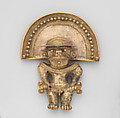
Tairona
10th–16th century
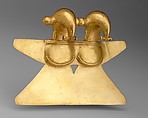
Initial Style artist(s)
1–500 CE
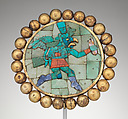
Moche artist(s)
400–700 CE
Tolima (?)
10th–15th century (?)
Related Content
 Free to download
Showing 4 of 5
Research Resources
The Met provides unparalleled resources for research and welcomes an international community of students and scholars. The Met's Open Access API is where creators and researchers can connect to the The Met collection. Open Access data and public domain images are available for unrestricted commercial and noncommercial use without permission or fee.
To request images under copyright and other restrictions, please use this Image Request form.
Feedback
We continue to research and examine historical and cultural context for objects in The Met collection. If you have comments or questions about this object record, please contact us using the form below. The Museum looks forward to receiving your comments.