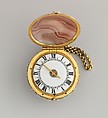
Watch
The man in the cameo traditionally was believed to be a sixteenth-century member of the Fugger family of Augsburg, but that is not borne out by surviving Fugger portraits. The cameo may instead be part of the "Dürer revival" of the early seventeenth century.
The Italian Renaissance brought with it a wholehearted embrace of classical antiquity throughout the fifteenth and sixteenth centuries. Emulation of ancient cameos played a large part. Carvers invested ancient myths with increasingly refined compositions and techniques, paying close attention to the latest archaeological discoveries. Demand for Italian carvers took them to all the courts of Europe. Milan in particular developed a taste for cameos with wondrous atmospheric effects.
Artwork Details
- Title: Watch
- Maker: Watchmaker: Wilhelm Peffenhauser (German, Augsburg, born 1618, master 1647, died before 1683)
- Artist: Cameo cut by P. Schweyger (active Augsburg, 1540–50)
- Date: watch ca. 1650, cameo 16th–17th century
- Culture: German, Augsburg
- Medium: Case: agate, onyx cameo, with cover of enameled gold set with gemstones (rubies); Dial: engraved gold and silver; Movement: gilded brass and steel, partly blued
- Dimensions: Overall: 1 1/2 × 1 1/16 × 3/4 in. (3.8 × 2.7 × 1.9 cm);
Overall (visible cameo): 13.8 × 11 mm - Classification: Horology
- Credit Line: Gift of J. Pierpont Morgan, 1917
- Object Number: 17.190.1517
- Curatorial Department: European Sculpture and Decorative Arts
More Artwork
Research Resources
The Met provides unparalleled resources for research and welcomes an international community of students and scholars. The Met's Open Access API is where creators and researchers can connect to the The Met collection. Open Access data and public domain images are available for unrestricted commercial and noncommercial use without permission or fee.
To request images under copyright and other restrictions, please use this Image Request form.
Feedback
We continue to research and examine historical and cultural context for objects in The Met collection. If you have comments or questions about this object record, please contact us using the form below. The Museum looks forward to receiving your comments.
Content Notice
The Metropolitan Museum of Art presents over 5,000 years of art from around the world, and our online collection reflects ongoing work conducted over the course of our more than 150-year history. You may encounter objects or images that may be inappropriate for some viewers or information that may be outdated.