克鲁姆宅第的挂毯房间
Artwork Details
- 标题: 克鲁姆宅第的挂毯房间
- 艺术家: 以罗伯特·亚当的设计为原型,英国,1728–1792年
- 创作日期: 1763–71年
- 地域: 伍斯特郡
- 尺寸: 13英尺103⁄4 英寸 x 22英尺8英寸 x 27英尺1英寸(4.23 x 6.9 x 8.26米)
- 来源信息: 塞缪尔·H·克雷斯基金会捐赠,1958年
- 藏品编号: 58.75.1–.22
- Curatorial Department: European Sculpture and Decorative Arts
Audio
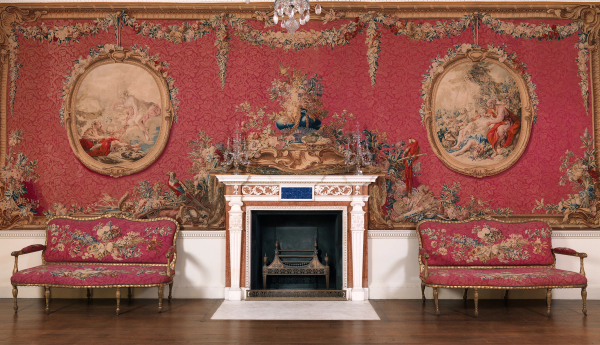
410. Tapestry Room from Croome Court
Gallery 514
LIZZIE CLELAND: This is one of the treasures of the Met’s collection, not just in terms of European textiles, but in terms of the entire museum.
NARRATOR: That’s curator Lizzie Cleland. The room that you’re standing in is from the 18th century country house, Croome Court, and it has been preserved here in its entirety.
LIZZIE CLELAND: Everything in this room is original, from the floor to the ceiling, to the doors, to the hardware on the doors, the mirrors. It’s incredibly rare to have all these elements surviving and preserved in one place.
NARRATOR: Perhaps the most impressive original element of this space is its walls, which were designed by not one, but three French artists. One artist came up with the overall scheme, another famous painter – Francois Boucher – designed the figures. And another did all the flowers and birds.
LIZZIE CLELAND: It’s as if someone’s brought in armfuls of flowers and stacked them up in front of the walls, and they’ve left the windows open, and the birds have flown in. It’sall about creating this sort of fantasy which envelops the viewer. But of course, it’s all an illusion – the whole thing is made out of woven tapestries.
NARRATOR: If you look closely, you’ll see that the illustrations on the walls are not paintings or wallpaper. They are woven out of silk and wool. That’s what made them phenomenally expensive!
LIZZIE CLELAND: I think any informed observer in the 18th century would’ve realized that these illusions of panel paintings were actually more expensive and much more impressive than just hanging paintings against the walls. So I think the joy of coming into this room is the almost visceral reaction we get.
You are really being enveloped by the 18th century, by this very vibrant pink palette, and above all by the smell which is in fact the smell of the wool of the tapestries on the walls. For me, that’s one of the joys of the room.
More Artwork
Related Content
Research Resources
The Met provides unparalleled resources for research and welcomes an international community of students and scholars. The Met's Open Access API is where creators and researchers can connect to the The Met collection. Open Access data and public domain images are available for unrestricted commercial and noncommercial use without permission or fee.
To request images under copyright and other restrictions, please use this Image Request form.
Feedback
We continue to research and examine historical and cultural context for objects in The Met collection. If you have comments or questions about this object record, please contact us using the form below. The Museum looks forward to receiving your comments.
Content Notice
The Metropolitan Museum of Art presents over 5,000 years of art from around the world, and our online collection reflects ongoing work conducted over the course of our more than 150-year history. You may encounter objects or images that may be inappropriate for some viewers or information that may be outdated.