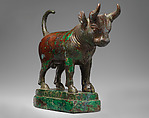
Standing bull
By the middle of the first millennium B.C., kingdoms had emerged in southwestern Arabia whose power was based on control of the trade in frankincense and myrrh, which are native to the region. The kingdoms' immense wealth is reflected in the use of bronze to cast large sculptures, as well as smaller objects, which were produced throughout most of the first millennium B.C. Bulls are commonly represented and can be found on funerary stelae, seals, and sculpture.
Artwork Details
- Title: Standing bull
- Date: ca. mid- to late 1st millennium BCE
- Geography: Southwestern Arabia
- Medium: Copper alloy, shell
- Dimensions: H. 9 1/2 × W. 3 1/2 × D. 9 3/8 in. (24.2 × 8.9 × 23.8 cm)
Base: L. 7 1/16 in. × W. 3 1/2 in. (18 × 8.9 cm) - Credit Line: Purchase, Michael Ward and Friends of Inanna Gifts, 2002
- Object Number: 2002.34
- Curatorial Department: Ancient West Asian Art
More Artwork
Related Content
 Free to download
Research Resources
The Met provides unparalleled resources for research and welcomes an international community of students and scholars. The Met's Open Access API is where creators and researchers can connect to the The Met collection. Open Access data and public domain images are available for unrestricted commercial and noncommercial use without permission or fee.
To request images under copyright and other restrictions, please use this Image Request form.
Feedback
We continue to research and examine historical and cultural context for objects in The Met collection. If you have comments or questions about this object record, please contact us using the form below. The Museum looks forward to receiving your comments.
Content Notice
The Metropolitan Museum of Art presents over 5,000 years of art from around the world, and our online collection reflects ongoing work conducted over the course of our more than 150-year history. You may encounter objects or images that may be inappropriate for some viewers or information that may be outdated.