English
DonateMembershipTickets

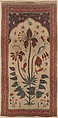
Panel of a Tent Lining

1700–1740
On view at The Met Fifth Avenue in Gallery 463
This panel was decorated using a traditional dyeing technique called kalamkari. This technique ws associated with the city of Burhanpur, which became a center for the production of dyed textiles in the late seventeenth and eighteenth centuries. Burhanpur textiles show great influence from the nearby Mughal tradition, favoring floral motifs within the cusped arches and arabesque decoration. On the Coromandel Coast, different types of kalamkari textiles were produced, including palampores (bed covers) made for the European market, and sarongs and ceremonial hangings traded to Southeast Asia. This panel lined an eighteenth-century Ottoman tent in Bulgaria, and its medallion-based design was probably made to suit that market.

Artwork Details

Object Information
  • Title: Panel of a Tent Lining
  • Date: 1700–1740
  • Geography: Attributed to India, Deccan, Burhanpur
  • Medium: Cotton; plain weave, mordant painted and dyed, resist dyed
  • Dimensions: Textile: H. 77 1/2 in. (196.9 cm)
    W. 51 in. (129.5 cm)
  • Classification: Textiles-Painted and/or Printed
  • Credit Line: Purchase, Friends of Islamic Art Gifts, 2005
  • Object Number: 2005.251
  • Curatorial Department: Islamic Art
More Artwork
Kalamkari Panel with Niche, Cotton; plain weave, mordant painted and dyed, resist dyed
late 17th–early 18th century
Panel from a Tent Lining (Qanat), Cotton; plain weave, mordant dyed and painted, resist-dyed
17th century
"Akbar With Lion and Calf", Folio from the Shah Jahan Album, Govardhan, Ink, opaque watercolor, and gold on paper
Painting by Govardhan
Calligrapher Mir 'Ali Haravi
verso: ca. 1630; recto: ca. 1530–50
Writing Box with Lattice and Flower Design, Wood; overlaid with dyed wool, stamped silver and gilt-copper plaques
mid-17th century
"Shah Jahan on a Terrace, Holding a Pendant Set With His Portrait", Folio from the Shah Jahan Album, Chitarman  Indian, Ink, opaque watercolor, and gold on paper
Painted by Chitarman
recto: dated 1627–28; verso: ca. 1530–50

Research Resources

The Met provides unparalleled resources for research and welcomes an international community of students and scholars. The Met's Open Access API is where creators and researchers can connect to the The Met collection. Open Access data and public domain images are available for unrestricted commercial and noncommercial use without permission or fee.

To request images under copyright and other restrictions, please use this Image Request form.

Feedback

We continue to research and examine historical and cultural context for objects in The Met collection. If you have comments or questions about this object record, please contact us using the form below. The Museum looks forward to receiving your comments.

Send feedback

Content Notice

The Metropolitan Museum of Art presents over 5,000 years of art from around the world, and our online collection reflects ongoing work conducted over the course of our more than 150-year history. You may encounter objects or images that may be inappropriate for some viewers or information that may be outdated.