Saint Augustine
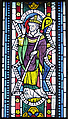
The panels were likely created by a travelling workshop based in the nearby town of Judenburg. The various hands and styles of the different craftspeople can be discerned in the subtle variations on common themes. The Judenburg workshop relied on a limited set of cartoons, or full-scale reusable drawings that outlined poses, facial features, and shading, to create their standard repertoire of figures. This is why so many of the saints appear visually similar; they were made using a shared set of designs.
Saint Augustine of Hippo (d. 430) was among the most influential of the Church Fathers, or early Christian theologians. He lived a solitary monastic life until he became Bishop of Hippo, as is represented by his mitre (ceremonial headdress) and crozier (hooked staff). The book in his left hand stands in for his many theological writings, including Confessions, an early autobiographical account of his life and conversion, and The City of God, a philosophical text that became the cornerstone of subsequent Christian writings.
Artwork Details
- Title: Saint Augustine
- Date: 1340–50
- Geography: Made in Carinthia, Austria
- Culture: Austrian
- Medium: Pot-metal glass, colorless glass, and vitreous paint
- Dimensions: 35 x 13 in. (88.9 x 33 cm)
with modern border: 35 7/8 × 19 × 5/8 in. (91.1 × 48.3 × 1.6 cm) - Classification: Glass-Stained
- Credit Line: The Cloisters Collection, 1965
- Object Number: 65.97.4
- Curatorial Department: Medieval Art and The Cloisters
More Artwork


Related Content
Publications
Books, guides, and catalogues published by The Met.
 Free to download
- Free to download
Research Resources
The Met provides unparalleled resources for research and welcomes an international community of students and scholars. The Met's Open Access API is where creators and researchers can connect to the The Met collection. Open Access data and public domain images are available for unrestricted commercial and noncommercial use without permission or fee.
To request images under copyright and other restrictions, please use this Image Request form.
Feedback
We continue to research and examine historical and cultural context for objects in The Met collection. If you have comments or questions about this object record, please contact us using the form below. The Museum looks forward to receiving your comments.
Content Notice
The Metropolitan Museum of Art presents over 5,000 years of art from around the world, and our online collection reflects ongoing work conducted over the course of our more than 150-year history. You may encounter objects or images that may be inappropriate for some viewers or information that may be outdated.