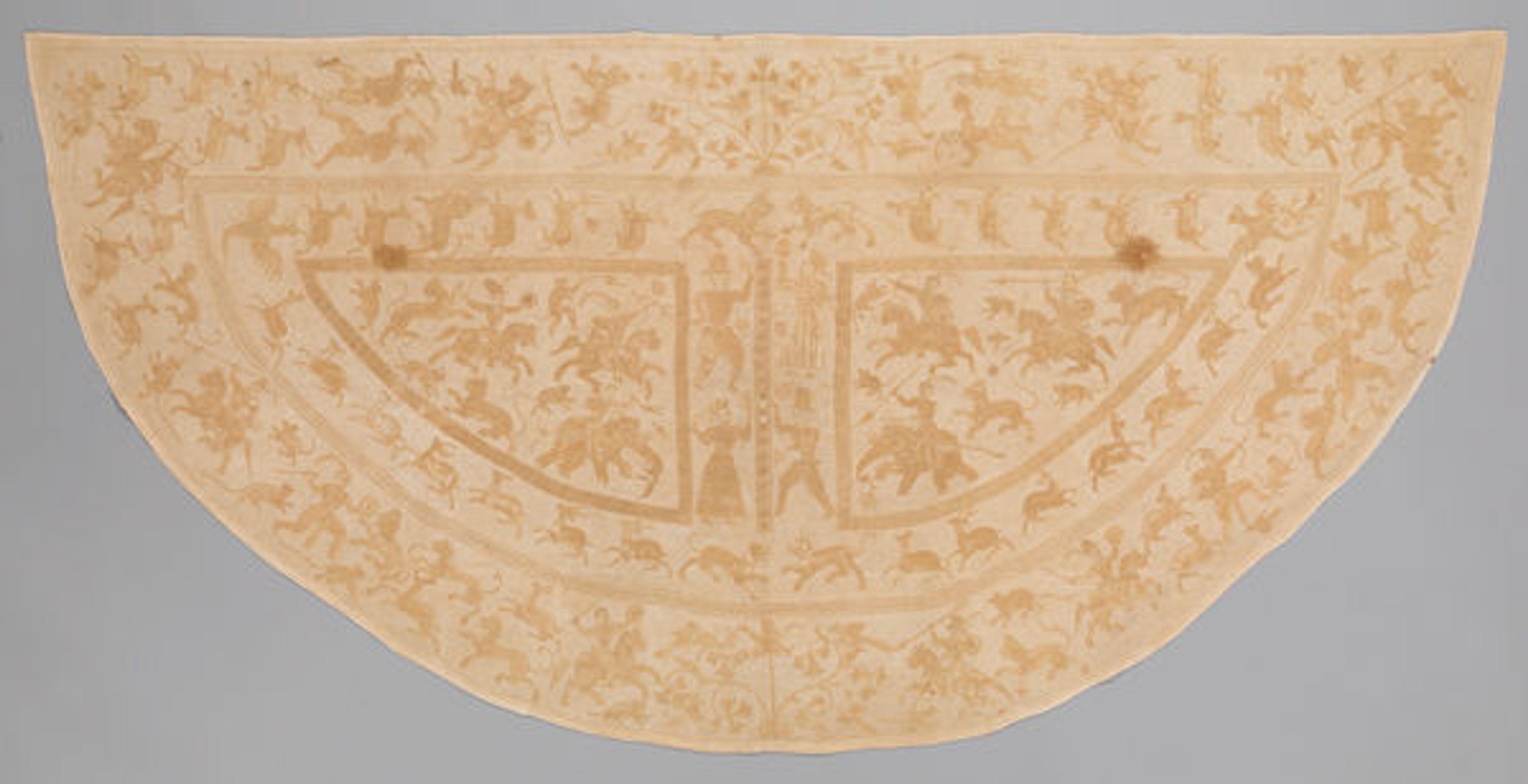
Cope, early 17th century. India, Bengal, Satgaon-Hugly. Cotton; tasar or muga silk; Ht. 81 in. (206.1 cm); W. 39.5 in. (100.3 cm). The Metropolitan Museum of Art, New York, Gift of Lily S. Place, 1923 (23.203.1)
«Though we tend to associate globalization with the modern, Western-dominated world of capital goods, in reality it began long ago with textiles. The current exhibition Interwoven Globe: The Worldwide Textile Trade, 1500–1800 is the first major exhibition to explore this international exchange of design ideas through the medium of textiles.»
In the fifteenth century, while the Chinese traded along the Silk Road and the Europeans searched for an ocean route to the Spice Islands of Southeast Asia, traders began to utilize woven fabric to barter for goods that they didn't have in their own countries. With this development came the diffusion and assimilation of textiles as a means of artistic expression. Eastern motifs began to appear in Western textiles and vice versa, spurring the creation of a global artistic language.
The distinct styles of different geographical regions are easily ascertained through the brushstroke of the dye work, the motifs, and the stylization of human beings. Trade brought out these differences and led to the emergence of trade textiles, which were produced by one culture specifically to be sold to another. These products were often amalgams of different styles that demonstrated the consumers' interest in the exotic and distant and the producers' interest in appealing to foreign markets.
For this reason, certain countries such as China and India retained their traditional artistic practices—like embroidering dragons and tigers—but modified aspects, such as the apparel of the subjects, so that they would appeal to different markets. In the exhibition, we noticed this tendency in the delicate animals and Western clothing in the Indian cope shown above, in Iberian carpets featuring Islamic floral patterns, and in Japanese samurai underclothes made from British cotton.
A visit to this multicultural exhibition allows you to travel the world without leaving New York City; make sure you come and see it before it closes on January 5!