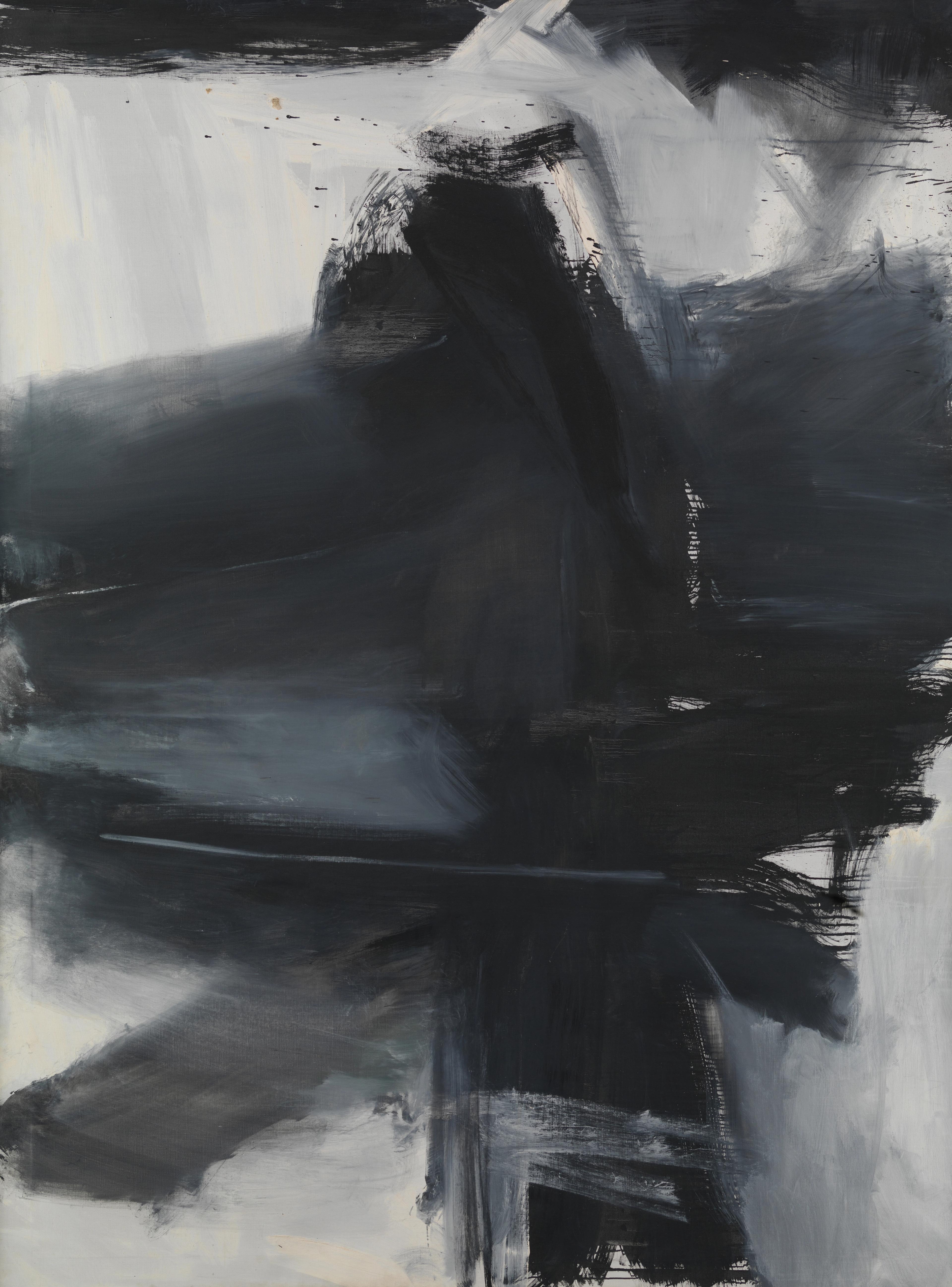
Franz Kline (American, 1910–1962). Black, White, and Gray, 1959. Oil on canvas, 105 1/2 × 78 × 1 1/2 in. (268 × 198.1 × 3.8 cm). The Metropolitan Museum of Art, New York, George A. Hearn Fund, 1959 (59.165). © 2026 Artists Rights Society (ARS), New York
My name's Alex Katz. I'm a painter.
There are a lot of rules in painting, you know, they tell you what you can do and what you can’t do. I’m a colorist, and I’m a figurative painter. When I first showed a painting in 1954 an older painter came over to me and says, “Figuration is obsolete and color is French.” People expect narration out of figurative art, putting humanism on and the “lonely American,” and all that stuff. It just seemed very corny to me. I knew what I wanted to do and it wasn’t that.
Narrative is in time, and I’m trying to get into the immediate present. That’s why I always liked abstract painting a lot. My grammar’s abstract—it’s not illusionistic—and it comes from looking at these abstract paintings.
I always liked Franz Kline. Of all of the Abstract Expressionist guys, he’s the one that I like the best. I just relate to him. He takes more risks emotionally than the other ones. Franz Kline had quick light. His painting comes off the wall really fast. And I wanted that kind of speed.
I don’t know if it’s the best thing he ever did, but I always liked this painting a lot, because of the risk of going into atmospheric painting. Particularly at that time, you’re not supposed to do atmospheric painting, you’re supposed to paint concrete. They all make dogmas about things. Modern art, communism, fascism, and the Ten Commandments—they’re all the same. Everything’s fixed.
When he first started out the paintings were graphic, and by the time he was in the middle fifties, when he got into big, expansive painting—painting with his whole arm—I think he went into another place. He has a fairly good image to start with on paper. And when you blow things up, if they’re literal they’re usually a little stiff, but he opened them up more and they breathe.
They’re very gestural and calligraphic. There’s only so many strokes, and Kline has real substance to the work. If you look at them up close, it’s real physical. But you get it from a distance, it’s a real powerhouse painting: very muscular but very refined. The edges are like Manet’s, you know, it’s like elegant, fancy brushwork, almost foppish. He’s essentially a bohemian painter. And I think he didn’t have an art-making policy. It’s very romantic, following something intuitive.
The fixed value system doesn’t seem to work well now. We live in an age with more variables. Kline’s work was not absolute. In once sense it was, with the black and white, but when he got to this atmospheric thing, he’s extending himself from the flat plane. It seems like an emotional gesture. He was out of the absolutes into another place.