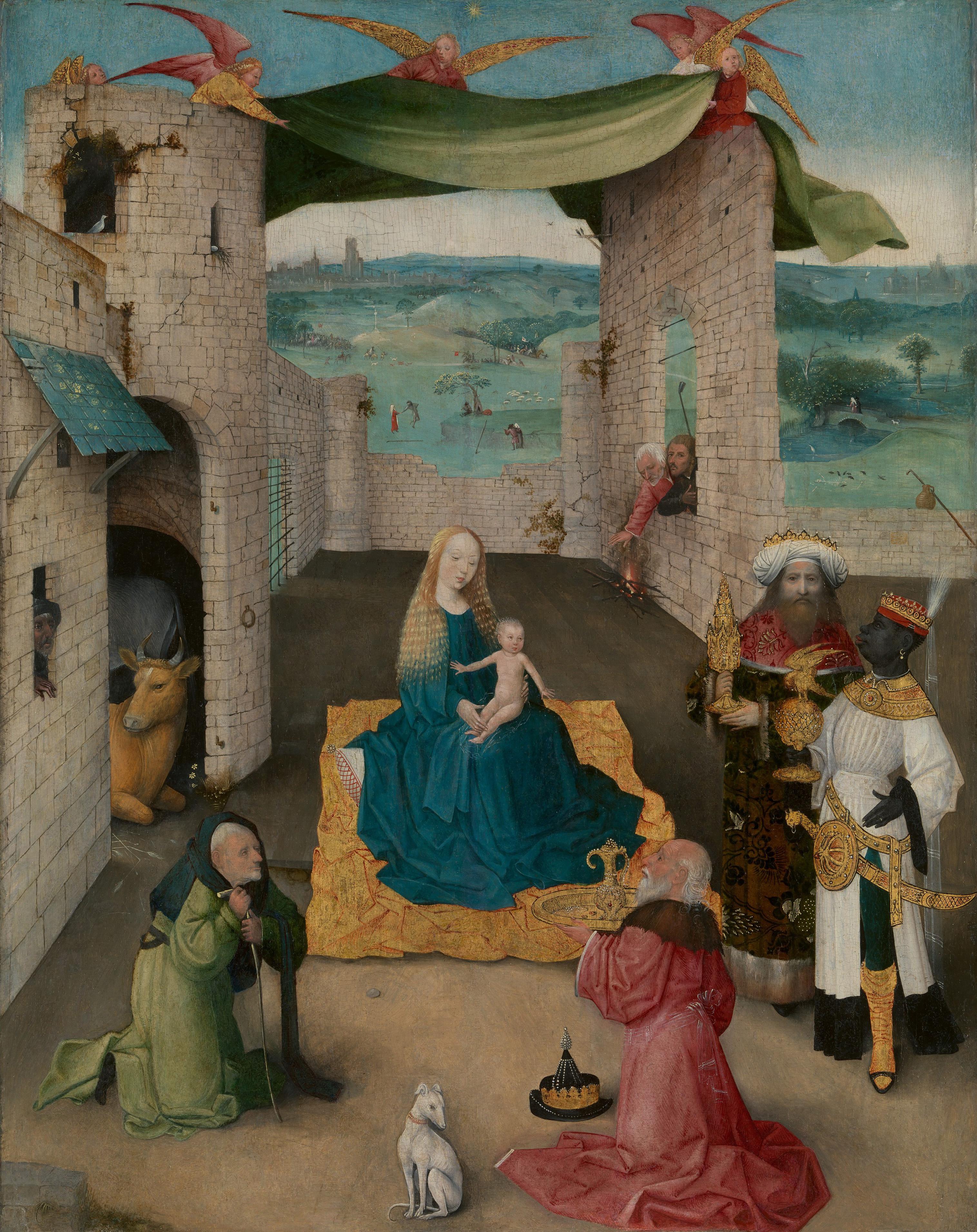
Hieronymus Bosch (Netherlandish, ca. 1450–1516). The Adoration of the Magi, ca. 1475. Oil and gold on oak, 28 x 22 1/4 in. (71.1 x 56.5 cm). The Metropolitan Museum of Art, New York, John Stewart Kennedy Fund, 1913 (13.26)
My name is Ali Banisadr and I'm a painter.
I have this synesthesia: within my own work I hear sounds. That's what helps me to compose the work. And when I go and see artwork, the works that are really appealing to me are the ones that also have this sound for me. And in this painting you just hear this sound traveling through those walls.
Hieronymus Bosch creates these worlds, all from the imagination, channeling unknown places of the psyche, which is what I'm interested in.
The Adoration of the Magi, it's one of his most normal paintings. But for me, when I look at it I kind of sense something has happened already, some kind of explosion. You can see the ruins, even look at the details—you see little things sticking out. It always has that sense of mystery.
He always has that bird's eye view of the situation. Even though there are those central figures, I think the composition brings you into the painting but then you could go in and out of those windows and you could go way into the background and come back to the foreground again. And it sort of moves your eyes around freely. It's like God's point of view, where since you're not in it you could be a sort of judge about what you're witnessing. You keep finding little hints and little mysteries and little things that might give you some clue about what he was trying to say.
The way he arranges groups of figures is always interesting to me. And I really like their faces. They're all contained within themselves. They're not in dialogue with each other; they're in their own minds. To me, he was a social critic. That's why the subject matter could be still contemporary. The figures will have different outfits or different roles but they're only human: the same things are going to happen over and over, they're not going to go away.
His worlds work more like hallucinations or dreams. You're like, "what am I looking at here? What is this?" And I think that's what painting does, really. Let it unveil itself to you as what it is as opposed to categorizing it. And then it starts to kind of communicate with you.
That's the way I've learned over the years to make my own painting. I have to open myself up to it and direct me of where it wants to go. And that has helped me also to look at other paintings too. And I think that's what's telling me that there's something within those walls that it's going to unleash some kind of a madness. There are other sounds within the work, but I feel like that's the sound that's very strong for me when I look at the painting.