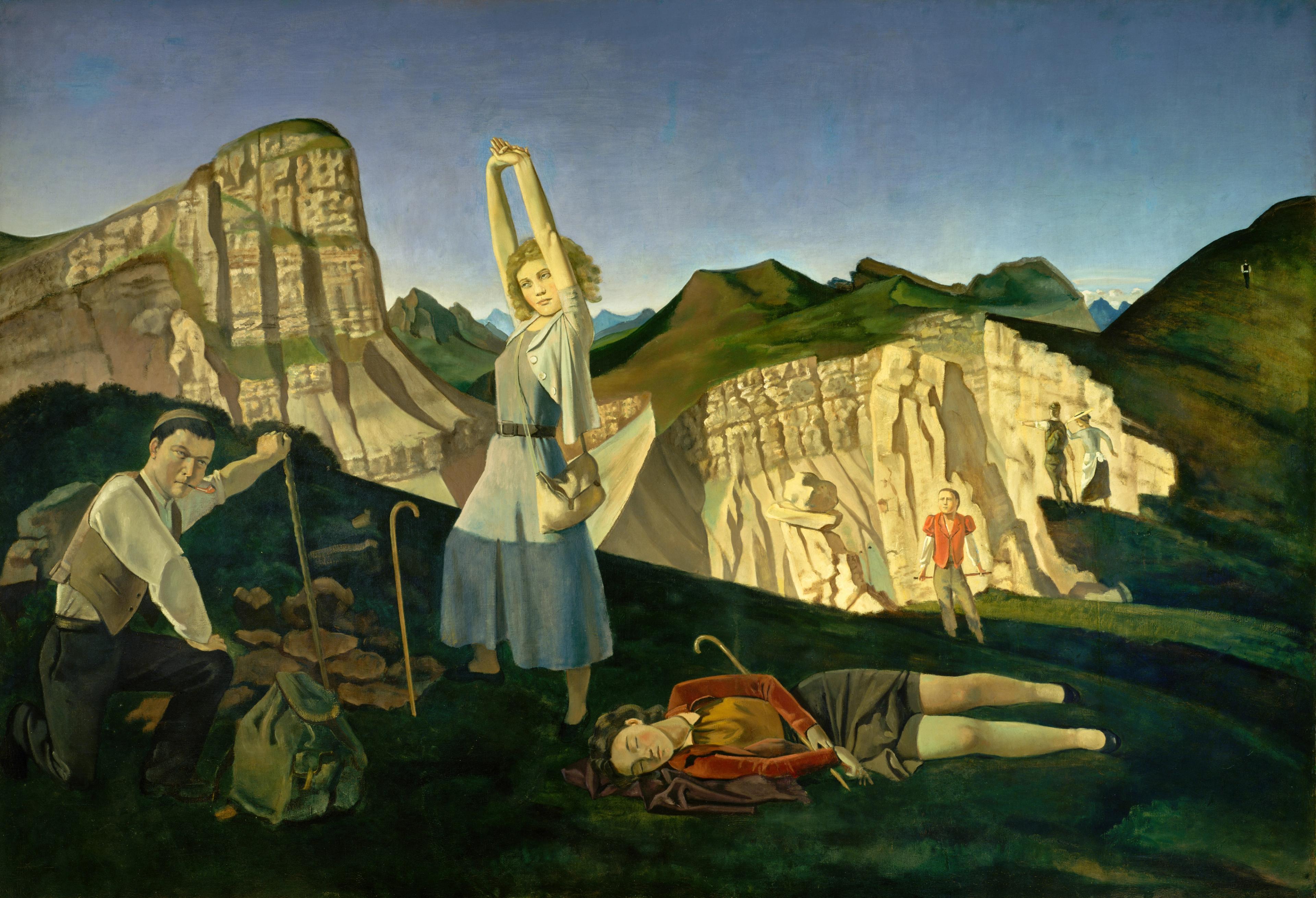
Balthus (Balthasar Klossowski) (French, 1908–2001). The Mountain, 1936–37. Oil on canvas, 98 in. × 12 ft. (248.9 × 365.8 cm). The Metropolitan Museum of Art, New York, Purchase, Gifts of Mr. and Mrs. Nate B. Spingold and Nathan Cummings, Rogers Fund and The Alfred N. Punnett Endowment Fund, by exchange, and Harris Brisbane Dick Fund, 1982 (1982.530). © 2015 Artists Rights Society (ARS), New York / ADAGP, Paris
My name is Dana Schutz.
I mostly make paintings that depict imaginative subjects in hypothetical situations. This is a painting that I think about often. It’s not initially a painting that you would love, I think, because it comes off very stiff and normal, and then the longer you look at it the more psychotic it seems.
I think the sense of scale in the painting and a kind of underlying terror is something that struck me. The landscape is big and vast and it feels like the sun is going down, like the figures could all die out there. You just don’t know how they’re ever going to get home. It feels very ominous. Another part of the terror is you just don’t know if the figure who almost seems dead or struck down, if she’s foreshadowing what’s going to happen to them. And then there’s the figure in the back who’s just abandoning the scene.
I think with landscape painting what’s interesting sometimes is how time can work in landscape—between the foreground, the middle ground, and the background—and I think that the way that Balthus sets it up is that the furthest back you go in the painting, you can go back in time. But I do think there’s a moment in this painting where time becomes untethered.
I think the way that Balthus uses light seems to always be about revealing the subject, or involved with shame or judgment. But I think in this painting it feels like it’s much more about desire, and also a way to tie these otherwise kind of disconnected figures together. The whole kind of symbolic narrative in the painting is happening in the light. It’s like the couple, this kind of companionship, and then the man who wants the woman but can’t access her.
Not every painting is narrative, but I think the ones that really are truly narrative are the ones where you care with what’s happening in them. You wonder what’s going on with the characters and it’s so rare, because I don’t think that’s painting’s strong suit.
There’s always a kind of stuffiness to Balthus. Like, you know, the figures are frozen and I always feel like there’s a certain amount of information that’s left out of the paintings, like there’s something missing. But that adds to the tension, I think.
The thing with Balthus is you start to feel so creepy. You look at it and at first its like, “oh, what a kind of dry painting,” like when you look at it, and then it becomes totally kind of sick in a way. There’s these hills in the back—they look like they could be breasts. And then there’s a rock formation that looks like a weird, mangled penis. I think there’s that feeling with Balthus, where you feel like you’re really entering the author’s head. Whether you like it or not, you’re somehow involved with what is going on, with the author’s vision. I think that’s really interesting.
It’s not my favorite painting in The Met, at all—like by a long shot—but sometimes you can actually get more from the paintings that bother you.